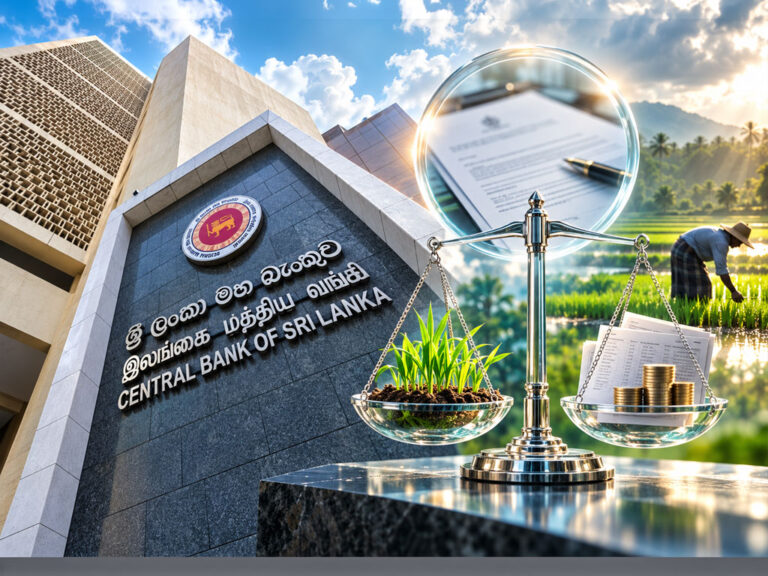
Colombo, November 1, 2026 — Concerns are emerging over potential conflicts of interest within the Central Bank of Sri Lanka (CBSL), as critics question whether the involvement of prominent private-sector figures in its highest decision-making bodies could undermine public confidence in the impartiality of financial regulation.
The debate has intensified following regulatory action against several companies accused of conducting unauthorised finance business through agricultural and plantation-related investment schemes.
While the Central Bank maintains that its enforcement measures are intended to protect depositors and prevent illegal financial activity, critics of the intervention argue that legitimate agricultural enterprises must not be unfairly affected by action directed at suspected financial misconduct.
The controversy raises two separate questions: whether regulatory enforcement has been proportionate and whether the Central Bank’s governance arrangements provide sufficiently robust safeguards against potential conflicts involving private commercial interests.
No independently verified evidence has been identified establishing that a Central Bank board member intervened to protect a business interest or directed enforcement action against a commercial competitor.

Private-Sector Representation Raises Governance Questions
Under the Central Bank of Sri Lanka Act, No. 16 of 2023, the institution operates through two principal governing bodies: the Governing Board and the Monetary Policy Board.
The Governing Board oversees the Central Bank’s administration, management and general institutional policies, while the Monetary Policy Board is responsible for monetary policy and maintaining domestic price stability.
Both include appointed members with professional experience in fields such as economics, banking, finance, accounting, law and risk management.
The Central Bank’s published membership lists include individuals with substantial backgrounds in private enterprise and financial services.
Such experience can strengthen financial policymaking by bringing practical knowledge of markets, investment and economic activity into regulatory discussions.
However, it also creates a need for effective safeguards to ensure that members’ private business interests do not influence decisions affecting competitors, borrowers, financial institutions or other market participants.
The concern is particularly relevant where individuals serving in public regulatory positions retain professional relationships or financial interests involving major commercial organisations.
Critics argue that even the appearance of preferential treatment can undermine confidence in a regulator whose decisions influence the wider economy.
Nevertheless, a connection to private business does not itself establish a conflict of interest, improper influence or misconduct.
A genuine conflict would require examination of the member’s relevant interests, the decision under consideration, disclosure arrangements and whether appropriate safeguards were followed.
Agricultural Investment Companies Face Enforcement Action
The immediate controversy concerns regulatory measures affecting companies that have attracted public funds through plantation, forestry and agricultural investment arrangements.
On September 22, 2026, the Central Bank published details of freezing orders issued under Section 44 of the Finance Business Act, No. 42 of 2011.
The orders concern six companies:
- Kasagala Green Plantation (Private) Limited.
- Ceylon Green Life Plantation (Private) Limited.
- Singhe Capital Investment Limited.
- Pro Shop Advertising Holdings (Private) Limited.
- Athens International Education Centre (Private) Limited.
- Eyon Lanka Investment & Film Production International Company (Private) Limited.
According to the Central Bank, the orders were issued by the Director of its Department of Supervision of Non-Bank Financial Institutions and subsequently confirmed and extended by the High Court of Colombo.
The measures restrict the disposal, transfer or other dealings involving specified assets of the companies and their directors.
The Central Bank distinguishes between the companies still under investigation and those for which it has already determined that unauthorised finance business or deposit-taking occurred.
Kasagala Green Plantation and Ceylon Green Life Plantation were identified as companies subject to continuing investigations under Section 42 of the Finance Business Act. Central Bank of Sri Lanka
The existence of freezing orders does not, by itself, establish that every activity conducted by the affected companies was fraudulent.
It is also important to distinguish asset-preservation orders from a blanket prohibition on legitimate cultivation.
Why the Central Bank Says Intervention Is Necessary
The Central Bank’s position is that certain investment schemes marketed through agriculture or forestry may involve unauthorised deposit-taking.
Under Sri Lankan law, accepting deposits from the public is a regulated financial activity. A company does not become exempt from financial legislation merely because it describes its activities as agriculture, forestry or plantation investment.
During 2026, the Central Bank warned about investment programmes promising exceptionally high returns through cultivation projects.
Governor Dr. P. Nandalal Weerasinghe has questioned the commercial sustainability of arrangements promising substantial annual returns while guaranteeing repayment of investors’ capital.
The regulator argues that such schemes may depend on attracting fresh funds rather than generating sufficient income through agricultural production.
It has also stressed that its enforcement action is intended to preserve assets and protect members of the public who may otherwise lose their investments.
The Central Bank has denied imposing a general ban on legitimate agricultural activity.
This distinction is central to the dispute: genuine farming operations remain lawful, while the acceptance of public deposits without the necessary authorisation may constitute a breach of financial legislation.
Entrepreneurs Question the Impact on Genuine Cultivation
Critics of the enforcement measures contend that agricultural enterprises should be assessed according to their actual activities rather than being treated uniformly because they raise capital through investment arrangements.
They argue that some businesses have cultivated crops, maintained relationships with farmers, entered into contractual agreements and undertaken identifiable agricultural operations.
From their perspective, the existence of plantations, cultivation agreements and productive activity should form part of any assessment of an enterprise’s legitimacy.
These factors may be relevant to understanding how a business operates.
However, genuine agricultural production does not automatically establish that its fundraising arrangements comply with the Finance Business Act.
A company could undertake real cultivation while also engaging in financial activities requiring authorisation.
The decisive issue is therefore not simply whether crops are grown, but whether the business has lawfully raised and managed funds entrusted to it.
Critics maintain that where legitimate farming operations are involved, enforcement should minimise unnecessary disruption to agricultural production and contractual obligations.
The source account alleges that restrictions have interrupted cultivation and endangered the livelihoods of thousands of farmers.
Those figures and the claimed extent of disruption have not been independently substantiated through payroll records, farmer contracts, court documents or other supporting evidence.
Are Smaller Businesses Being Disadvantaged?
Some entrepreneurs have gone further, questioning whether regulatory action could disproportionately affect smaller agricultural investment firms competing with established businesses.
Their concern is that emerging enterprises seeking capital outside traditional financing arrangements may face severe restrictions while larger companies retain easier access to financial institutions and established investment networks.
The suggestion that regulatory enforcement is deliberately being used to eliminate smaller competitors is a serious allegation.
At present, the information reviewed does not establish that a major agricultural or export business directed, influenced or benefited improperly from the Central Bank’s freezing orders.
Nor does it demonstrate that the Governing Board or Monetary Policy Board instructed the Department of Supervision of Non-Bank Financial Institutions to target specific commercial competitors.
The published enforcement mechanism identifies the department’s director as the official responsible for issuing the relevant orders, with subsequent judicial confirmation.
Any allegation of deliberate market suppression would therefore require evidence connecting particular business interests to identifiable regulatory decisions.
Such evidence could include records of conflicts disclosed by decision-makers, inappropriate communications, departures from established procedures or preferential treatment benefiting specific companies.
Without that evidence, the allegation remains a concern raised by critics rather than an established explanation for the regulatory action.
Judicial Oversight and Due Process
The High Court’s involvement is an important aspect of the enforcement process.
According to the Central Bank’s September announcement, the freezing orders were subsequently confirmed and extended by the Colombo High Court.
Judicial oversight provides a legal mechanism through which restrictions on assets can be examined.
Nevertheless, affected companies retain an interest in receiving clear information about the grounds for enforcement, the procedures available to challenge relevant decisions and the status of investigations.
Investors and farmers may also have legitimate concerns about what happens to their funds, contractual rights and ongoing agricultural operations while proceedings continue.
The protection of depositors and the preservation of assets must be considered alongside the rights of parties whose activities are subject to investigation.
Both objectives require transparent procedures and decisions supported by evidence.
Are Existing Conflict-of-Interest Safeguards Sufficient?
The broader governance question extends beyond the companies currently under investigation.
The Central Bank has published a Code of Conduct covering members of its Governing Board, Monetary Policy Board and other senior officials.
Such safeguards are intended to support ethical conduct and the proper management of conflicts of interest.
However, critics argue that written policies alone are insufficient unless declarations, recusals and enforcement mechanisms are implemented effectively.
A credible framework should enable public confidence that regulatory decisions are based on statutory responsibilities rather than private commercial relationships.
That does not require excluding everyone with private-sector experience from public financial institutions.
Instead, it requires effective separation between personal commercial interests and decisions taken in an official capacity.
Where potential conflicts arise, the relevant interests should be disclosed and managed through the applicable procedures.
Questions about the adequacy of these safeguards are legitimate matters for public discussion, although they must not be confused with proof that particular officials have acted improperly.
Protecting Investors Without Undermining Agriculture
Sri Lanka needs both effective financial regulation and a productive agricultural sector.
Fraudulent fundraising arrangements can destroy household savings, damage public trust and divert capital away from productive economic activity.
At the same time, legitimate agricultural enterprises require predictable rules, access to finance and protection from arbitrary interference.
The challenge is ensuring that financial enforcement distinguishes accurately between lawful enterprise and unauthorised financial activity.
For the Central Bank, this means demonstrating that investigations and restrictions are grounded in legislation, supported by evidence and subject to appropriate scrutiny.
For agricultural investment companies, it means providing transparent records of how money is raised, how investor obligations are structured and how funds are used.
For policymakers, the wider responsibility is to ensure that smaller enterprises can access legitimate financing without exposing investors to unregulated financial risks.
The present controversy should ultimately be resolved through documentary evidence, transparent regulatory decisions and judicial processes.
Neither the size of an enterprise nor the influence of its owners should determine whether it receives protection under the law.
Equally, the existence of genuine agricultural activity should not place a business beyond financial scrutiny.
A credible regulatory system must protect depositors, respect lawful enterprise and apply the same standards of fairness and accountability to everyone.