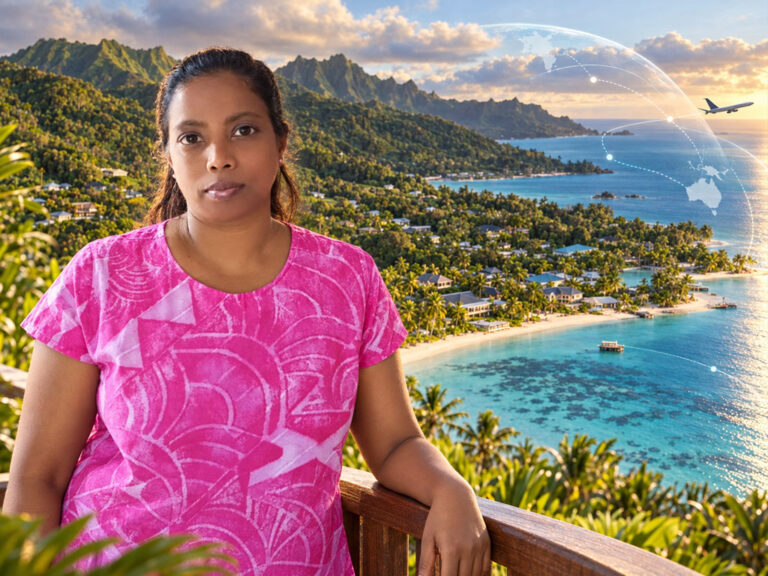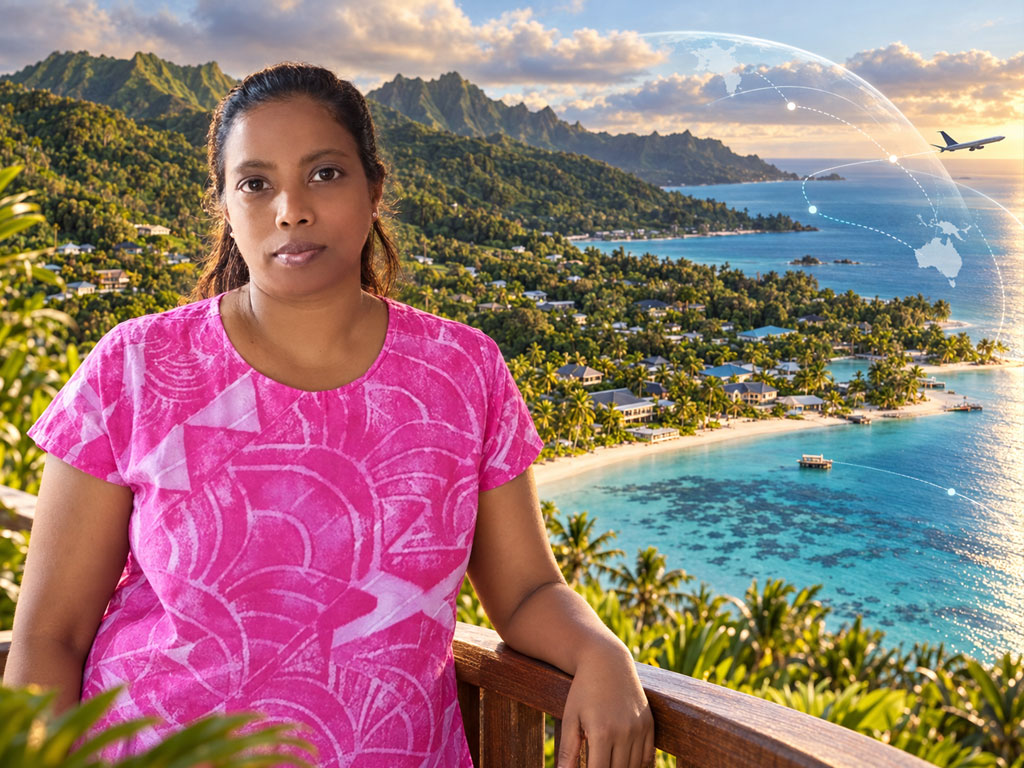
COLOMBO — Fifty-year-old Ruchira Ranasinghe says repeated transit visa refusals have prevented her from returning to Sri Lanka since November 2023, despite attempts to secure assistance from immigration authorities and diplomatic officials.
A 50-year-old Sri Lankan woman has been stranded in the Cook Islands for nearly three years after unsuccessful immigration applications and repeated refusals of transit visas through New Zealand and Australia left her without a viable route home.
Ruchira Ranasinghe, originally from Borkundara in Piliyandala, travelled to the South Pacific territory on November 8, 2023, believing she could apply for a New Zealand employment visa from outside that country.
Instead, her application was refused, and she subsequently discovered that the New Zealand visa she previously held did not permit her to leave and re-enter the country.
Attempts to return to Sri Lanka through New Zealand and Australia have also failed because transit visas were denied.
Ranasinghe, who has been relying on the generosity of hotel staff in the Cook Islands for accommodation and food, says the prolonged uncertainty has severely affected her physical and mental health.
Her family has appealed to the Sri Lankan government to intervene, while the Ministry of Foreign Affairs says it is coordinating with the Sri Lanka High Commission in Wellington, New Zealand authorities and the International Organization for Migration (IOM) to facilitate her return.
Her brother, Sameera Ranasinghe, said the family is increasingly concerned about her wellbeing.
Describing a distressing telephone conversation, he recalled his sister asking whether her body could at least be returned to Sri Lanka if she died before being able to come home.
The family fears that her prolonged isolation and deteriorating health have left her increasingly vulnerable.

From Financial Difficulties in Sri Lanka to Employment in Hong Kong
Ranasinghe’s difficulties began long before she arrived in the Cook Islands.
A married woman with one son, she had operated a small garment business in Sri Lanka before financial problems forced her to close it.
She said her husband, who had struggled with drug addiction, died approximately seven years ago.
With debts accumulating and few opportunities to restore her finances, she decided to seek employment overseas.
In 2018, she travelled to Hong Kong, where she worked as a caregiver, primarily looking after elderly people in private homes.
Explaining her circumstances, she said:
“I ran a small garment business. Later, along with the economic problems that arose, I had to close it. So I had some debts.
“Then, in 2018, I came to Hong Kong to work as a caregiver. I worked in houses. I looked after elderly people.”
While working in Hong Kong, she began exploring opportunities in New Zealand, where she had a relative who was a citizen.
With that relative’s assistance, she obtained a visitor visa and travelled to New Zealand on December 7, 2022.
“While working like that, I tried to go to New Zealand. A relative of mine lives in New Zealand. He has citizenship there. I told him I wanted to come there. Later, he got me a visit visa. I departed from Hong Kong on December 7, 2022,” she recalled.
Her visitor visa was valid for approximately two months.
As the visa approached expiry, she sought professional assistance to remain in New Zealand legally.
That decision would become central to the difficulties she later encountered.
Immigration Advice That Led to a Protection Claim
According to Ranasinghe, she consulted a Sri Lankan immigration adviser or lawyer based in New Zealand regarding the possibility of extending her stay.
She said the adviser recommended that she submit a refugee or protection claim, which would enable her to seek permission to work while the application was considered.
“My visit visa was for two months. Because it was Christmas at that time, there was not even a way to get a visa made.
“After that, I met a lawyer and said I needed to get a visa. Then that lawyer said that he would apply for a refugee visa for me and get me an open working visa.”
Ranasinghe said she subsequently obtained an open work visa covering March 2023 to March 2024.
She found employment at a restaurant and worked there for approximately nine months.
During that period, she began investigating whether her employer could support an application for a conventional employment visa.
“Then I received an open visa for a period of one year, from March 2023 to March 2024. Then I worked at a restaurant for nine months.
“After that, the lawyer said that if the restaurant where I work agrees to keep me on continuously, I could get a working visa.”
According to her account, the subsequent employment visa application was unsuccessful.
Her adviser then reportedly recommended that she leave New Zealand and submit another application from overseas.
Ranasinghe said she understood that she could return once the application had been processed.
What she did not realise, she maintains, was that departing New Zealand could prevent her from returning under her existing immigration arrangements.
Why Leaving New Zealand Became a Critical Mistake
New Zealand’s immigration rules generally distinguish between temporary visas issued to ordinary migrants and visas granted to people awaiting the determination of refugee or protection claims.
An individual who has sought protection may qualify for temporary permission to remain or work while the claim is considered.
However, such visas ordinarily do not include travel conditions permitting departure and re-entry.
Immigration New Zealand’s published operational instructions explain that its obligations towards a protection claimant generally cease when the individual leaves New Zealand.
Anyone wishing to return must satisfy the requirements for a new visa.
That distinction is central to Ranasinghe’s experience.
She said her adviser instructed her to travel to the Cook Islands, where she initially expected to remain for only three weeks.
“He said to leave the country, apply for a working visa, and come back. That is why I went to Cook Island, which is close to New Zealand, on a three-week visa.
“When I came like that, there was still time remaining on my New Zealand visa.”
She arrived in the Cook Islands on November 8, 2023.
Her subsequent visa applications were rejected.
“Then I applied for a visa again, but that too was rejected. Even though I tried on several such occasions, New Zealand rejected the visa.
“Then, when I looked into it, I learned that according to the visa I had been given, I could not return to New Zealand after leaving it.”
She said the adviser continued attempting to obtain another visa for approximately six or seven months.
Those efforts were unsuccessful.
Nearly Three Years Dependent on the Kindness of Strangers
With her immigration difficulties unresolved, Ranasinghe remained in the Cook Islands, a self-governing Pacific territory in free association with New Zealand.
Although geographically closer to New Zealand than Sri Lanka, the islands are separated from her home country by approximately 13,400 kilometres.
Her initial accommodation was at a hotel where she had planned to stay for three weeks.
As her situation deteriorated, she informed the hotel management that she had no confirmed departure date and could not afford to continue paying for accommodation.
According to Ranasinghe, the hotel owner responded by offering her a room in accommodation normally reserved for employees.
She has remained dependent on that assistance.
“When I came to Cook Island, I stayed for three weeks at this lady’s hotel. Then, because I did not get a visa, I told them about my problem. Then they said they would help me.
“But after some time, because there was no way for me to go back to New Zealand, the lady who owns the hotel allocated a room for me as well in the quarters reserved for their employees.”
Ranasinghe said hotel staff have also helped provide meals and internet access.
“The people here are really good. I even get food from them. Also, internet costs a lot here. I am taking even this call through hotspots given to me by the people working at this hotel.”
Their generosity has provided her with temporary security, but it has not resolved the immigration restrictions preventing her departure.
Immigration Lawyer Criticises Advice Given to Ranasinghe
New Zealand immigration lawyer Alastair McClymont has criticised the advice Ranasinghe says she received before travelling to the Cook Islands.
According to McClymont, protection claimants may receive temporary work rights while their applications are examined, but they face important restrictions on their ability to obtain other visas or return after leaving the country.
“Anyone in New Zealand can lodge a protection claim at any time. After such a claim is lodged, it is considered. Generally, that process takes about two years. During the period when the protection claim is being considered, they are given an open work visa.”
He identified her departure from New Zealand as a consequential error.
“Also, the second mistake she made was leaving the country. Her first visa application was rejected because under the law, it had to be rejected.”
McClymont was sharply critical of the professional conduct described by Ranasinghe.
“All of this has happened because of the conduct of the person who submitted these applications on her behalf. Legal action should be taken against him and he should be imprisoned. He has subjected her to a fraud.”
Those remarks represent the lawyer’s assessment of the allegations. They do not constitute a judicial finding that the unidentified adviser committed fraud or any criminal offence.
Thousands of New Zealand Dollars Paid for Immigration Assistance
Ranasinghe alleges that she paid substantial sums to the person handling her applications.
According to her account, the initial payment was NZD 10,000, followed by further amounts including NZD 3,000 and NZD 2,000 for additional work.
She said the adviser eventually acknowledged that the attempts to obtain another visa had failed.
“Then the lawyer called me and said he tried on many occasions, but there was no way to get the visa, so I should go back to Sri Lanka. He accepted that a mistake had been made by him.”
McClymont advised that a formal complaint should be submitted concerning the immigration assistance she received.
“Many immigration lawyers earn money by submitting such protection applications. But they have long-term impacts. Very often, these applications are rejected. Also, it becomes very difficult to apply for other visas as well.”
He characterised Ranasinghe as a victim of the alleged misconduct and recommended that the matter be reported to the relevant New Zealand authorities.
The allegations against the adviser have not been independently adjudicated in the information available for this report.
Transit Visa Refusals Block Her Journey Home
After failing to obtain permission to return to New Zealand for employment, Ranasinghe decided to abandon those plans and return to Sri Lanka.
She approached immigration officials in the Cook Islands and explained her predicament.
According to her, officials indicated that she could leave the territory.
She then purchased an Air New Zealand ticket.
However, when she arrived at the airport, airline staff informed her that she required a transit visa to pass through New Zealand.
“I bought a ticket to go to Sri Lanka from Air New Zealand. I went to the airport and went to board the aircraft, and there they told me that I needed to get a transit visa from New Zealand.”
She returned to her accommodation and submitted an application.
Approximately two weeks later, she received another refusal.
Ranasinghe said the decision referred to her history of unsuccessful visa applications.
She subsequently sought assistance from the Cook Islands immigration authorities, who reportedly contacted their counterparts in New Zealand.
A further application was also rejected.
“Then the Cook Island immigration department sent a letter to the New Zealand immigration department about my situation. After that, I applied for a transit visa again.
“That time, in response to my visa application, they had sent a letter saying, why don’t I go to another country and try to go to Sri Lanka.”
Why Other Routes Have Proved Difficult
Ranasinghe explored alternatives involving Tahiti and Hawaii.
Those options, she said, presented additional visa and biometric requirements that she could not complete from the Cook Islands.
“Even if we tried to go through Tahiti or Hawaii, there are no offices on Cook Island to obtain transit visas for those countries for Sri Lankan passports.
“We have to go to Wellington or Auckland to give fingerprints. Because I was not allowed into New Zealand, I lost even that opportunity.”
She also considered travelling by sea but was unable to identify a workable arrangement.
Cook Islands immigration officials reportedly proposed supervised transit arrangements to address New Zealand’s concerns about her intentions.
Ranasinghe said she remained willing to cooperate with stringent conditions if doing so would allow her to return home.
New Zealand Explains Why Transit Applications Were Rejected
Immigration New Zealand confirmed that Ranasinghe had submitted several applications for transit visas.
Its Operations Director, Janine Parsons, explained that the applications had been declined because authorities were not satisfied that Ranasinghe genuinely intended to transit through New Zealand.
“It can be confirmed that Ruchira Ranasinghe has submitted several applications for New Zealand transit visas.
“However, because the authorities were not satisfied that she genuinely intended to transit through New Zealand, those applications have been rejected.
“Due to privacy reasons, further information regarding this cannot be released.”
The department’s response confirms the reason given for the refusals but does not disclose the detailed evidence or considerations underlying the decisions.
New Zealand’s immigration system requires travellers who are not exempt from transit visa requirements to obtain appropriate permission before travelling through the country.
Consequently, a ticket for an onward international flight does not necessarily entitle a passenger to enter or transit through New Zealand.
Australia Also Declines Transit Permission
Following the unsuccessful attempts to transit through New Zealand, Ranasinghe explored an alternative journey through Australia.
Cook Islands immigration officials reportedly encouraged her to consider that option.
She purchased another ticket but was again unable to travel because an Australian transit visa had not been granted.
“Then I took a ticket and tried to go that way too, but because they did not give a transit visa there either, I could not go to Sri Lanka that way either.”
Responding to an inquiry, Australia’s Department of Home Affairs explained that visa applications are considered individually under the country’s immigration legislation.
The department referred to the Migration Act 1958 and Migration Regulations 1994.
“All foreigners who intend to travel to, enter, or stay in Australia must satisfy the requirements stipulated by the Migration Act 1958 and the Migration Regulations 1994.”
Applicants may also be required to satisfy health, character and security requirements.
The department did not provide a detailed public explanation of Ranasinghe’s individual application.
The Complication Created by Her Earlier Protection Claim
McClymont suggested that Ranasinghe’s earlier protection claim in New Zealand may be relevant to the reluctance of other countries to grant transit permission.
He explained that immigration authorities may consider whether someone who previously sought protection in another country could attempt to make a further claim while travelling.
“She has already stated that she does not want to return to Sri Lanka. So it is very difficult for her to obtain visas to those countries again.”
He also referred to immigration information-sharing arrangements between Australia and New Zealand.
“Australia and New Zealand share immigration information with each other. So they are not willing to take the risk of allowing her to transit through those countries.”
McClymont acknowledged that the available options appeared limited.
“Actually, I am not clear on what the solution to this problem is. In the end, she will have to transit through some country. But no country is willing to take such a risk.”
His comments describe a possible explanation for the difficulties but should not be interpreted as an official determination of every country’s reasons for refusing a visa.
Health Concerns Deepen as Family Milestones Approach
Almost three years after leaving New Zealand, Ranasinghe says her principal concern is no longer obtaining employment abroad.
She wants to return to Sri Lanka and reunite with her family.
Her mother is seriously ill, she says, and her own health has deteriorated during her extended stay in the Cook Islands.
Ranasinghe reported that she has developed diabetes and is struggling emotionally.
Her son’s wedding, scheduled for November, has added urgency to her appeal.
According to her, the ceremony had already been postponed once because of her circumstances.
“Since November 8, 2023, I have been trying in every way to go to Sri Lanka. My mother is also very ill now. I am also ill.
“With the situation I have ended up in, I am also very mentally down. Now I also have diabetes.
“My son’s wedding is in November. My son’s wedding was supposed to be held last year. Because of this problem, the wedding was postponed.”
Her greatest fear, she said, is that continued delays will prevent her from seeing her family again.
“If my son doesn’t have a mother either, then he has no one. Bring me to Sri Lanka somehow. That is all I am asking of everyone.”
Sri Lanka’s Foreign Ministry Says Repatriation Efforts Are Underway
Sri Lanka’s Ministry of Foreign Affairs has acknowledged Ranasinghe’s circumstances and says diplomatic efforts are continuing.
Director General of Consular Affairs Theshantha Kumarasiri confirmed that family representatives had met ministry officials.
He said the ministry was coordinating with the Sri Lanka High Commission in Wellington and New Zealand authorities to identify a means of facilitating her return.
“Relatives of Ruchira Ranasinghe’s family also met the officials of the Ministry of Foreign Affairs.
“The Ministry of Foreign Affairs is taking all necessary steps regarding the bringing back of Ruchira Ranasinghe, who is currently on Cook Island, to Sri Lanka.”
Kumarasiri added that the International Organization for Migration was providing assistance.
“The Ministry of Foreign Affairs is working closely with the officials of the Sri Lanka High Commission in Wellington, New Zealand, as well as with the New Zealand authorities.
“Also, the IOM organisation is providing support to the Ministry of Foreign Affairs in this task.”
He said further information would be released when appropriate, subject to considerations relating to Ranasinghe’s privacy.
No confirmed travel arrangement or repatriation date has been announced in the information available.
Brother Offers to Pay Expenses as Family Appeals for Intervention
Ranasinghe’s brother, Sameera, says the family is willing to bear the financial cost of bringing her home.
He stressed that their request is for official assistance in resolving the immigration difficulties that have prevented her departure.
“We are ready to bear the expenses to bring my sister to Sri Lanka.
“We are only asking that the government intervene in this matter and provide the necessary intervention to bring my sister to Sri Lanka.”
He said his sister had become physically and emotionally exhausted.
“She is very weak both mentally and physically.”
Her son, who is living and working in New Zealand, has also reportedly sought assistance through legal representatives and the Sri Lankan diplomatic mission.
According to Sameera, his nephew has communicated his willingness to cooperate with strict conditions to ensure that his mother travels onward to Sri Lanka.
The family says those representations have not yet produced a successful outcome.
A Journey Home Still Without a Confirmed Route
Ranasinghe’s experience illustrates how immigration decisions made in different jurisdictions can combine to leave an individual with few practical travel options.
Her original intention was to find employment overseas and improve her family’s financial circumstances.
Instead, an unsuccessful attempt to change immigration status, followed by departure from New Zealand and repeated transit visa refusals, has left her dependent on strangers thousands of kilometres from home.
The circumstances surrounding the advice she received remain disputed allegations requiring proper examination.
Meanwhile, the official reason given for New Zealand’s transit visa refusals is that immigration authorities were not satisfied she intended to transit through the country.
Sri Lanka’s Foreign Ministry says it is pursuing a resolution with diplomatic and international partners.
For Ranasinghe and her family, however, the immediate objective is simpler than the immigration processes surrounding her case: securing lawful passage from the Cook Islands to Sri Lanka.
Until an acceptable route is approved, she remains unable to make the journey home.
Mental Health Support
If you or someone you know is experiencing severe emotional distress or thoughts of suicide, confidential support is available in Sri Lanka.
- National Mental Health Helpline: 1926
- Sri Lanka Sumithrayo: 011 269 6666 or 011 268 2535
Anyone facing immediate danger should seek urgent medical or emergency assistance.