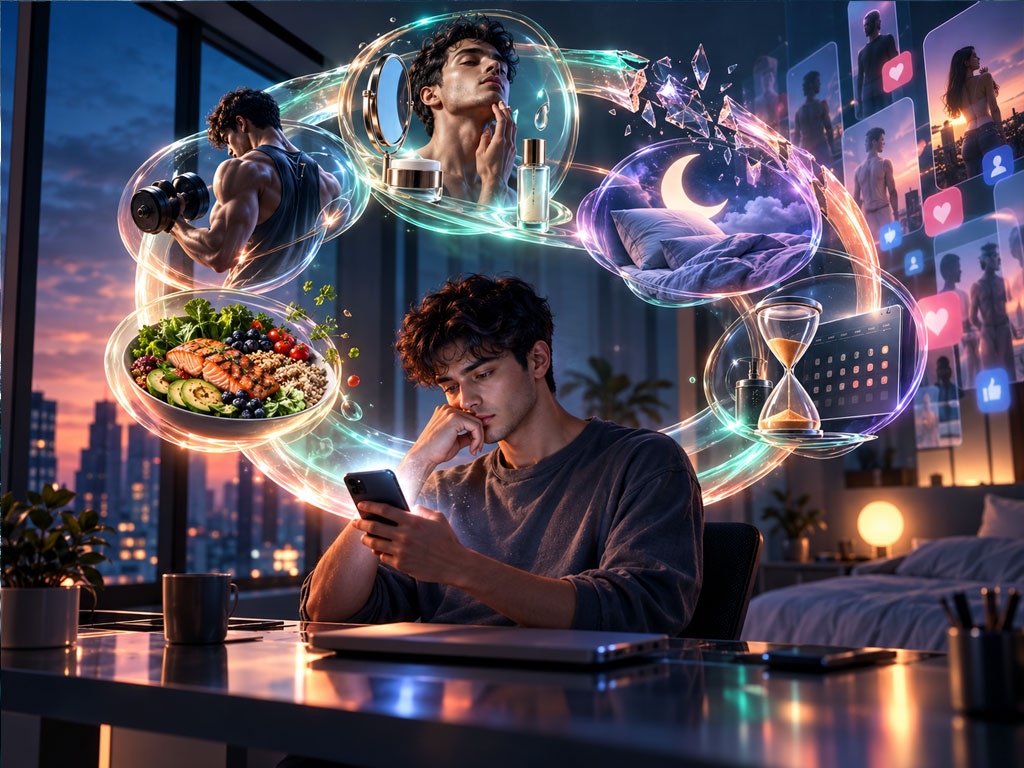
Dictionary.com’s 2026 Word of the Year captures a culture increasingly obsessed with optimising everything, from appearance and productivity to sleep and relaxation. But the pursuit of constant improvement may come with an unexpected cost.
Is getting enough sleep no longer enough? Must every meal be nutritionally perfect, every workout scientifically optimised and every hour of the day devoted to becoming a better version of ourselves?
Even relaxation, once understood as time away from responsibilities, is increasingly treated as something that must produce measurable benefits.
Modern life has developed an extraordinary appetite for self-improvement. What began as encouragement to develop healthier habits has, in some corners of social media, evolved into an expectation that almost everything should be pursued at maximum intensity.
There is now a word for this phenomenon: maxxing.
Dictionary.com selected “maxxing” as its Word of the Year for 2026, reflecting the term’s rapid spread through social media and its growing influence on conversations about beauty, fitness, technology, wellness and everyday life.
The choice captures a revealing contradiction in contemporary culture.
For years, people were encouraged to simplify their lives, reduce clutter and embrace minimalism. Now, the prevailing message across many digital platforms appears to be that every aspect of life can, and perhaps should, be optimised.
The question is whether that pursuit makes life genuinely better or simply gives people more reasons to feel inadequate.

What Is Maxxing, and Why Has It Become So Popular?
Derived from maximising, maxxing describes the pursuit of an activity or personal characteristic to its fullest possible extent.
The term can stand alone or be attached to another word to describe an increasingly specific form of self-improvement.
Although its linguistic roots include gaming terminology such as min-maxing, the modern expression developed within online communities before spreading to mainstream social media.
Its appeal lies partly in its flexibility.
Almost any activity can be transformed into a new form of maxxing simply by adding the suffix.
Some examples illustrate how widely the concept has spread:
- Looksmaxxing: Attempting to improve physical appearance through skincare, exercise, grooming, fashion or more intensive interventions.
- Softmaxxing: Pursuing relatively conventional appearance-related improvements, including skincare routines, moisturising, sun protection, haircuts and eyebrow grooming.
- Hardmaxxing: Seeking more extensive physical changes through procedures such as rhinoplasty, chin augmentation, facial surgery or cosmetic injections.
- Sleepmaxxing: Attempting to optimise sleep quality through structured routines, environmental adjustments and lifestyle changes.
- Proteinmaxxing: Deliberately increasing protein consumption as part of a broader nutrition or fitness strategy.
- Cozymaxxing: Creating surroundings and routines intended to maximise comfort, relaxation and a sense of wellbeing.
- Productivitymaxxing: Organising time, habits and work processes to achieve the greatest possible output.
Not all these expressions are used seriously.
Some describe genuine attempts at self-improvement, while others are deliberately exaggerated or humorous.
Someone spending an evening under a blanket watching television might jokingly describe the experience as cozymaxxing.
Yet the humour reveals something about the wider culture: even doing nothing can be repackaged as an activity with a measurable objective.
From Minimalism to Maximalism
The popularity of maxxing also invites comparison with two established approaches to lifestyle and design: minimalism and maximalism.
Although the terms sound related, the social media practice of maxxing is not identical to maximalism as a design philosophy.
One concerns the pursuit of optimisation. The other traditionally concerns abundance, expression and aesthetic richness.
Nevertheless, both can reflect a preference for pursuing more rather than settling for less.
Maximalism: The Philosophy of “More Is More”
Maximalism celebrates abundance, personality, emotional expression and sensory richness.
Its guiding principle is often described as “More is More”.
In interior design and visual culture, maximalism encourages bold colours, layered textures, varied patterns, decorative objects and collections that communicate personal identity.
A maximalist home may feature elaborate furnishings, treasured possessions, artwork and objects accumulated over many years.
Its appeal is not necessarily the quantity of those possessions, but the stories and emotional connections attached to them.
Rather than treating every object as something that must justify its practical usefulness, maximalism allows personal significance, history and aesthetic pleasure to influence what is retained.
For some people, such surroundings encourage creativity and a sense of belonging.
Others may find visually crowded environments distracting or overstimulating.
The effect depends on individual preferences and the way a space is organised.
Minimalism: The Philosophy of “Less Is More”
Minimalism approaches the same questions from a different direction.
Associated with the principle “Less is More”, it emphasises simplicity, clarity, functionality and the deliberate removal of unnecessary elements.
In visual design, minimalism often favours restrained colours, open spaces, limited decoration and carefully selected furnishings.
As a lifestyle philosophy, it encourages people to consider whether their possessions and activities genuinely serve their needs.
Its central idea is that reducing excess may create more room for what matters.
A minimalist approach can make daily routines easier to manage and reduce the practical burden of unnecessary possessions.
However, minimalism is not automatically superior to maximalism.
A sparse environment may feel peaceful to one person and impersonal to another.
Neither philosophy offers a universal formula for wellbeing.
The difficulty begins when an aesthetic preference becomes another standard against which people feel compelled to judge their lives.
Social Media and the Pressure to Become Better at Everything
The rapid spread of maxxing reflects the influence of social media on contemporary ideas about success, beauty and personal development.
Influencers regularly share carefully organised morning routines, demanding workout schedules, elaborate skincare practices and precisely calculated diets.
Such content can offer useful information and motivation.
It may encourage viewers to exercise regularly, improve their eating habits, establish healthier sleep routines or become more organised.
But it can also create unrealistic expectations.
A short video may present an impressive daily routine without revealing the years of practice, financial resources, professional assistance or personal circumstances that make it possible.
The viewer sees the finished result, not the full conditions behind it.
Someone with demanding employment, family responsibilities or limited financial resources may struggle to reproduce a lifestyle presented as ordinary and achievable.
Repeated exposure to these comparisons can create the impression that personal improvement is not an opportunity but an obligation.
The individual is no longer simply encouraged to become healthier, more confident or more productive.
They are encouraged to feel that remaining as they are represents a failure.
When Self-Improvement Becomes a Source of Anxiety
The appeal of maxxing rests on an understandable desire.
People want to make better use of their time, improve their health and develop greater control over their circumstances.
There is nothing inherently harmful about those ambitions.
The problem arises when improvement becomes an endless process with no acceptable point of completion.
Productivity Without Permission to Rest
Productivitymaxxing illustrates the contradiction particularly clearly.
A person may begin by adopting better organisational habits to reduce stress and make more time for family, friends or leisure.
Over time, however, the measurement of productivity can become an objective in itself.
Every hour must be accounted for.
Every task must demonstrate progress.
Even relaxation may begin to feel wasteful unless it contributes to better performance later.
Instead of creating freedom, the pursuit of efficiency can consume the very time it was intended to protect.
Rest becomes another responsibility.
Appearance and the Pursuit of an Ideal Body
Looksmaxxing raises different concerns.
Conventional practices such as maintaining personal hygiene, using appropriate skincare products and exercising regularly may support health and confidence.
More intensive approaches, however, can encourage people to view their appearance as a collection of defects requiring correction.
Social media comparisons may reinforce narrow beauty standards that are difficult or impossible for many individuals to achieve.
When improvement becomes an obsession, the emotional consequences can include dissatisfaction, insecurity and persistent concern about appearance.
Some extreme online looksmaxxing practices may also involve physical risks.
The distinction between caring for one’s appearance and becoming consumed by it is therefore important.
Self-care should not require someone to believe that their natural appearance is inherently inadequate.
The Limits of Optimisation
Maxxing culture often rests on the assumption that sufficient effort can produce almost any desired outcome.
That belief can be motivating, but it overlooks the complexity of individual circumstances.
Health, income, genetics, family obligations, education, opportunity and chance all influence what a person can achieve.
Two individuals following identical routines may experience very different results.
More effort does not always guarantee a better outcome.
Nor does every aspect of life benefit from being measured.
Friendship, creativity, happiness and relaxation may lose some of their meaning when treated primarily as projects requiring improvement.
A conversation with a friend does not need to enhance communication skills to be worthwhile.
A holiday does not have to maximise personal growth.
An afternoon spent doing very little is not necessarily an afternoon wasted.
Finding a Balance Between Growth and Contentment
The distinction worth making is between meaningful self-improvement and relentless self-optimisation.
Improvement can be valuable when it serves a clear personal purpose.
Better sleep may support health. Exercise can improve physical fitness. Developing useful skills may expand professional opportunities.
Yet those activities should contribute to a fulfilling life rather than become the sole measures of its worth.
The same principle applies to minimalism and maximalism.
A person may enjoy simplicity without feeling compelled to eliminate every unnecessary possession.
Another may embrace colour, decoration and abundance without becoming consumed by acquiring more.
Neither approach needs to become an identity that must be performed perfectly.
Perhaps the most useful lesson from maxxing culture is that improvement works best when it remains a choice rather than an obligation.
Dictionary.com’s decision to recognise “maxxing” as its 2026 Word of the Year reflects a moment in which society has developed increasingly sophisticated language for pursuing improvement.
But a richer vocabulary for optimisation does not necessarily mean a better understanding of contentment.
In a world offering more tools than ever to measure, analyse and improve our lives, knowing when to stop may be one of the most valuable abilities of all.