People leave public life. Their positions are eventually filled, their responsibilities redistributed and their names gradually absorbed into history.
What cannot be replaced so readily is the independence of mind that allows someone to challenge authority without first calculating the political consequences.
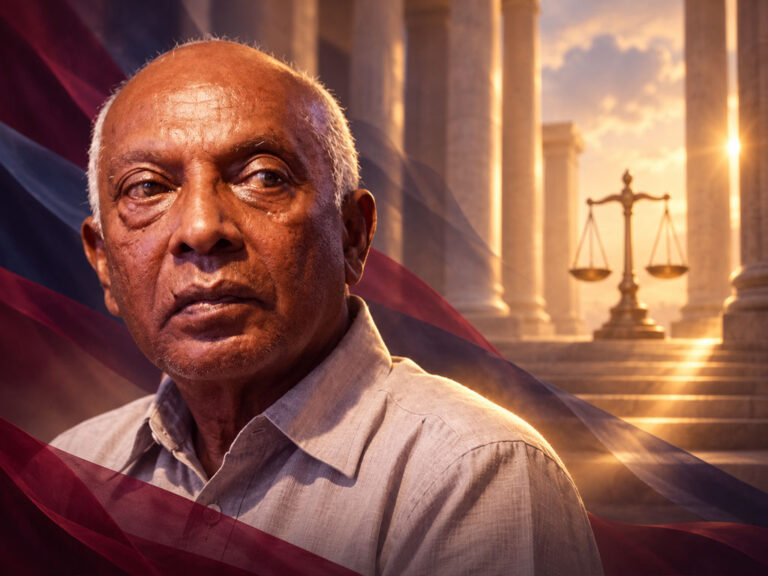
With the death of senior lawyer and veteran left-wing political activist Lal Wijenayake on October 31, 2026, Sri Lanka has lost one such voice.
His significance cannot be measured solely by the political positions he occupied or the organisations he helped build. It rests equally on his refusal to allow political allegiance to determine the boundaries of his conscience.
Wijenayake was not simply a veteran socialist who eventually joined the National People’s Power (NPP). He was prepared to challenge the exercise of power even when that power was held by a political movement to which he belonged.
That distinction became particularly important during the final months of his life.

A Political Life Rooted in the Sri Lankan Left
Wijenayake’s political journey began in 1963, when he joined the Lanka Sama Samaja Party (LSSP) as a student.
Over the following decades, he rose through the party’s ranks, serving on its Central Committee and Politburo and holding responsibilities that included the position of treasurer.
He subsequently helped establish the United Left Front, continuing his commitment to left-wing politics after departing from the LSSP.
Following the introduction of Sri Lanka’s provincial council system in 1988, Wijenayake became Leader of the Opposition in the first Central Provincial Council.
His political life was shaped by longstanding arguments concerning socialism, devolution, democracy and the distribution of state power.
Those commitments eventually brought him into the NPP, where he served on its leadership and executive bodies.
He supported constitutional reform, including the abolition of the executive presidency, but his relationship with the political movement was never one of unquestioning agreement.
For Wijenayake, membership of a political organisation did not mean surrendering the right to criticise its decisions.
A Lawyer Who Took His Principles into Court
Admitted as an attorney-at-law in 1969, Wijenayake developed a legal career closely connected to the political and social principles he advocated.
He appeared alongside senior lawyer S. Nadesan before the Criminal Justice Commission in proceedings involving young people accused following the April 1971 insurrection.
His work also extended to disputes affecting ordinary citizens whose interests were frequently overshadowed by the authority of the state.
He represented Mahaweli farmers challenging the imposition of a water tax and individuals contesting the recovery of land by the Land Reform Commission.
These cases reflected an understanding of law that went beyond professional advancement.
Legal principles mattered because they affected livelihoods, property, liberty and the relationship between citizens and public institutions.
Wijenayake also helped establish and convene Lawyers for Democracy, promoting judicial independence, civil liberties and respect for the rule of law.
His contribution was not confined to defending rights after violations occurred. He was equally concerned with strengthening the institutions intended to protect those rights.
Constitutional Reform and the Importance of Listening
One of Wijenayake’s most significant contributions to public life came through his leadership of the Public Representations Committee on Constitutional Reform.
Appointed during the constitutional reform process initiated under the Yahapalanaya administration, the committee conducted consultations across Sri Lanka and prepared recommendations reflecting public submissions.
The exercise was based on a democratic principle that is frequently acknowledged but less consistently practised: constitutional reform should not be the exclusive responsibility of political leaders, lawyers and government officials.
Citizens must have an opportunity to influence the structures under which they are governed.
Wijenayake’s involvement reflected his belief that public participation was an essential component of meaningful constitutional change.
His work also addressed questions of devolution, provincial authority and the circumstances of communities whose political and social concerns were insufficiently represented.
Among those were the difficulties experienced by the Up-Country Tamil community.
Yet consultation does not automatically produce reform.
Recommendations may be carefully prepared, publicly discussed and formally submitted, only to remain unimplemented.
That gap between participation and political action was one of the enduring frustrations of Sri Lanka’s constitutional experience.
Wijenayake understood that democratic legitimacy could not rest on consultation alone.
Governments also had to demonstrate a willingness to act upon the principles they claimed to uphold.
His Final Act of Dissent Came From Within the NPP
Perhaps the clearest expression of Wijenayake’s political independence emerged during the controversy surrounding the Twenty-Second Amendment to the Constitution.
The NPP government proposed increasing the retirement ages of judges of the Supreme Court and Court of Appeal.
The amendment raised the Supreme Court retirement age from 65 to 67 and that of Court of Appeal judges from 63 to 65.
The government presented the changes as part of a wider effort to strengthen judicial capacity and address pressures within the court system.
Wijenayake disagreed.
He argued that altering judges’ conditions of service during their tenure could compromise judicial independence by creating opportunities for political influence.
In an interview with the Daily Mirror, he explained the principle underlying his objection:
“Unless you have an independent judiciary, you cannot build a society where there is equality and democracy.”
His concern was not simply whether extending judicial service was desirable.
It was whether governments should be able to alter the conditions under which serving judges hold office.
A government that could extend judicial tenure, he argued, might also establish a precedent for another administration to shorten it.
For a lawyer who had spent decades opposing political interference with the judiciary, the question was too important to set aside because his own political allies supported the proposal.
The disagreement became more pointed when Wijenayake said Agriculture Minister K. D. Lalkantha had asked him to remain silent on the issue.
The allegation was disputed by the party.
Wijenayake nevertheless maintained his position and supported legal opposition to the proposed amendment.
He did not resign from the NPP.
Nor did he conclude that disagreement required abandoning the wider political project he had supported.
Instead, he insisted on preserving his right to dissent from within it.
Parliament passed the Twenty-Second Amendment with a special majority, and the Speaker endorsed it on September 25, 2026.
Wijenayake’s opposition did not prevent the constitutional change.
But its importance was not dependent on whether he prevailed.
He demonstrated that political loyalty need not require intellectual obedience.
The Difference Between Discipline and Submission
Political movements frequently speak of democracy, accountability and the importance of constructive criticism.
Those commitments are tested most seriously when criticism comes from people within their own ranks.
It is relatively easy to praise dissent directed at a political opponent.
Accepting criticism from a respected colleague requires something more demanding.
Wijenayake’s opposition to the judicial retirement amendment exposed that distinction.
He believed that supporting a political movement did not relieve him of his responsibility to examine its decisions.
His objections were grounded in the same principles he had defended under previous administrations.
That consistency was what made his intervention significant.
He was not seeking to establish that every decision of the NPP was wrong.
He was demonstrating that no government should be exempt from the standards it expects others to observe.
The matter also raised a wider question for Sri Lankan political culture.
Can a party accommodate members who publicly disagree with important decisions without treating their disagreement as disloyalty?
For Wijenayake, the answer had to be yes.
A movement incapable of tolerating principled dissent risks confusing discipline with submission.
A Final Commitment to Civil Liberties
Wijenayake’s opposition to the Twenty-Second Amendment was not his only disagreement with government policy.
He also criticised proposed legislation concerning the protection of the state from terrorism.
His objections reflected longstanding concerns about the potential misuse of state power and the importance of protecting civil liberties.
During his final weeks, he remained active in left-wing political organisation, reportedly helping establish a Left Centre in Kandy.
Even in the closing period of his life, he continued to engage with the political questions that had shaped his career.
There was no indication that he considered his responsibility to public life complete.
His commitments extended beyond party politics and legal advocacy.
Wijenayake was also an art collector, a friend of artist George Keyt and a participant in Sri Lanka’s wider intellectual and cultural life.
His interests reflected a conviction that politics, law, culture and the humanities were connected through their ability to shape how societies understand themselves.
A Legacy That Does Not Require Unquestioning Agreement
Wijenayake was not beyond criticism.
His political choices, alliances and judgments remain legitimate subjects of debate.
No meaningful assessment of a public figure should require agreement with every position that person adopted.
His importance lies elsewhere.
He preserved the possibility of disagreement.
Through legal advocacy, political organisation, constitutional consultation and criticism of governments, including one supported by his own movement, he demonstrated that intellectual independence was not a luxury.
It was a public responsibility.
Wijenayake opposed the use of ideas as ornaments that could be displayed in political speeches and abandoned when they became inconvenient.
For him, principles had to be tested against institutional conduct.
Claims about democracy meant little unless those making them were willing to protect the independence of the courts, respect civil liberties and tolerate criticism.
That was the value of his dissent.
Who Will Be Willing to Disagree?
Sri Lanka has become accustomed to the departure of prominent figures from its political and intellectual life.
Institutions continue. Committees appoint replacements. Political parties fill vacancies.
But a vacancy filled is not necessarily a loss repaired.
A title can be inherited.
Decades of experience, intellectual independence and the courage to confront political allies cannot.
With Lal Wijenayake gone, the NPP has lost an internal critic who remained committed to its broader political project while challenging decisions he believed threatened democratic principles.
The legal community has lost a persistent advocate of judicial independence and civil liberties.
Sri Lanka’s Left has lost a connection to an older political tradition in which ideas were expected to withstand rigorous argument, including arguments among comrades.
His death leaves a question that extends beyond any one political party.
Who will defend the right to disagree when disagreement becomes inconvenient?
The rebel within is no more.
The responsibility he carried remains.
SOURCE:- SRI LANKA GUARDIAN