Disputes over domestic fuel sales, long-term tax concessions, environmental responsibilities and the future of the state-owned Sapugaskanda refinery have placed one of Sri Lanka’s largest proposed foreign investments at risk.
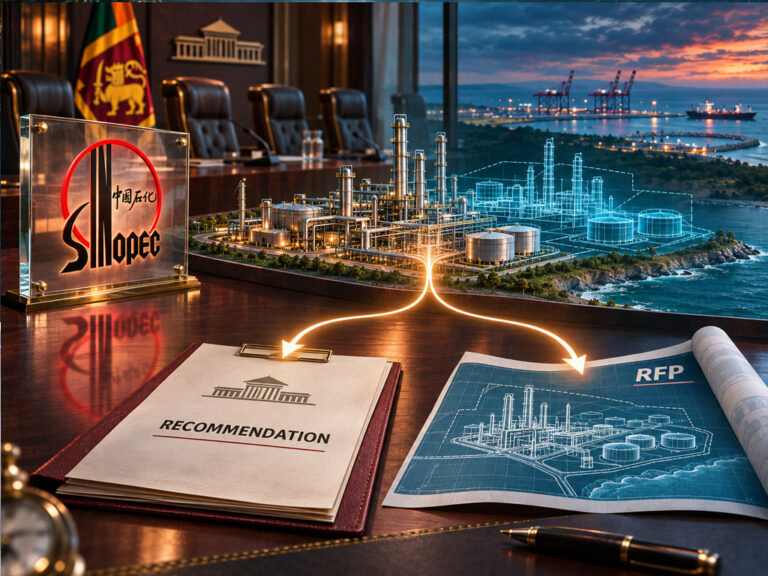
Sri Lanka’s proposed US$3.7 billion Sinopec oil refinery in Hambantota, once celebrated as a landmark foreign investment, is now facing the possibility of cancellation following a reported recommendation by a Cabinet-appointed negotiating committee.
The proposed refinery, to be developed by China Petroleum & Chemical Corporation (Sinopec), was expected to process approximately 200,000 barrels of crude oil per day, with most of its output destined for international markets.
However, negotiations have become increasingly complicated as disagreements emerged over how much refined fuel Sinopec could sell within Sri Lanka, the tax exemptions it would receive, and the environmental and infrastructure obligations it would undertake.
The Cabinet Appointed Negotiating Committee (CANC) has reportedly recommended discontinuing the existing project arrangement and initiating a fresh investment selection process.
Although a final Cabinet decision cancelling the project has not been independently confirmed, the reported recommendation highlights a fundamental disagreement over whether the proposed investment would provide sufficient long-term benefits to Sri Lanka.

1. Sinopec’s Request for Greater Access to Sri Lanka’s Fuel Market
One of the most significant disagreements concerns Sinopec’s proposed access to Sri Lanka’s domestic petroleum market.
The Hambantota refinery was originally conceived as an export-oriented development, with the company permitted to sell up to 20% of its refined petroleum products locally.
Sinopec subsequently sought greater flexibility, with discussions reportedly considering an increase to 40%.
For a refinery capable of processing approximately 200,000 barrels of crude oil daily, even a 20% domestic allocation would represent a substantial volume of petroleum products.
Increasing that proportion could have major consequences for the domestic fuel market and the Ceylon Petroleum Corporation (CPC).
The government’s concern is that granting a large foreign-owned refinery significantly greater access to local consumers could weaken the commercial position of the state-owned petroleum enterprise.
It could also complicate plans to expand the existing Sapugaskanda refinery.
However, the position has not remained entirely consistent throughout negotiations.
In early 2026, Energy Ministry Secretary Professor Udayanga Hemapala stated that Sinopec had agreed in principle to the government’s 20% domestic-market limit.
Consequently, the precise status of this disagreement in the committee’s latest assessment requires confirmation.
Nevertheless, domestic-market access has remained one of the central issues affecting the project’s progress.
SINOPEC Deal Cancelled! The $4.5 Billion Decision That Changes Everything
Proposed US$3.7 billion investment faces renewed scrutiny over domestic-market access, tax concessions and environmental obligations, while a final Cabinet decision remains unconfirmed.
READ FULL STORY →2. The Dispute Over Long-Term Tax Exemptions
Another major obstacle involves the extensive tax concessions reportedly sought by Sinopec.
The supplied account of the committee’s findings refers to a request for a corporate income tax exemption lasting as long as 35 years.
Earlier reporting, however, referred to a proposed 25-year tax holiday, making it necessary to establish the exact terms contained in the latest negotiating documents.
Whatever the precise duration, the underlying concern is significant.
Sri Lanka is attempting to strengthen government revenue following its economic crisis and the introduction of reforms under its International Monetary Fund programme.
Granting unusually extensive tax concessions to a single major investor could conflict with efforts to broaden the tax base and establish a more consistent investment framework.
The government must also consider whether the potential economic benefits justify the revenue it could forgo.
Supporters of the project can reasonably argue that the investment would generate employment, export earnings, industrial development and demand for supporting services.
However, these benefits must be weighed against the fiscal value of the requested concessions.
The reported committee recommendation suggests that this balance has become a significant obstacle to finalising an acceptable agreement.
3. Environmental Protection and the Water Supply Problem
A refinery of the proposed scale would require substantial industrial infrastructure, including a reliable water supply.
Hambantota’s climatic conditions and water-resource constraints make this an especially important issue.
Large petroleum refineries consume significant quantities of water for cooling, processing and other industrial requirements.
The reported committee findings raise concerns about Sinopec’s willingness to assume responsibility for constructing a seawater desalination facility.
Such infrastructure could reduce the refinery’s dependence on freshwater resources that are also needed by surrounding communities.
Questions have additionally been raised about the project’s Environmental Impact Assessment (EIA).
The supplied account alleges that the company had not submitted an adequate assessment or demonstrated how potential environmental impacts would be mitigated.
These specific allegations have not been independently established from official regulatory records.
An EIA may be required at a particular stage of project approval, so its absence during negotiations would not automatically mean that the company had breached environmental legislation.
Nevertheless, the commercial agreement must clearly establish responsibility for environmental protection, water infrastructure and the financial costs of compliance.
A project of this magnitude cannot be evaluated solely on the investment it promises.
The long-term environmental and infrastructure obligations must also be considered.
4. Why Sapugaskanda Has Become Central to the Debate
The reported recommendation has renewed attention on Sri Lanka’s plans to modernise and expand the state-owned Sapugaskanda refinery.
Sapugaskanda currently has a crude oil processing capacity of approximately 50,000 barrels per day.
Expanding that capacity could allow the country to refine a greater proportion of its petroleum requirements domestically and reduce dependence on imported finished products.
Such an investment could strengthen the Ceylon Petroleum Corporation’s refining operations and create opportunities to retain more value within the national petroleum supply chain.
From an energy-security perspective, maintaining a substantial state-owned refining capability could also reduce reliance on external suppliers during periods of international market disruption.
However, the economic case for expanding Sapugaskanda must be assessed independently.
Modernisation would require substantial capital expenditure, suitable financing and a commercially viable operating strategy.
Moreover, Hambantota and Sapugaskanda were conceived for different purposes.
The Sinopec project was intended primarily to supply export markets, while Sapugaskanda is closely connected to domestic petroleum requirements.
Prioritising Sapugaskanda would therefore represent a policy choice about the structure and ownership of Sri Lanka’s refining industry, rather than a direct replacement of one identical project with another.
5. Why the Government May Prefer a Fresh Tender
The reported committee recommendation also calls for a fresh Request for Proposals for an export-oriented refinery in Hambantota.
This suggests that the concern may not be with establishing a major refinery in the area, but with the commercial conditions attached to the existing proposal.
Restarting the selection process could allow the government to establish clearer requirements concerning:
- The proportion of refined products permitted for domestic sale.
- The maximum duration and value of tax concessions.
- Responsibility for environmental assessments and compliance.
- Industrial water supply and desalination infrastructure.
- Land allocation and associated infrastructure costs.
- Government revenue and wider economic benefits.
- Procurement transparency and competition among potential investors.
A new tender could attract alternative investors or revised proposals.
However, abandoning negotiations after considerable time has already been invested also carries risks.
Sri Lanka could lose an important investment opportunity, delay industrial development and raise concerns among international investors about the consistency of its investment policies.
The government would therefore need to demonstrate that the benefits of restarting the process outweigh the costs of further delay.
6. Is Sri Lanka Turning Away From China?
The controversy has also raised questions about whether discontinuing the Sinopec arrangement would signal a broader change in Sri Lanka’s relationship with China.
There is insufficient evidence to support that conclusion.
China remains an important economic partner, and the proposed refinery is only one component of the wider bilateral relationship.
A government can reject or renegotiate a commercial proposal without abandoning cooperation with the investor’s home country.
The essential question is whether the agreement meets Sri Lanka’s economic, environmental and regulatory requirements.
Framing the dispute exclusively as a geopolitical decision risks overlooking the practical commercial issues that have delayed the project.
What Happens Next?
The reported committee recommendation places the government at an important decision point.
If the Cabinet accepts the recommendation, it could bring the current Sinopec arrangement to an end and initiate a fresh procurement process.
Alternatively, the government could seek further negotiations aimed at resolving the outstanding disagreements.
Either outcome would need to address the concerns that have delayed the proposed development.
The decision will have implications beyond Hambantota.
It will affect Sri Lanka’s petroleum refining strategy, its relationship with major foreign investors and the government’s ability to balance investment promotion with fiscal and environmental safeguards.
Ultimately, the dispute illustrates the challenge of attracting large-scale foreign investment while ensuring that the terms of such investments remain consistent with national economic priorities.
The question is not simply whether Sri Lanka can attract billions of dollars in foreign capital.
It is whether the agreements governing that capital produce sustainable benefits for the country.
For the Sinopec refinery, that question appears to have become decisive.