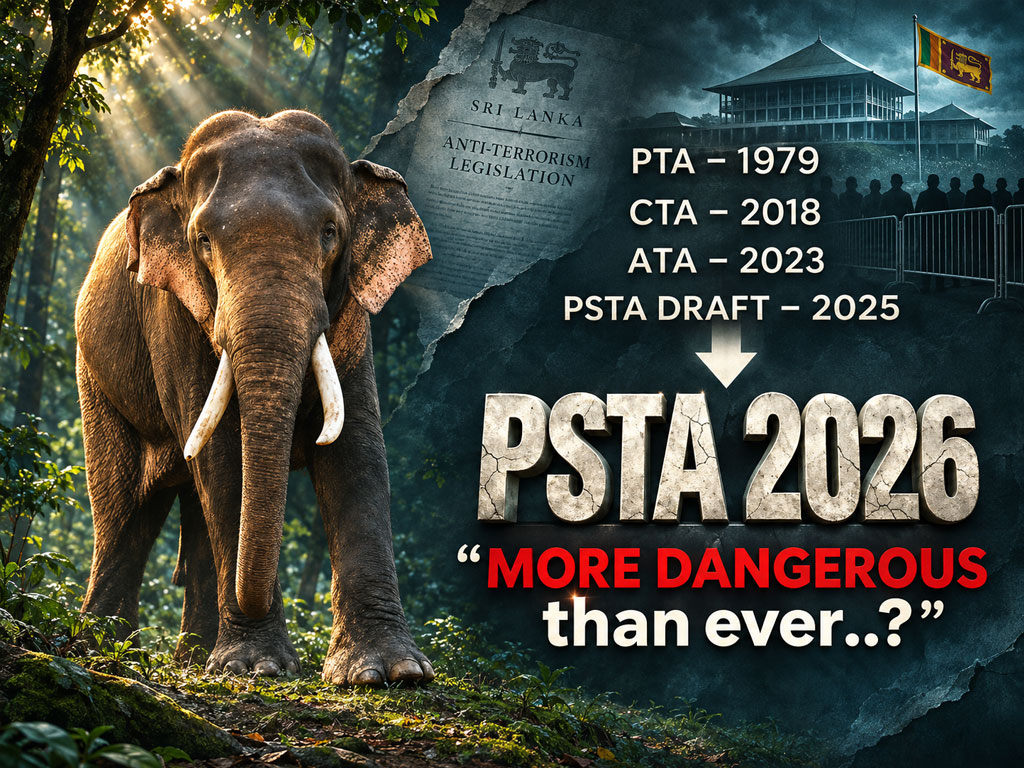
COLOMBO — From growing resistance to security legislation and demands for constitutional reform to tensions within the UNP, the Kavantissa memorial, controversial broadcasting sponsorship and the approaching 2027 Budget, Sri Lanka’s political landscape is shifting on several fronts.
Sri Lanka’s political landscape is entering a particularly unpredictable period, with President Anura Kumara Dissanayake’s Government confronting renewed pressure over proposed security legislation, constitutional reform and long-delayed Provincial Council elections.
At the same time, disagreements within the opposition are raising questions about the future of the United National Party (UNP) and its relationship with the Samagi Jana Balawegaya (SJB).
Beyond Parliament, the late tusker Kavantissa has unexpectedly become part of the political conversation, while controversy surrounding a Rs. 104.6 million broadcasting sponsorship and speculation over the 2027 Budget have added further complications.
Some of these developments are established public events. Others involve political predictions, reported private discussions or allegations that have not been independently verified.
Taken together, they provide a revealing picture of the challenges, alliances and emerging political calculations that could shape 2027.

1. Terrorism and Organised Crime Bills Trigger Widespread Resistance
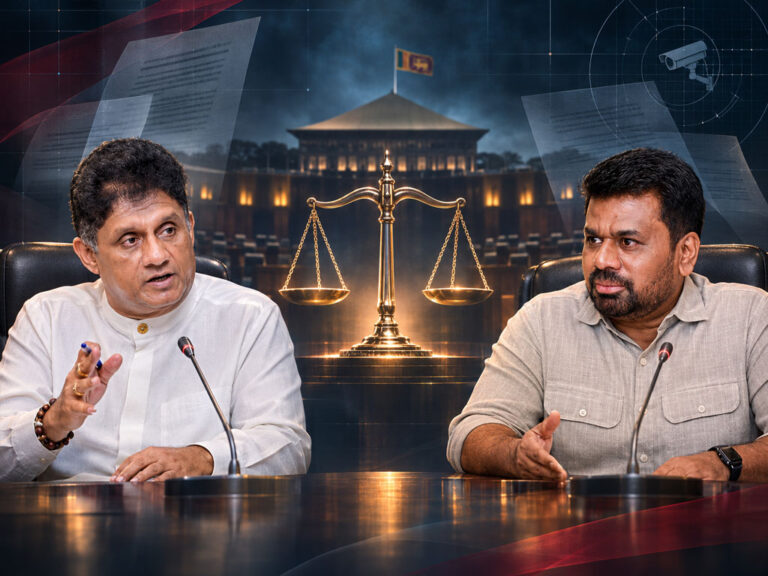
Two proposed security laws have become the immediate focus of opposition to the Government’s legislative agenda.
The Prevention of Organised Crimes Bill and Protection of the State from Terrorism Bill have drawn criticism from political parties, civil society organisations, trade unions and international human rights groups.
The SJB has opposed the legislation inside and outside Parliament, while the Frontline Socialist Party (FSP) and People’s Struggle Movement have participated in demonstrations against the proposed expansion of law enforcement powers.
Critics argue that the Bills could permit prolonged detention, weaken judicial supervision and expose individuals to arbitrary enforcement.
The objections are not confined to Sri Lanka.
United Nations human rights experts raised concerns in a 31-page communication dated October 30 about provisions of the organised crime legislation affecting detention, communications data and protections for confidential journalistic sources.
Separately, the Office of the United Nations High Commissioner for Human Rights called for substantial revisions to the proposed anti-terrorism legislation, warning that certain provisions could reproduce or expand shortcomings associated with the existing Prevention of Terrorism Act.
Human Rights Watch and other international organisations have also urged stronger safeguards.
The Government maintains that Sri Lanka needs effective legislation to combat organised criminal networks and terrorism. It has nevertheless indicated a willingness to consider amendments.
President Offers Three Concessions
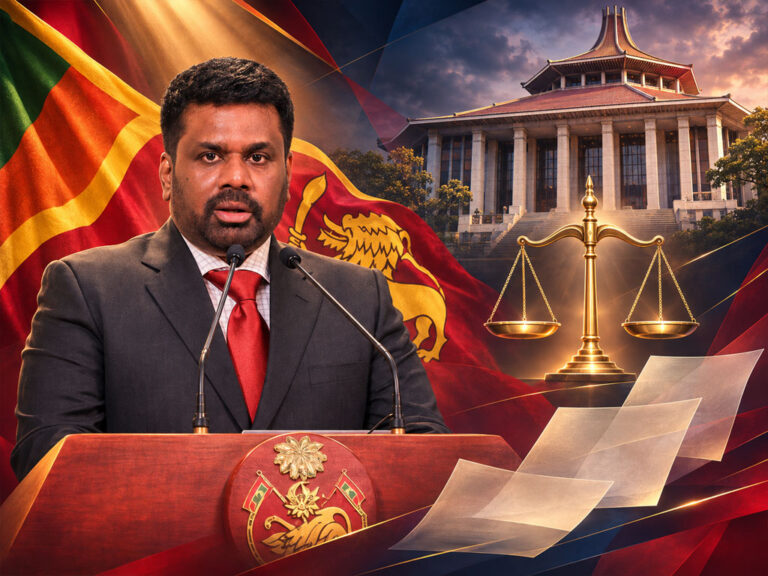
On November 5, President Dissanayake announced that the Government was prepared to revise three controversial elements of the Prevention of Organised Crimes Bill.
The proposed changes would:
- Reduce the initial period before a suspect must generally be produced before a magistrate from 72 hours to 48 hours.
- Remove provisions concerning tattoos as identifying characteristics associated with organised criminal groups.
- Exclude offences under the Excise Ordinance from the Bill’s scope.
Under the ordinary criminal procedure framework, arrested suspects generally must be produced before a magistrate within 24 hours, subject to applicable legal provisions.
Critics argue that reducing the proposed period to 48 hours does not adequately address their concerns over longer detention arrangements.
They point to other provisions that could permit extended detention under orders issued by executive authorities.
The President’s announcement has therefore left a central question unresolved: will the Government make substantial revisions to the legislation, or proceed with most of its existing provisions?
Could the Bills Be Withdrawn?
The political source account suggests that discussions within Government circles have included possible changes to the legislative timetable.
It also raises the prospect of the Bills being delayed until 2027.
However, no confirmed Government decision to withdraw either Bill has been established.
The administration has already demonstrated its ability to secure the parliamentary majority needed for contentious legislation.
In September 2026, Parliament passed the Twenty-Second Amendment to the Constitution with the required two-thirds majority.
That amendment concerned judicial retirement ages and involved different constitutional questions from the proposed security laws.
Nevertheless, the vote illustrated the Government’s strength in Parliament.
Whether political pressure will produce further concessions or a fundamental reconsideration of the proposed laws remains to be seen.
2. The Constitutional Question Returns to Haunt the Government
While the security legislation has attracted immediate public attention, a second political challenge is developing around constitutional reform.
The Janatha Vimukthi Peramuna (JVP), the principal party within the ruling National People’s Power (NPP) alliance, has historically opposed Sri Lanka’s Executive Presidential system.
Its opposition dates back several decades.
In 1994, the JVP supported Chandrika Bandaranaike Kumaratunga’s presidential campaign following an understanding involving abolition of the Executive Presidency.
Its own presidential candidate, Nihal Galappaththi, withdrew from the election.
Kumaratunga subsequently served two presidential terms without abolishing the system.
In 2005, the JVP supported Mahinda Rajapaksa under another political agreement that included constitutional reform.
Rajapaksa also retained the Executive Presidential system, with his administration later introducing the Eighteenth Amendment, which removed the two-term presidential limit.
The NPP’s 2024 election campaigns revived the promise to abolish the Executive Presidency and introduce a new constitution.
Those commitments have now become an important measure against which the Government’s performance is being assessed.
Promises to the North and East
Constitutional reform has particular significance for Tamil political representatives and communities in the Northern and Eastern Provinces.
During the election campaigns, the NPP pledged progress on constitutional reform, Provincial Council elections and the release of privately owned lands retained under military control.
The source column argues that these commitments contributed to the NPP’s increased electoral support among Tamil voters.
The precise influence of those promises on individual voting decisions cannot be independently determined.
Nevertheless, they created expectations that the new administration would accelerate reforms affecting regional representation and land rights.
Nearly two years after the presidential election, critics contend that meaningful progress has been insufficient.
A completed new constitutional framework has not emerged, while Provincial Council elections remain outstanding.
These unresolved commitments are becoming an increasingly important political issue.
3. Provincial Council Elections Become a New Political Battleground
The continued absence of elected Provincial Councils has intensified criticism from opposition parties and Tamil political representatives.
The elections have been delayed partly because of unresolved questions surrounding the electoral framework introduced through the Provincial Councils Elections (Amendment) Act of 2017.
Parliament subsequently appointed a Select Committee chaired by Minister Vijitha Herath to examine the system under which the elections should be held.
The committee received submissions from political parties and other stakeholders.
However, opposition representatives became increasingly dissatisfied with the time taken to complete the process.
The SJB and other opposition members announced their withdrawal after the committee’s term was extended until December 17, 2026.
They argued that further procedural discussions were becoming a means of postponing elections.
Government representatives have maintained that the committee must complete its examination before making recommendations.
Sumanthiran Demands Elections First
Ilankai Tamil Arasu Kachchi (ITAK) General Secretary M.A. Sumanthiran has challenged the argument that further electoral reform must precede Provincial Council polls.
He has argued that Parliament should first establish a legally workable mechanism for conducting the elections and address additional changes afterwards.
Sumanthiran presented proposals to the Parliamentary Select Committee, including a private member’s legislative initiative.
His position reflects concern among Tamil political representatives that continued debate has left Provincial Councils without elected administrations for an extended period.
According to the supplied political account, ITAK has also explored cooperation with other Tamil political organisations, including the party associated with Suresh Premachandran.
The aim is reportedly to strengthen pressure for Provincial Council elections and greater regional representation.
The precise structure and extent of any formal alliance still require confirmation.
If cooperation among Tamil parties expands, the elections could become a major political issue for the Government in 2027.
4. Tamil Diaspora Organisations Reportedly Prepare a Constitutional Campaign
Another development described in the source involves an initiative among Tamil diaspora organisations to formulate constitutional proposals for Sri Lanka.
According to the political account, discussions initiated by groups in the United Kingdom have expanded to include organisations elsewhere and Tamil political representatives in the Northern Province.
The reported objective is to develop a common position rather than submit separate proposals through competing organisations.
The source claims that nearly one hundred diaspora groups have participated.
That figure and the extent of agreement among participants have not been independently confirmed.
A Shift From Federalism to Protected Devolution?
One of the more consequential claims concerns the language being considered for a future constitutional settlement.
According to the source, some participants have discussed whether continued insistence on the word federal might create obstacles to wider political acceptance.
The reported alternative would focus on the substance of devolved powers rather than a particular constitutional label.
Two principles were identified:
1. Powers assigned to Provincial Councils should be protected against unilateral withdrawal or interference by central authorities.
2. Decisions falling within provincial jurisdiction should primarily rest with elected provincial institutions.
These proposals reflect longstanding demands for meaningful regional autonomy.
However, it would be inaccurate to conclude that the Tamil diaspora as a whole has abandoned federalism.
The reported discussions concern participating organisations and do not establish a universal position among Tamil political parties or diaspora groups.
An International Conference in Britain?
The account further suggests that organisers are exploring a conference in Britain to unveil their proposals.
It claims that international figures previously associated with Sri Lankan political and human rights issues have been approached.
Among those mentioned are former UN High Commissioner for Human Rights Navi Pillay and former British Foreign Secretary David Miliband.
The source also refers to alleged discussions with former United States President Barack Obama.
Those specific engagements could not be independently verified.
Any claim that such meetings took place would require confirmation from the participants or supporting documentation before publication as fact.
If the conference proceeds, however, it could create a new platform for debate over constitutional reform and devolution.
For the Government, the challenge would be to respond to those demands while maintaining support across Sri Lanka’s wider electorate.
5. Is a Generation Z Revolt Developing Inside Ranil’s UNP?
While the NPP faces pressure from outside, the UNP is confronting questions about its own political future.
The possibility of cooperation between the UNP and SJB remains one of the opposition’s most frequently discussed strategic options.
UNP Deputy General Secretary Harin Fernando has repeatedly advocated closer cooperation, recognising the SJB’s wider electoral organisation as an important factor.
The source column interprets Fernando’s remarks as an indirect challenge to UNP leader and former President Ranil Wickremesinghe.
It alleges that individuals close to Wickremesinghe have obstructed attempts to establish a formal political understanding.
That allegation remains an interpretation of internal party developments rather than an independently established fact.
Harin Fernando Calls for Political Unity
Fernando has argued that the UNP and SJB should pursue a strategy capable of bringing their supporters together.
His comments have renewed debate over the leadership arrangements and political compromises such an alliance would require.
The source claims that senior UNP figures and electoral organisers welcomed his intervention.
It further suggests that his remarks generated concern among individuals close to Wickremesinghe.
Those accounts of private reactions have not been independently confirmed.
What is clear is that the UNP’s future relationship with the SJB remains unresolved.
Ranil Turns His Attention to Young Voters
At an October 30 meeting of the UNP Working Committee, Wickremesinghe argued that a possible alliance with the SJB would not automatically produce an electoral victory.
He emphasised the importance of attracting Millennial and Generation Z voters.
The UNP also announced initiatives intended to strengthen participation among younger members and supporters.
Wickremesinghe’s position reflects a broader recognition that political parties must adapt to changing forms of communication, organisation and voter engagement.
The source column, however, suggests that younger UNP activists could eventually challenge his leadership.
It predicts a possible internal political movement different from the conventional leadership disputes the party has experienced previously.
Such a rebellion has not been established as an organised movement.
There is a distinction between dissatisfaction among individual members and a coordinated challenge capable of changing party leadership.
Nevertheless, the historical record demonstrates that the UNP has experienced significant internal disagreements during Wickremesinghe’s long tenure.
Former Deputy Leader Karu Jayasuriya was among the prominent figures whose relationship with the party leadership changed over time.
The eventual emergence of the SJB further transformed the opposition landscape.
Whether the UNP’s next major change comes through a new generation of leaders, cooperation with the SJB or internal restructuring remains uncertain.
6. Kavantissa’s Legacy Creates an Unexpected Political Story
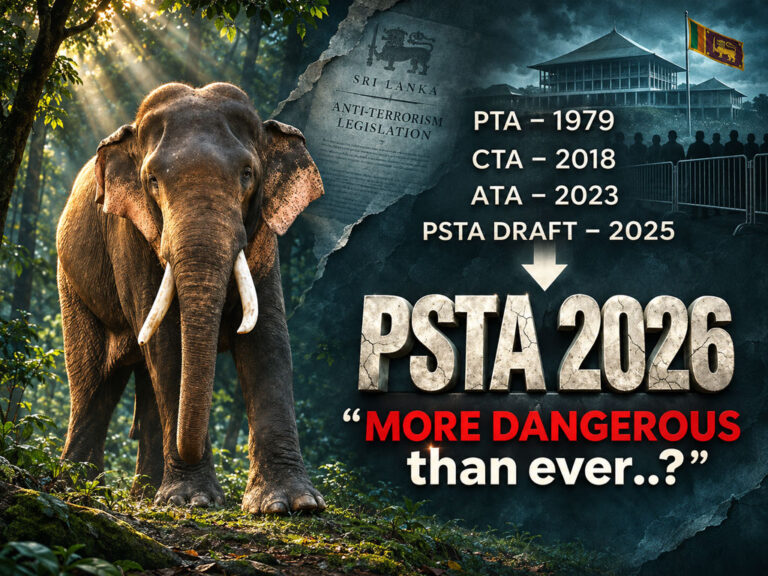
Away from the disputes surrounding security legislation and party leadership, the death of the celebrated tusker Kavantissa has prompted calls for a permanent memorial.
Kavantissa had become a familiar and much-admired elephant among wildlife enthusiasts.
Following his death, photographs, videos and recollections circulated widely on social media.
The public response prompted proposals for a memorial recognising the elephant’s life and the importance of wildlife conservation.
Opposition Leader Sajith Premadasa subsequently announced an initiative to establish a life-sized statue.
A site in Ambanpola, near the Siyambalangamuwa Tank Reservation, has been identified in public reporting.
There have also been proposals for a wildlife conservation and research facility associated with the memorial.
Did Politics Interfere With the Search for Land?
The source account alleges that local residents initially sought assistance from local authorities to obtain land for the memorial.
It further claims that officials faced pressure from political circles not to support the proposal because Premadasa had previously given Kavantissa his name.
The allegation has not been independently substantiated.
It would therefore be inappropriate to present political interference as the established reason for any decision concerning land allocation.
The account states that those supporting the memorial subsequently approached Premadasa directly.
According to the source, he considered using family-owned property and discussed the matter with his mother, Hema Premadasa, and sister, Dulanjalee Premadasa.
Dulanjalee reportedly proposed that the project should extend beyond a statue and include a museum dedicated to Kavantissa.
The details of the property arrangements and museum proposal remain unverified.
A Memorial, Museum or Conservation Centre?
Premadasa also attended a photographic exhibition organised by environmentalist Nayanaka Ranwella, according to the source.
The event reportedly brought together individuals who had followed Kavantissa’s movements and contributed to conservation efforts.
Among those mentioned was Kumara, who had helped establish a safer crossing point along a road used by the elephant.
Whatever the final form of the project, Kavantissa’s legacy has created an opportunity to promote public awareness of elephant conservation.
The essential question is whether the initiative will produce lasting benefits for wildlife protection, beyond the symbolism of a memorial.
7. Rs. 104.6 Million Sirasa Sponsorship Becomes a Political Controversy
Another issue drawing scrutiny concerns the allocation of Rs. 104.6 million through the Sri Lanka Tourism Promotion Bureau for the 63rd General Assembly of the Asia-Pacific Broadcasting Union.
The event was hosted in Colombo by MTV Channels (Private) Limited from October 30 to November 3, 2026.
The sponsorship covered the assembly and associated activities.
Cabinet approval for the expenditure prompted criticism from opposition representatives and civil society activists.
Critics have questioned whether the amount was justified and whether the anticipated tourism benefits warranted the expenditure.
Government Says Funds Came Through Tourism Promotion Bureau
At the post-Cabinet media briefing, Minister Nalinda Jayatissa explained that the sponsorship had been provided through the Sri Lanka Tourism Promotion Bureau rather than as a direct allocation from the Treasury.
The Government defended the expenditure as an international tourism promotion initiative.
Sri Lanka Tourism indicated that the event could generate promotional media value exceeding Rs. 250 million.
That estimate concerns the anticipated value of international exposure, not independently verified financial revenue.
The distinction between funding sources is important.
However, because the sponsorship involved a statutory tourism promotion body, questions about expenditure approvals, value for money and public accountability remain legitimate.
SJB Considers Parliamentary Action
According to the source column, SJB parliamentarians have discussed challenging the expenditure through parliamentary oversight mechanisms.
Some reportedly referred to their dissatisfaction with MTV’s previous editorial coverage of Opposition Leader Sajith Premadasa and the SJB.
That dissatisfaction does not establish that the sponsorship was politically motivated.
A separate complaint seeking an investigation into the sponsorship has also been submitted to the Commission to Investigate Allegations of Bribery or Corruption.
The existence of a complaint does not establish wrongdoing.
Any credible assessment must examine the approvals, funding arrangements, procurement considerations and measurable benefits associated with the event.
For the Government, the controversy illustrates how expenditure decisions involving private organisations can become politically contentious even when presented as legitimate promotional initiatives.
8. The 2027 Budget Could Become a Major Political Test
President Dissanayake is scheduled to present the 2027 Budget to Parliament on Thursday, November 12, in his capacity as Minister of Finance.
The Second Reading debate is scheduled to continue from November 13 until December 14.
The Budget arrives at an important stage in Sri Lanka’s economic recovery.
The Government must balance fiscal commitments with expectations for improved household incomes, lower living costs and stronger economic opportunities.
According to the source column, the administration has been considering additional relief measures beyond those originally anticipated.
Possible proposals discussed include:
- Further support for public-sector employees.
- Tax concessions affecting private-sector workers.
- Additional measures to relieve household financial pressures.
- Other targeted assistance for vulnerable groups.
These remain reported expectations until the Budget is formally presented.
A Budget Designed to Restore Confidence?
The column suggests that recent political challenges have encouraged the administration to consider a more expansive package of concessions.
It also predicts a major social media campaign to explain the Budget’s measures.
Such communication would be consistent with normal government efforts to publicise fiscal policy.
However, claims that the campaign is specifically designed to recover lost political support remain interpretations rather than confirmed Government intentions.
The substance of the Budget will ultimately determine its reception.
Measures that produce meaningful improvements in household welfare may strengthen public confidence, while proposals that fall short of expectations could generate further criticism.
The challenge will be to deliver relief without undermining fiscal stability.
9. A New Campaign Against Alleged State Land Grabbers?
The source’s final major development concerns reports that the Government is preparing investigations into historical state land transactions.
According to the political account, the proposed initiative would examine transactions in which politicians, politically connected individuals or commercial operators may have acquired public land at unusually favourable prices or through improper procedures.
Some properties were allegedly developed into hotels, tourism ventures and other commercial establishments.
The source claims that investigative agencies have already gathered substantial information but have been occupied with other inquiries.
These claims have not been independently corroborated through official announcements or identified case files.
Could Investigations Begin in 2027?
The source suggests that investigations could become public during the early months of 2027.
Any such inquiry would need to establish the legal basis of each transaction, the valuation process, relevant approvals and ownership records.
An unusually favourable sale or lease arrangement would not, by itself, establish criminal wrongdoing.
Likewise, political connections would not automatically prove that a land transaction was unlawful.
If investigations are formally announced, their credibility will depend on evidence, procedural fairness and consistent application of the law.
Until then, the reported campaign remains a political claim requiring official confirmation.
10. What These Political Shake-Ups Could Mean for 2027
Viewed together, these developments reveal several challenges confronting Sri Lanka’s political leadership.
The Government must decide how to proceed with controversial security legislation while responding to legal scrutiny and international human rights concerns.
Demands for Provincial Council elections and constitutional reform are likely to remain important, particularly among Tamil political representatives and communities seeking meaningful regional representation.
Within the opposition, the UNP and SJB face strategic decisions about cooperation, leadership and attracting younger voters.
Meanwhile, the Kavantissa memorial has illustrated how wildlife conservation can intersect with political identities and public expectations.
The ABU sponsorship controversy has renewed scrutiny of expenditure involving public bodies, while the approaching Budget is likely to dominate the immediate political agenda.
Reports of possible investigations into historical state land transactions add another potential issue for 2027, although their scope and timetable remain unconfirmed.
Not every prediction in the political source account will necessarily materialise.
The coming months will distinguish actual political developments from speculation.
For President Dissanayake’s administration, the central challenge is to translate electoral commitments into decisions that command public confidence.
For the opposition, it is to develop credible alternatives rather than rely solely on the Government’s difficulties.
And for the country, the most consequential outcomes will not be the political manoeuvres themselves, but whether they produce stronger institutions, fairer representation, economic relief and greater public accountability.