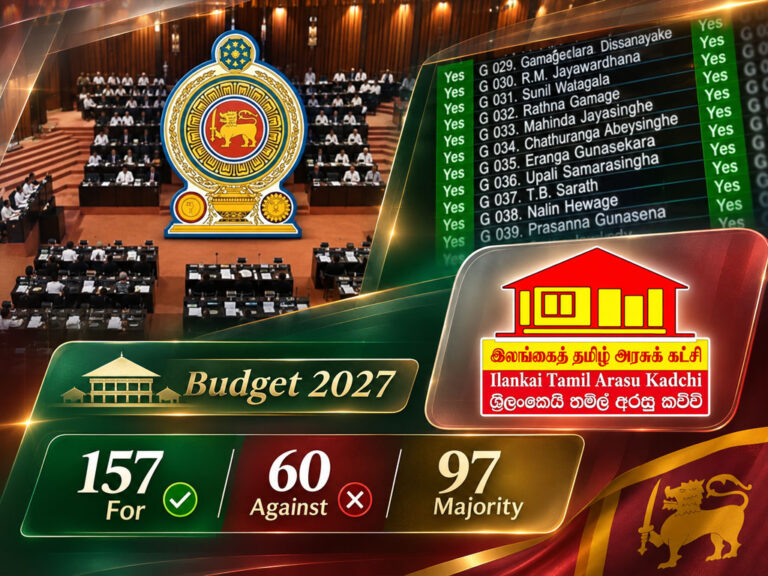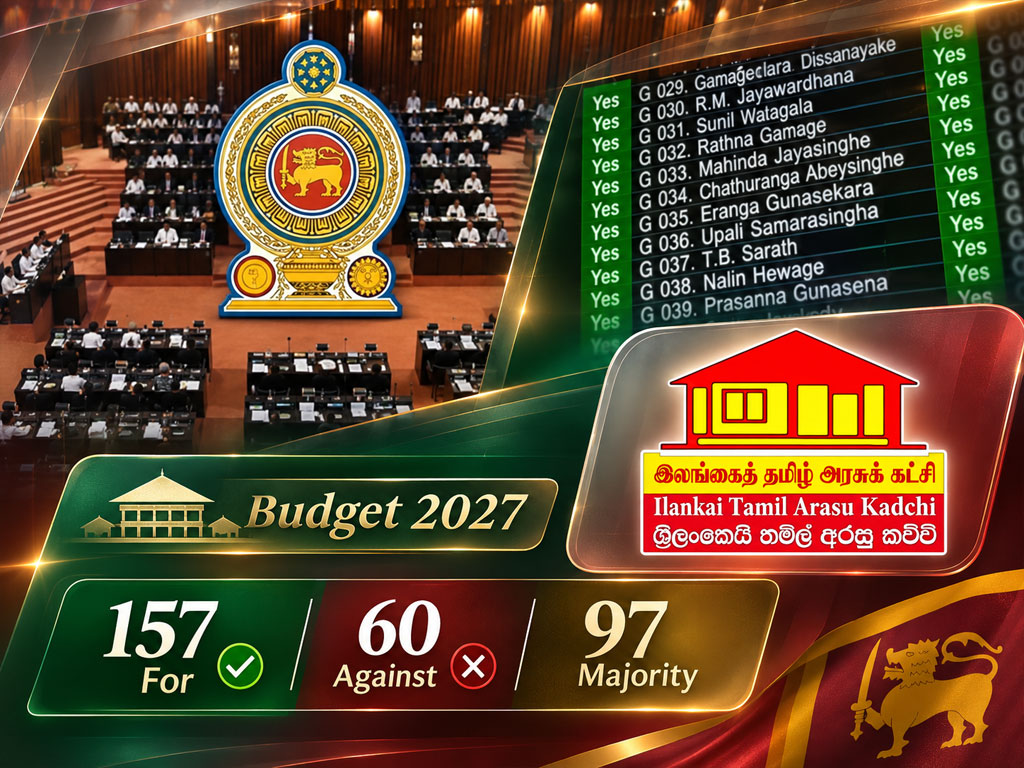
COLOMBO, November 21, 2026 — Sri Lanka’s Parliament approved the second reading of the 2027 Budget by a majority of 97 votes on Friday, November 20, with 157 Members of Parliament voting in favour and 60 against, as the Ilankai Tamil Arasu Kachchi (ITAK) announced its opposition to the government’s financial proposals for the first time since the National People’s Power administration assumed office.
The vote followed seven days of debate on the Appropriation Bill, presented to Parliament on November 12 by President Anura Kumara Dissanayake in his capacity as Minister of Finance.
The division, held at 6.50 p.m., marked the successful completion of the Budget’s second reading, allowing the government to proceed to detailed examination of proposed expenditure during the committee stage.

All 217 Voting MPs Take a Position
According to Parliament’s official announcement, 157 MPs supported the second reading while 60 voted against it, giving the government a comfortable majority.
The recorded figures account for 217 votes, with no abstentions reported among those who participated in the division.
Major opposition parties, including the Samagi Jana Balawegaya (SJB) and Sri Lanka Podujana Peramuna (SLPP), opposed the Budget.
Jaffna District independent MP Ramanathan Archchuna also voted against the proposals, according to the reported voting breakdown.
Although the government’s majority was sufficient to secure passage, the division attracted particular attention because of a change in the position adopted by ITAK.
ITAK Opposes Government Budget for First Time
ITAK’s decision to vote against the 2027 Budget represents a departure from its position on the National People’s Power government’s previous two Budgets.
ITAK Parliamentarian S. Shritharan announced the party’s decision during parliamentary proceedings on November 20, explaining that it had supported the administration’s earlier Budget proposals but would oppose the latest financial programme.
According to Shritharan, the decision reflected dissatisfaction with the government’s response to the aspirations and political concerns of the Tamil people.
Batticaloa District MP Shanakiyan Rasamanickam had also criticised the Budget during the second-reading debate, particularly over its failure to address the Tamil national question.
The party’s decision places its concerns over minority political representation and unresolved national issues within the broader parliamentary debate over government policy.
While an opposition vote on the Budget does not necessarily indicate a change in ITAK’s position on every government proposal, it establishes a clear difference from its earlier approach to the administration’s financial measures.
The decision also adds a political dimension to the Budget proceedings beyond the usual divisions over taxation, public spending and economic priorities.
Committee Stage Begins on November 21
With the second reading approved, Parliament will proceed to the committee-stage debate, during which the proposed expenditure of individual ministries and government institutions will be examined in greater detail.
The committee stage provides MPs with an opportunity to scrutinise allocations, question spending priorities and propose amendments in accordance with parliamentary procedures.
The remaining Budget timetable is as follows:
- Committee-stage debate: November 21 to December 14, 2026, covering 19 sitting days.
- Saturday sittings: Four Saturdays have been allocated to the committee-stage proceedings.
- Final vote: The division on the third reading of the 2027 Appropriation Bill is scheduled for 6.00 p.m. on December 14.
During this period, opposition MPs will have an opportunity to examine how government ministries intend to utilise their proposed allocations and seek explanations for spending commitments.
Final Approval Scheduled for December 14
Passage of the second reading represents parliamentary approval of the Budget’s general principles, but it does not constitute final enactment of the Appropriation Bill.
The government must still complete the committee-stage proceedings and secure approval at the third reading.
Those discussions will determine whether amendments are made to individual expenditure provisions before the Bill reaches its final parliamentary vote.
ITAK’s decision to oppose the Budget, alongside the positions adopted by other opposition groups, will remain part of the political context as scrutiny moves from the government’s overall economic programme to the detailed allocation of public funds.
Parliament is scheduled to conclude the process on December 14, when MPs will cast their final votes on the Appropriation Bill for the 2027 financial year.