Research suggests that even babies can show early signs of deception, while psychologists explain how parents can encourage honesty without undermining their children’s confidence.
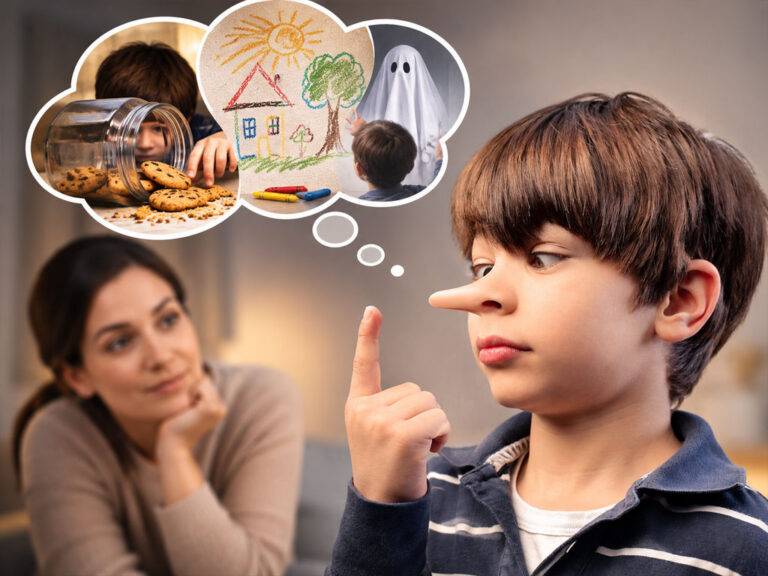
When a drawing mysteriously appears on the living room wall or biscuits disappear from the kitchen tin, a young child may confidently blame the family dog. Others might insist that a ghost was responsible, even with colouring pencils in their hands or biscuit crumbs still on their fingers.
For many parents, discovering that their child has lied can be frustrating or worrying. Yet developmental psychologists suggest that such behaviour is not necessarily a sign of dishonesty becoming a permanent character trait. Instead, learning to deceive can be an important part of a child’s cognitive and social development.
The ability to conceal information, invent explanations or anticipate what another person believes reflects increasingly sophisticated mental processes.
Clinical psychologist Dr. Jade Redfern, speaking on the BBC’s CBeebies Parenting Download podcast, explained that children experiment with deception as they develop and refine their understanding of the world.
“It’s a skill they are developing. It’s something they use repeatedly to develop it further,” she said.
Although deliberate lying requires abilities that very young children are still developing, research indicates that simpler forms of deceptive behaviour can emerge surprisingly early.

Research Suggests Deception Begins Before a Child’s First Birthday
Research led by Professor Elena Hoicka of the University of Bristol found that approximately one-quarter of children demonstrate an understanding or use of basic deceptive behaviour by the age of 10 months.
The findings challenge the assumption that deception begins only when children become old enough to construct convincing verbal explanations.
Early deception may involve hiding objects, pretending not to notice something or concealing an activity from a caregiver.
Hoicka, a mother of three, said observing the increasingly resourceful behaviour of young children was fascinating.
“As a mother of three children, I can definitely testify to how cunningly and tactically children can behave.”
One familiar example involves children hiding beneath a table or retreating to the bathroom to eat sweets or chocolate they have been told not to take.
Such behaviour may appear mischievous, but it can also demonstrate an emerging awareness that parents cannot always see what their children are doing.
By approximately two years of age, children may begin using simple strategies to avoid consequences or unwanted responsibilities.
They might pretend not to hear a parent’s instructions, deny having done something or secretly examine a bag they have been specifically told not to open.
Some may attempt to escape an unpleasant task by claiming they need to use the toilet.
These early strategies become increasingly elaborate as children develop stronger language abilities and a better understanding of how others think.
How Lying Reflects a Child’s Developing Understanding of Others
By around three years of age, children may become more inventive in their explanations and more selective about the information they reveal.
A child involved in an argument with a sibling, for example, might report being hit while conveniently omitting the fact that they struck the first blow.
According to Redfern, these behaviours can reflect the development of an important psychological ability known as theory of mind.
This refers to understanding that other people possess their own thoughts, beliefs, feelings, intentions and knowledge, which may differ from one’s own.
As children develop this awareness, they gradually recognise that another person does not necessarily know everything they know.
That distinction makes deception possible. It also supports important social abilities, including empathy and perspective-taking.
Redfern explained that growing children begin to understand themselves as individuals with separate minds and intentions.
Learning that other people have different thoughts and feelings helps children develop the capacity to consider another person’s experiences.
In other words, some of the cognitive abilities that allow a child to mislead someone also contribute to their ability to understand and respond to others.
This does not mean that lying should be encouraged. Rather, it suggests that the emergence of deception is not automatically evidence of poor character or unsuccessful parenting.
Why Children Sometimes Lie to Protect Themselves
Fear of punishment is not the only reason children conceal the truth.
Many children are deeply concerned about disappointing their parents or damaging the relationships on which they depend for emotional security.
Redfern explained that human behaviour is strongly influenced by relationships and the desire to maintain meaningful connections.
Children depend on their caregivers for protection, reassurance and affection. As they grow, they begin recognising which behaviours attract approval and which may provoke disappointment or anger.
A child who has broken something valuable may therefore invent an explanation not simply to escape punishment, but because admitting responsibility feels threatening to the relationship.
This is why Redfern believes parents should create an environment in which children feel sufficiently secure to acknowledge mistakes.
“We should think about ways we can help children feel safe enough to tell the truth when they’ve done something wrong… they don’t want to disappoint us.”
Such an approach does not require parents to abandon rules or consequences. It involves distinguishing between correcting unacceptable behaviour and responding in ways that make children afraid to speak honestly.
How Parents Can Encourage Children to Tell the Truth
Rachel Duffy, a mother of three and winner of a UK series of the BBC reality programme The Traitors, described how she encourages openness within her family.
She recalled an incident in which her eldest son took his younger brother’s bicycle, went out riding and was struck by a car.
Initially, the boy attempted to give an inaccurate account of what had happened.
Rather than immediately confronting him angrily, Duffy reassured her son that telling the truth would not result in severe punishment.
“I told him, ‘If you tell me the truth, you won’t get into big trouble.’ I stepped aside a little and gave him a small opportunity.”
Her son subsequently admitted what had happened.
“Then he said, ‘Yes, it was me who did it.’ After that he knew it was safe there. We discussed it—no shouting, no crying, no yelling.”
Redfern considers this a constructive example of how parents can respond when children initially conceal the truth.
By remaining calm and offering reassurance, parents can make honesty feel safer than continued deception.
The objective is not to remove accountability, but to help children understand that admitting a mistake does not threaten their relationship with a parent.
Understanding the Difference Between Dishonesty and Social Sensitivity
Not every situation involving an untrue or carefully adjusted statement carries the same moral significance.
Children also encounter social situations in which complete bluntness may hurt another person’s feelings.
For example, a child who receives an unwanted birthday present may eventually learn to express appreciation without openly criticising the gift.
Similarly, children may make unexpectedly frank observations about another person’s appearance.
Redfern recalled that her own children recently delighted in pointing out that she had developed numerous wrinkles.
Rather than responding defensively, she described approaching their observations with curiosity.
Such exchanges can become opportunities to explain that words affect other people and that sensitivity is an important part of communication.
Duffy likewise emphasised the value of open conversations as children become older.
Repeatedly demonstrating kindness, sensitivity and honesty gives children practical examples of how to balance truthful communication with consideration for others.
The distinction is important: understanding why someone might conceal an uncomfortable truth is different from teaching children that dishonesty is always acceptable.
The Importance of Trust in Raising Honest Children
The research and experiences discussed by Hoicka, Redfern and Duffy point towards a broader understanding of childhood behaviour.
Deception can emerge alongside developing language, memory, self-awareness and the ability to understand other people’s perspectives.
Nevertheless, possessing the ability to lie does not mean that a child should be encouraged to use it without limits.
Parents play an important role in helping children distinguish between imagination, playful pretence, attempts to avoid responsibility and deliberate dishonesty.
A supportive response to a child’s mistake can reinforce both honesty and accountability, particularly when parents explain the consequences of the behaviour without resorting to humiliation or excessive anger.
Above all, experts emphasise the importance of maintaining trust.
When children know they can acknowledge mistakes, discuss difficult experiences and tell uncomfortable truths without losing their parents’ affection, they have a stronger foundation for developing responsible and honest behaviour.
The lesson for parents is therefore not that lying is desirable, but that its appearance can be part of normal development. What matters most is how adults respond and whether children learn that telling the truth is both worthwhile and emotionally safe.