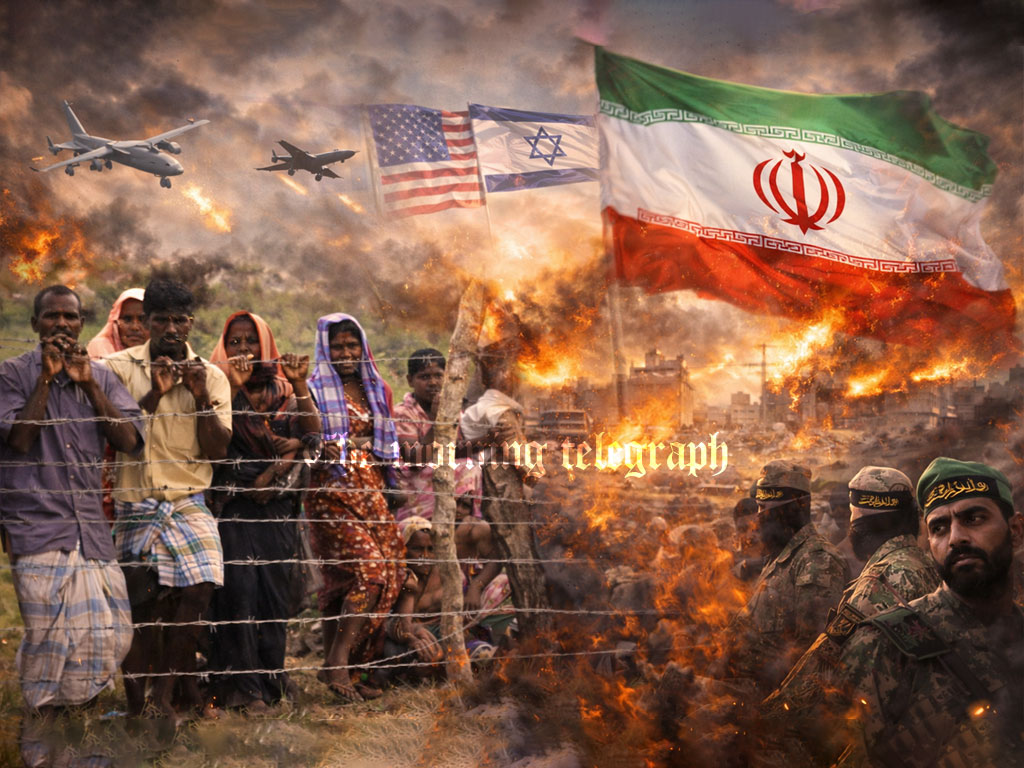
A Sri Lankan political scholar warns that the growing United States and Israel pressure on Iran carries echoes of the isolation that preceded the defeat of the Eelam Tamils in 2009, raising urgent questions about geopolitics, alliances, and the lessons of history.
Iran has been facing sustained geopolitical and military pressure from the United States and Israel in recent days, triggering concerns about a possible escalation into a wider conflict. Professor K.T. Ganeshalingam, Head of the Department of Political Science at the University of Jaffna, believes that the current crisis carries troubling similarities to the final phase of Sri Lanka’s civil war in 2009. According to the academic, the situation highlights how international isolation can determine the fate of vulnerable communities and states.

Writing in the publication Yarl Thinakkural, Professor Ganeshalingam explains that during the closing stages of the Sri Lankan civil war the Eelam Tamil population was effectively cut off from international support. Without meaningful intervention from major global powers, the Tamil movement faced overwhelming military pressure from the Sri Lankan state.
The professor also reminds readers that international politics is rarely straightforward. He notes that Iran itself had previously provided certain forms of military assistance to the Sri Lankan government during the war years. That historical detail, he argues, reflects the complicated nature of global alliances and the shifting interests of states in international conflict.
According to Ganeshalingam, the destruction of the Eelam Tamil movement in 2009 was largely possible because no powerful country stepped forward to intervene. Major global actors including the United States, Israel, Russia, China, India, and Pakistan either supported the Sri Lankan government or remained silent during the final military offensive. Without allies or diplomatic protection, the Tamil population was left exposed to the decisive military campaign that ended the war.
The professor also criticizes the internal weaknesses of Tamil political leadership. Even more than a decade after the war, he argues that there has been no serious collective examination of why the movement ultimately collapsed. He observes that organized resistance in the North and East of Sri Lanka weakened during the final stages of the conflict, while Tamil political groups struggled to maintain strong international diplomatic relationships.
In contrast, the professor says Iran currently occupies a different geopolitical position. Unlike the Tamils in 2009, Iran retains strategic partnerships with major powers such as Russia and China. Its standing within international institutions including the United Nations system also provides a degree of diplomatic leverage.
Still, Ganeshalingam warns that the unfolding crisis demonstrates the continuing importance of unified national leadership, strategic planning, and international alliances. For small states and vulnerable communities, isolation in global politics can carry devastating consequences.