A deepening political storm grips Sri Lanka as a historic financial blunder raises urgent questions on accountability, governance, and whether top resignations are now inevitable.
Political uncertainty in Sri Lanka appears to be intensifying, with growing speculation that the fallout from the recent Treasury controversy could extend far beyond a single ministry. The unfolding crisis has revived historical comparisons and triggered a broader debate about leadership, administrative competence, and accountability within the country’s financial institutions.

When Chandrika Bandaranaike Kumaratunga assumed power in 1994 and appointed A.S. Jayawardena as Secretary to the Ministry of Finance, it sparked significant unrest within her own administration. Jayawardena, who had begun his career as a junior executive officer at the Central Bank, was at that time serving as Secretary to Prime Minister Ranil Wickremesinghe’s Ministry of Industries. Critics within the government alleged that he was aligned with Ranil and could act as a destabilizing influence. However, Chandrika chose to ignore those accusations. Lacking administrative experience herself, she prioritized competence and integrity over political suspicion, ultimately appointing a seasoned and respected official to the role.
Her decision aligned with a long-standing tradition in Sri Lanka’s governance. Since independence in 1948, the position of Secretary to the Ministry of Finance had consistently been entrusted to the most senior and experienced individuals within the administrative service. Successive governments followed this model, selecting either top-ranking administrative officers or highly experienced Central Bank professionals with strong economic expertise.
This precedent began to shift in 2002 when Ranil Wickremesinghe appointed Charitha Ratwatte, a close associate and UNP Chairman, as Finance Ministry Secretary. Despite concerns, Ratwatte brought considerable administrative experience, having held key roles such as Chairman of the Youth Services Council and Permanent Secretary to the Ministry of Youth Affairs. During his tenure, he played a crucial role in stabilizing a deficit-ridden economy and steering it toward fiscal balance.
Even during Mahinda Rajapaksa’s presidency, the importance of expertise in the Finance Ministry remained evident. He appointed P.B. Jayasundera, a veteran Central Bank official, to the position. Despite criticism from political allies who accused Jayasundera of being aligned with international financial institutions, Mahinda retained him, recognizing his deep understanding of the financial system.
The Maithripala Sirisena and Ranil Wickremesinghe administration in 2015 continued this tradition by appointing Dr. R.M.S. Samaratunga, an experienced administrative officer with a strong background in economic governance. Similarly, in 2019, Gotabaya Rajapaksa appointed S.R. Attygalle, a former Deputy Governor of the Central Bank with nearly three decades of experience. Following the economic collapse, Mahinda Siriwardena, another seasoned Central Bank official, took over the role, reflecting the continued reliance on expertise during times of crisis.
When Ranil Wickremesinghe later assumed the presidency in 2022, he chose to retain Siriwardena, maintaining continuity during a critical phase of economic recovery. Likewise, when Anura Kumara Dissanayake became President in 2024, he initially refrained from making changes to the position, despite internal pressure. Recognizing his own lack of administrative experience and the fragility of the IMF programme, he opted for stability.
However, a significant shift occurred following Siriwardena’s retirement. President Anura appointed Harshana Suriyapperuma, a figure from the private sector and a representative of the JVP, as Secretary to the Ministry of Finance. Unlike his predecessors, Suriyapperuma did not emerge from the administrative service or the Central Bank. His experience included serving as a Director of the Securities and Exchange Commission and playing a prominent role in the 2024 presidential election campaign.
His appointment marked a historic departure from established norms. He had entered Parliament through the national list and briefly served as Deputy Minister of Finance before resigning to assume the Secretary position. This transition represented the first time in Sri Lanka’s history that a sitting Member of Parliament stepped down to take up the role of Finance Ministry Secretary.
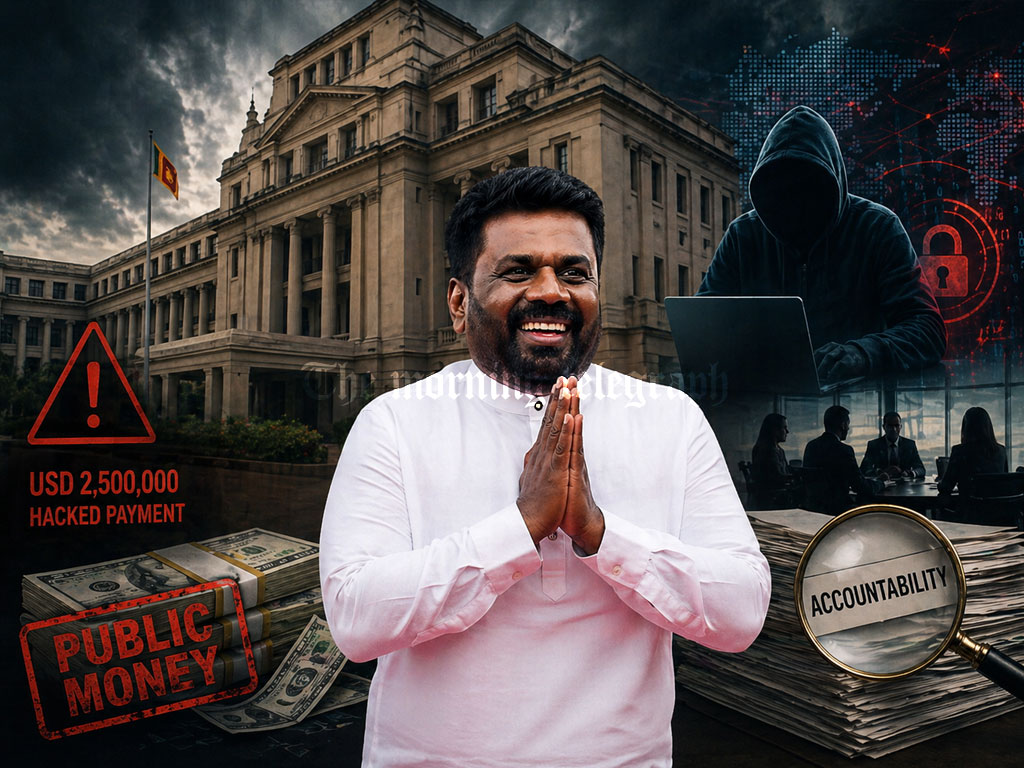
Amid this backdrop, the recent Treasury incident has intensified scrutiny. A payment of USD 2.5 million intended for an Australian creditor reportedly ended up in the hands of hackers. This unprecedented breach is widely regarded as one of the most serious financial errors in the country’s history. For a nation already navigating bankruptcy and debt restructuring under international oversight, the incident has raised serious concerns about financial governance, cybersecurity vulnerabilities, and institutional accountability.
The implications extend beyond financial loss. The funds involved belong to taxpayers, making the incident not just a technical failure but a public trust issue. Analysts warn that such lapses could damage Sri Lanka’s credibility with international lenders and investors at a time when restoring confidence is critical.
Comparisons have been drawn with the 2016 Bangladesh Central Bank cyber heist, where hackers siphoned funds from foreign reserves. In that case, swift action was taken, including the resignation of the Central Bank Governor, signaling accountability at the highest level. The Bangladesh government treated the incident as a national embarrassment and moved decisively to address it.
In Sri Lanka’s current situation, the breach has occurred within the Ministry of Finance itself, raising even more pressing questions. Observers are now closely watching how the government will respond and whether similar standards of accountability will be applied.
The central question dominating public discourse is whether responsibility will be acknowledged at the highest levels. Will Finance Minister Anura Kumara Dissanayake demand accountability from Secretary Harshana Suriyapperuma, or will the issue be managed through internal adjustments?
As the political climate grows increasingly tense, the Treasury controversy has evolved into a defining moment for governance in Sri Lanka. It has exposed deeper structural issues, from appointment practices to institutional oversight, and has reignited debates about the balance between political loyalty and professional competence.
For now, the nation remains in a state of anticipation. The coming days may determine not only the fate of key officials but also the broader direction of Sri Lanka’s economic governance and political stability.