
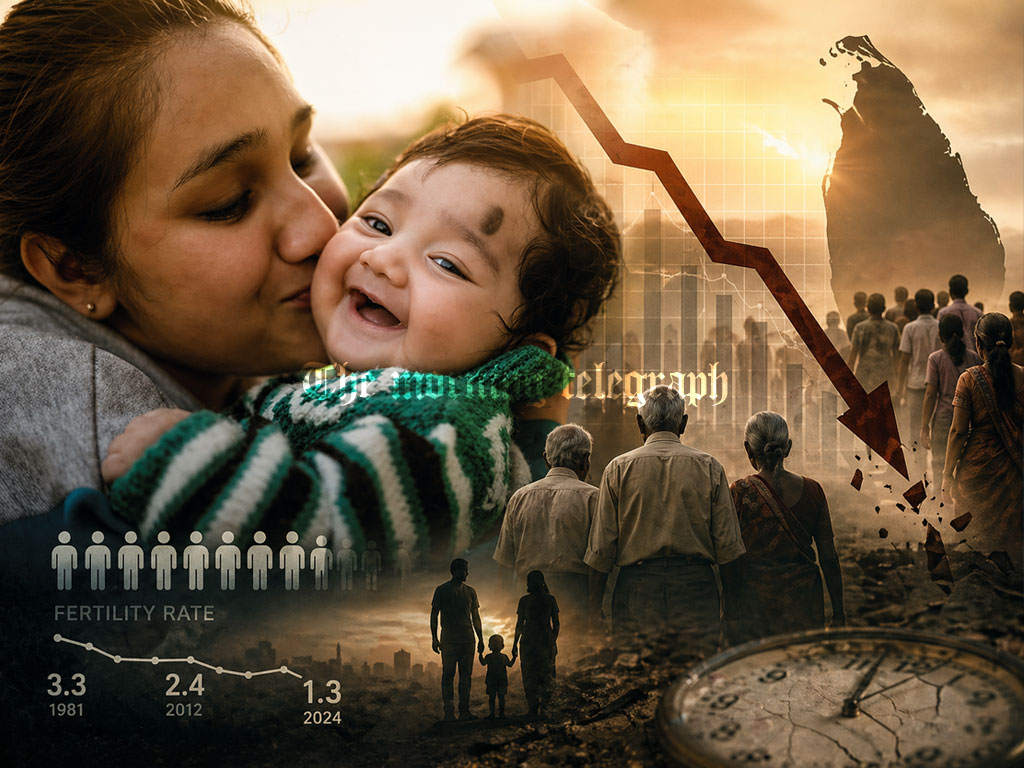
A sharp decline in Sri Lanka’s fertility rate is raising alarm bells among experts, with long-term consequences looming over the economy, workforce, and ageing population dynamics.
According to the final report of the 2024 Census of Population and Housing, new data has revealed critical insights into the steady decline in Sri Lanka’s live birth rate, highlighting a major demographic shift that could reshape the country’s future.
The report states that among women aged 15 years and above who have ever been married, 10.6 percent have not had a live birth. A significant portion of married Sri Lankan women, 33.3 percent, have had only two live births throughout their lifetime. In contrast, women living in the estate sector show a different pattern, with the highest proportion having given birth to three children.

However, the same report indicates that 12 percent of ever married women in the estate sector have had no live births at all. Meanwhile, the urban sector records the highest percentage of women with only one child, standing at 21.3 percent, reflecting shifting family preferences and lifestyle choices in cities.
According to census data, out of every 100 married women in the estate sector, 45.4 have given birth to three or more children, while in the rural sector the figure stands at 37.8. In comparison, the urban sector records 31.8 women out of 100 having three or more children, pointing to a clear divide between regions in fertility trends.
The report further highlights that the total fertility rate among married women aged 15 years and above at the time of the census has dropped to 1.3, a sharp decline compared to 3.3 in 1981 and 2.4 in 2012. This significant reduction signals a long-term demographic transformation with wide-ranging socio-economic implications.
“We Are Still Analysing This Trend as Demographers”
Demography experts stress that the decline in Sri Lanka’s birth rate requires deeper analysis and careful interpretation, especially given the unique circumstances surrounding the timing of the census.
Professor Manori Kalutanthri Weerathunga, Chair of the Department of Demography at the University of Colombo and President of the Association of Demographers, explained that the fertility trends revealed by the census are still under detailed study.
She noted that the data clearly shows a rapid decline in births, with the marital fertility rate recorded at 2.7 and the overall fertility rate falling sharply to 1.3. According to standard demographic benchmarks, such a drop represents a substantial shift that cannot be ignored.
The Professor further pointed out that the census was conducted during a period marked by unusual national conditions, including the aftermath of the COVID-19 pandemic, the economic crisis, and other social disruptions. These factors may have influenced individual decisions about marriage and childbirth.
She explained that during such periods of uncertainty, people tend to delay major life decisions, including starting families. The economic downturn also led to a surge in youth migration, particularly among individuals in their prime reproductive years, directly impacting fertility levels.
Changes in social attitudes have also played a role. Younger generations are increasingly postponing marriage and delaying childbirth due to financial pressures, career priorities, and evolving lifestyle preferences. As a result, fertility intentions, interest in parenthood, and long-term family planning decisions have become more uncertain and fluid.
Professor Weerathunga emphasised that fertility trends are closely tied to a relatively small age group between 15 and 49, meaning that shifts within this group can have a disproportionately large impact on overall population patterns. She noted that while older generations have already reached their desired family size, the decline is being driven largely by those entering childbearing age today.
She added that Sri Lanka remains in a stage where detailed analysis is ongoing, with experts examining global trends and comparing local data with experiences from other countries facing similar demographic transitions.
Impact of a Rapidly Ageing Population
Another major concern highlighted by experts is the growing proportion of elderly citizens in Sri Lanka, which is closely linked to declining birth rates.
According to census data, the population aged over 60 years has increased from 12 percent in 2012 to 18 percent in 2024, representing a significant demographic shift. This increase is largely due to earlier periods of high birth rates, with those generations now moving into older age groups.
In addition, rising life expectancy has contributed to this trend, as people are living longer due to improvements in healthcare and living standards. At the same time, the decline in births has reduced the proportion of younger populations, making the elderly demographic more prominent.
Experts warn that this shift could place increased pressure on social welfare systems, healthcare infrastructure, and pension schemes, while also reducing the size of the active workforce.
“The Population Must Be Used Effectively for Growth”
Despite the challenges posed by declining fertility and an ageing population, experts believe that Sri Lanka still has an opportunity to adapt and leverage its demographic structure for economic development.
Professor Weerathunga pointed out that while a shrinking population may reduce the available labour force, it also presents an opportunity to improve productivity and efficiency. The focus, she noted, should be on maximising the potential of the existing workforce through education, skills development, and technological advancement.
She stressed that in a modern, digitally driven economy, a smaller but highly skilled and efficient workforce can still sustain economic growth and innovation. Strategic investment in human capital, combined with policy reforms, can help offset the negative impacts of population decline.
In conclusion, Sri Lanka’s declining birth rate represents a critical turning point in the country’s demographic journey. While the immediate effects may not be fully visible, the long-term implications for economic stability, labour markets, and social structures are profound.
The challenge now lies in understanding the underlying causes, adapting policies accordingly, and ensuring that the country is prepared to navigate the realities of a changing population landscape. If managed effectively, this transition could become an opportunity rather than a crisis.




Sri Lanka has a massive infertility problem among both men and women in the country and my take on the cause being the consumption of processesd foods most of which are pure chemicals or Lab produce, there is no natural substance in those foods resulting in the alteration of Human Body Chemistry. Some of the ingredients which are banned in most other countries are used in Food products in Sri Lanka and they are known to cause infertility or Cancer in Humans as a result of Long Term Consumption.
The Government should step in to demand that Manufacturers or Importers of these type of foods clearly print on the packaging the ingredients and additives included in such foods if we are to rectify the damage already caused to society instead of Politicians lining their pockets with ill gotten gains from these vendors.