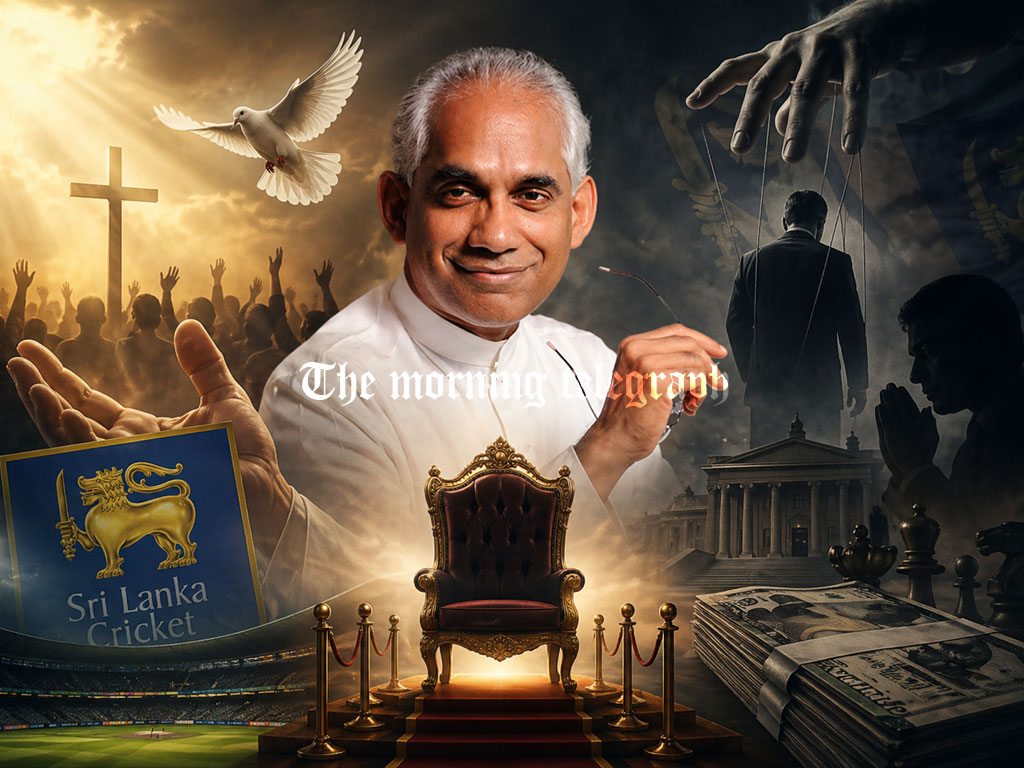
As Eran Wickramaratne emerges as a contender for Sri Lanka Cricket’s top post, questions swirl around faith, power, and purpose, is this a divine calling or a controversial rise shaped by politics and perception?
In a country where religious figures from multiple faiths have recently made headlines for all the wrong reasons, the possible rise of Eran Wickramaratne to one of the most powerful positions in Sri Lankan sport adds yet another layer to an already complex national narrative.
From 22 Buddhist monks who were arrested and remanded over serious allegations of smuggling drugs worth over Rs 1 billion a couple of days ago, to self-proclaimed prophets drawing criticism for prosperity-focused preaching, the intersection of faith and power in Sri Lanka is under intense scrutiny. It is within this backdrop that Wickramaratne, a son of a pioneering figure who helped introduce Pentecostal-style Christian worship to Sri Lanka over five decades ago, now finds himself at the center of a different kind of spotlight.

A Sudden Rise That Raises Questions
Wickramaratne’s potential move toward the presidency of Sri Lanka Cricket has sparked widespread debate. Social media discourse has been particularly intense, with claims, unverified but persistent, suggesting that elements within a “Born Again” movement, allegedly aligned with the ruling NPP, may be quietly backing his emergence, despite his position within the opposition.
Whether these claims hold truth or not, they reveal something deeper: a growing unease about how influence is exercised in Sri Lanka, not just in politics, but now in sport.
Divine Calling or Borrowed Authority?
Among sections of the Christian community itself, the narrative is far from unified.
Some view Wickramaratne’s rise as divinely inspired, a calling into leadership at a crucial time. Others, however, interpret it through a far more cautionary lens, drawing parallels to the story of Cain and Abel, where questions of inheritance, favor, and moral standing shaped one of the earliest conflicts in scripture.
Is this, they ask, a moment of anointing, or something that resembles a “stolen birthright”?
The Bible offers a sobering reminder in Exodus 20: “Thou shalt not steal.”
But beyond material theft lies a deeper question, can authority itself be taken rather than given?
The Weight of Public Perception
Wickramaratne has long been regarded as a disciplined and principled figure in Sri Lankan politics. Yet, like many in public life, he has not been immune to criticism. Claims that have circulated in the public domain have questioned whether he, during his time in Parliament, benefited from duty-free vehicle permits and subsequently disposed of them to third parties for significant financial gain.
While such claims, their persistence continues to shape public perception, especially at a time when trust in leadership is already fragile.
And in today’s climate, perception often travels faster, and settles deeper, than proven fact.
Faith, Power, and Responsibility
The deeper question, however, is not about one man alone.
It is about the relationship between faith and power.
Scripture repeatedly warns of the dangers of worldly ambition. In Matthew 16:26, the question is asked:
“What good will it be for someone to gain the whole world, yet forfeit their soul?”
Leadership, whether in politics, sport, or religion, is not merely about position. It is about purpose. It is about stewardship. And ultimately, it is about accountability, not just to people, but to a higher calling.
A Judgment Beyond This World
As the debate intensifies, it is important to recognize a fundamental truth: the final judgment of any individual does not belong to public opinion.
It lies beyond.
As written in Romans 14:12:
“So then, each of us will give an account of ourselves to God.”
Whether Wickramaratne’s rise is seen as a divine appointment or questioned as a contested ascent, the responsibility, and the consequences, rest ultimately with him.
The Question That Remains
In a nation already wrestling with issues of governance, integrity, and truth, this moment is about more than a single appointment.
It is about what Sri Lanka chooses to believe.
Is leadership granted or taken?
Is influence earned or orchestrated?
Is this faith in action or power in disguise?
And perhaps most importantly:
Is this a divine appointment or a stolen birthright?