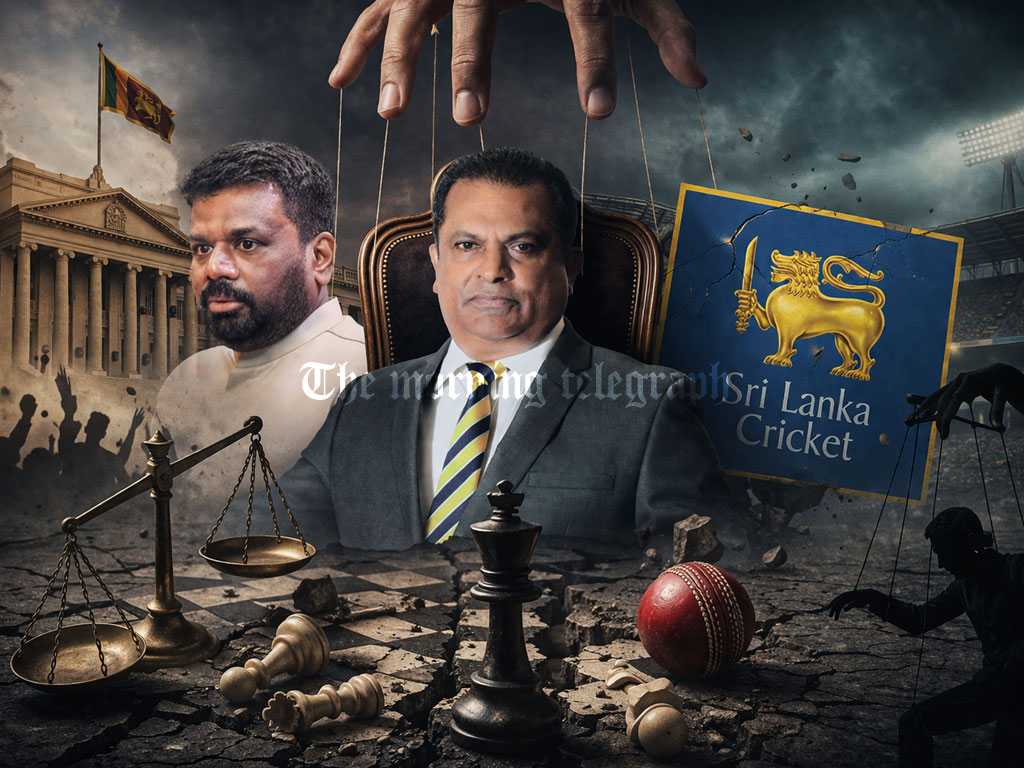
As pressure mounts on Shammi Silva to step down from Sri Lanka Cricket, questions intensify over whether this is genuine reform or political thuggery exercised in its finest form.
At this moment, the country appears consumed by a single obsession, the removal of Sri Lanka Cricket President Shammi Silva. Everything else seems to fade into the background. The very political force that swept into power with a commanding mandate, promising the long-awaited “system change” Sri Lankans have yearned for since independence in 1948, now presides over a nation grappling with deepening crises. Fuel prices surge. Gas costs climb. The coal tender controversy lingers. The scandal of 323 containers allegedly released without customs clearance raises alarm. The cost of living tightens its grip, while financial irregularities and banking concerns continue to surface.

And yet, the recurring refrain in public discourse appears almost absurd in its simplicity: remove Shammi Silva.
If that is the cure for every national ailment, then it raises a far more uncomfortable question. Should the same logic not apply across the board? If accountability demands the removal of a democratically elected cricket administrator for failures attributed to his tenure, then what of those entrusted with governing the entire country? If we are to make a true like-for-like comparison, an apples-to-apples measure of responsibility, can one justify holding one man to account while absolving another, whose decisions impact millions far beyond the boundary ropes?
In that contradiction lies the real crisis, not of cricket, but of consistency, fairness, and the very meaning of accountability itself. Reports, still unconfirmed but widely circulated, suggest that Sri Lanka Cricket President Shammi Silva has been informally asked to step down, allegedly at the behest of President Anura Kumara Dissanayake.
A Nation Reacts Before the Facts Emerge
No official statement has been issued. No formal directive has been acknowledged. Yet, the entire country is already reacting, as though the verdict has been delivered.
And that, perhaps, is where the real story begins.
Applause vs Anxiety: A Country Divided
On one side, there is applause. A section of the public views this as a bold, decisive move, long overdue in an institution often accused of mismanagement and stagnation. For years, Sri Lanka Cricket has been an easy target whenever the national team falters.
But on the other side lies a quieter, more unsettling question.
Justice or Political Thuggery in Disguise?
Are we witnessing justice or political thuggery exercised in its finest form?
Shammi Silva, for all the allegations that surround him, remains a democratically elected official. He has not been convicted in a court of law. Yet, the momentum to remove him appears to be building not through transparent due process, but through pressure, political, social, and possibly coordinated.
The ICC Factor: Risk of Global Isolation
There is also the looming shadow of the International Cricket Council. Sri Lanka has faced suspension before. Any perception of government interference in cricket administration could once again invite sanctions, isolating the nation from the global game. This is why, some suggest, any resignation may be framed as “personal”, a convenient label to mask a far more complex reality.
Why Now? Timing Raises More Questions Than Answers
But step back for a moment.
With only months remaining in the current administration’s term, what urgency justifies such a dramatic move? Is this truly about reform or about control?
Who Really Holds the Power Behind the Scenes?
Unconfirmed reports hint at a convergence of powerful interests, politicians, former cricketers, media forces, and even religious groups aligning behind the push for change. If true, it raises a deeper concern: when multiple centers of influence unite to remove one individual, is it accountability or consolidation of power?
The Blame Game: Players vs Administrators
And then there is the uncomfortable truth that fans rarely confront.
When Sri Lanka wins, the players are heroes.
When Sri Lanka loses, the administrators are villains.
It is a convenient narrative but an incomplete one.
The Hidden Role of the Sports Ministry
The governance of cricket in Sri Lanka is not confined to the boardroom. The Ministry of Sports plays a direct role in shaping the national team, including the appointment and approval of selectors. Responsibility is shared, yet blame is often selectively assigned.
Whispers of Match-Fixing and Systemic Rot
More troubling are the whispers that refuse to fade.
Allegations of match-fixing, questionable selections, and undue influence continue to circulate. Of particular concern is the widely discussed role of a player manager connected to at least eight national cricketers, who has consistently seen a significant number of his clients, often as many as five who feature in playing elevens. This pattern has raised serious red flags within Sri Lanka Cricket, especially in the context of ongoing concerns around spot-fixing and match-fixing.
It is understood that these matters have been taken seriously at administrative level, with increased scrutiny and internal corrective efforts. However, such actions have reportedly not gone down well with certain players and associated stakeholders. Several of these cricketers are also believed to have fallen short of required fitness standards and, as a result, were not granted release letters to participate in overseas franchise leagues.
In this backdrop, there are indications that some among this group may have escalated their grievances beyond the sport, approaching government authorities with complaints against the SLC President and calling for his removal. If true, this adds a new and complex layer to the unfolding situation, one that raises questions about whether the push for change is driven purely by reform, or influenced by competing interests within the game itself.
Removing a Man vs Fixing a System
And so, the debate sharpens.
If the issues run deeper than individuals, then focusing solely on one figure risks ignoring the structural flaws that continue to undermine Sri Lankan cricket.
A Dangerous Precedent for Governance
If Shammi Silva is to be removed under pressure despite being democratically elected, what precedent does that set? Can the same standard be applied to political leadership?
One Rule for Cricket, Another for the Country?
Sri Lanka today faces rising living costs, economic strain, and widespread hardship. These realities are shaped not by cricket administrators but by those in national office.
Selective Justice or National Hypocrisy?
So the question becomes unavoidable:
Are we applying one standard to sport and another to the state?
Because accountability, if it is to mean anything, cannot be selective. It must be consistent, fair, and grounded in truth, not pressure, perception, or convenience.
The Bigger Question Sri Lanka Must Answer
Until then, every “resignation” will carry doubt. Every “reform” will invite suspicion.
And every such moment will force the nation to ask:
Is this justice or just another innings in Sri Lanka’s long and complicated game of power?