
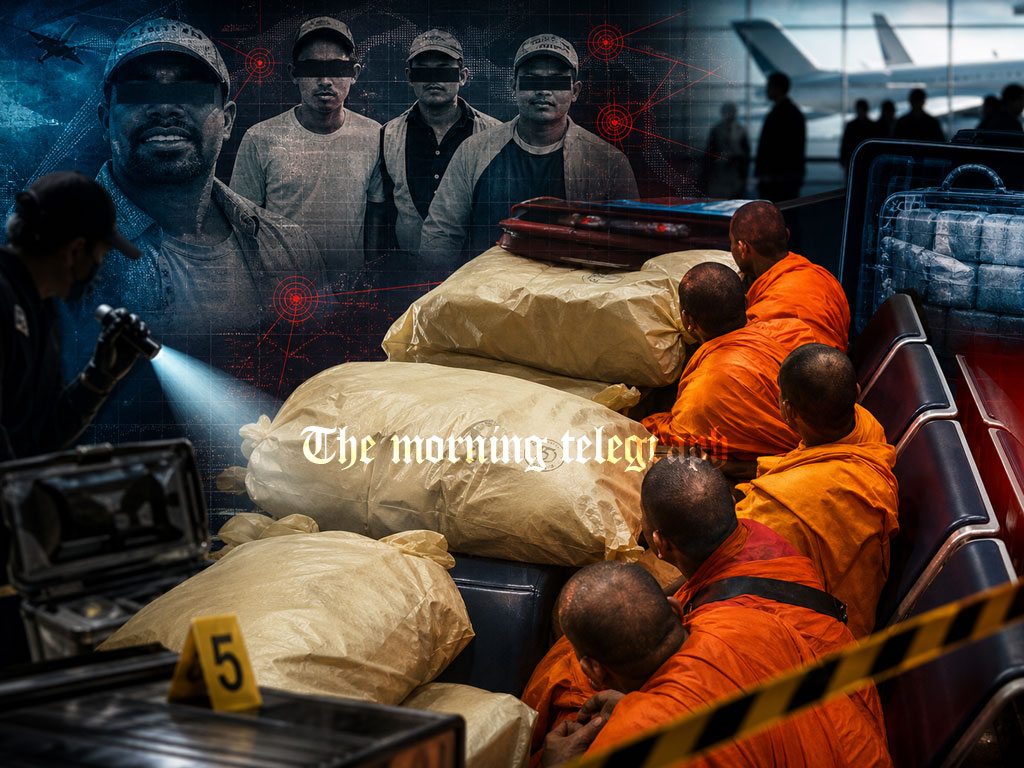
Drug trafficking monks arrested at Katunayake reveal how 112kg of Kush and Hashish were allegedly moved through a Thailand pilgrimage.
The drug trafficking monks scandal has shaken Sri Lanka after 22 monks arriving from Bangkok were arrested at Katunayake Airport with 112 kilograms of Kush and Hashish hidden inside suitcases.
The incident has triggered shock, anger, and sorrow among Buddhists and the wider Sri Lankan public, especially as it unfolded during a period when another chapter of the global peace walk known as ‘Ehipassiko’ was taking place inside Sri Lanka.

That peace walk was part of a global pilgrimage undertaken by foreign Buddhist monks, including Vietnamese monk Pannakara Thero, accompanied by a dog named Aloka, across countries such as India and America to promote world peace, harmony, and humanity.
While that foreign Buddhist monk group was engaged in what was described as a great meritorious act, praying for world peace through Buddhist philosophy, a separate group of 22 Sri Lankan monks had been taken to Bangkok, Thailand on the 22nd, allegedly for religious, educational, and international exposure.
The group that organized the trip had provided free air tickets, accommodation, and all facilities. After spending about three days in Thailand, the monks arrived at Katunayake Airport at around 10:15 p.m. on the 25th on Thai Air Asia flight FD 140 from Bangkok.
All 22 monks arrived at Katunayake Airport pushing 22 suitcases of the same type.
Due to Thailand’s recently relaxed drug policies, customs officials and Police Narcotics Bureau officers at Katunayake Airport had been extremely alert. Officers were closely watching passengers and luggage arriving from Thailand when the breakthrough information reached them.
A few hours before the flight arrived in Sri Lanka, a Police Narcotics Bureau officer stationed at the airport had received reliable information from an informant.
The informant had told the officer: “Sir… a flight is coming to Katunayake from Bangkok tonight… 22 monks are arriving on it… they are bringing 22 black and blue travelling bags of the same type… there are drugs in those bags… stay alert.”
The informant had also provided several other details about the flight and the monks who were due to arrive. Acting on that information, narcotics officers remained under surveillance until the flight landed.
After the 22 monks placed their luggage on the belt, narcotics officers took possession of the bags at the arrivals baggage hall. The monks then questioned why police were taking their luggage.
The officer in charge of the airport Police Narcotics Unit, a sub-inspector, then told them: “Venerable Sirs… we received information… that there are drugs inside these 22 bags… we need to check all 22 bags.”
The 22 bags were first referred to customs officials to check whether there were any dutiable goods. Narcotics officers then began inspecting the bags.
At first, officers found toffees, chocolates, sweets, soaps, shampoos, razors, toothpaste, and stationery inside. However, as the inspection continued, officers noticed changes in the behaviour of the monks.
When the narcotics officers carefully cut open the false bottoms crafted into the suitcases, they discovered approximately 112 kilograms of Kush and Hashish hidden inside secret compartments.
The seizure included approximately 101 kilograms and grams of Kush and 10 kilograms and 500 grams of Hashish.
According to calculations made by narcotics officers, the total value of the drug haul exceeded Rs. 1.12 billion, or 112 crore.
This seizure of 112 kilograms of drugs at Katunayake Airport is considered the largest in history and the first time a group of monks has been arrested with drugs.
When narcotics officers questioned the monks, it was revealed that the 22 suitcases had allegedly been ordered to be brought to the hotel where the monks were staying by a monk named Mahanamathilaka, who had led and organized the pilgrimage.
The monks told officers: “Sir… it was Most Venerable Mahanamathilaka who called and ordered these bags to the hotel where we stayed… these items were brought to give to children in poor schools in our country and to monks in poor temples… they also told us that when the bags were brought to Sri Lanka, Ven. Amithananda would come to the airport and take delivery… they also advised us never to open these bags under any circumstances…”
Further questioning by narcotics officers revealed another suspicious detail. Due to the weight of the suitcases, the monks had reportedly been forced to reopen them at Bangkok airport and remove some items.
Narcotics officers believed that because Kush and Hashish can emit a noticeable smell, all the monks must have known about the drugs in the bags unless they were unfamiliar with the odour.
At that point, according to the account, the three monks who organized the pilgrimage, including Mahanamathilaka, had told the others: “Don’t be afraid, Venerable Sirs… generally, bags carried by monks are not checked much at Katunayake… so don’t be afraid of anything…”
However, the meticulous raid based on information received by an airport narcotics officer turned the entire operation upside down.
The incident has now created a situation that many believe has brought deep disgrace to the Buddhist faith through the conduct of the ordained monks involved.
Questioning also revealed that three of the 22 monks had travelled to Thailand last March with another group of 22 monks and had allegedly brought back drugs in the same manner.
Accordingly, the three monks previously identified as having gone to Thailand were Piyandala, Madapatha, and Jamburaliya Punyavardanaramaya’s Dematara Mahanamathilaka, Ranalde Gnanasiha, and Ritigahawatta Seelarathna.
The narcotics officers then moved quickly to arrest a monk named Agunukole Amithananda, who, according to the arrested monks, had arrived at the airport with a van to take delivery of the 22 parcels brought from Thailand.
However, after the parcels were intercepted by narcotics officers, Amithananda fled from the airport.
Officers of the Police Narcotics Bureau later went to the Kadawatha, Rammuthugala Sri Punyalankara Purana Temple where Amithananda had been residing. He was not there.
Meanwhile, Deputy Inspector General of Police in charge of the Police Narcotics Bureau, Ashoka Dharmasena, received information that Amithananda was hiding at the Ipilikantha Meditation Centre in Meegahawatta, Gampaha, where he had lived around seven years earlier.
Narcotics officers who went to that meditation centre arrested Amithananda on the morning of the 26th.
It was also revealed that the monks did not know each other before the trip and had become acquainted only during the journey.
When officers examined the mobile phones of the arrested monks, they were reportedly shocked by the videos and photographs found inside.
An officer who took part in the raid said: “The phones of all those monks contained not only photographs taken during the three days in Thailand but also photographs taken in Sri Lanka… among those photos were many that were inappropriate for ordained monks. Photographs of them removing their robes and wearing ordinary civilian clothes… wearing hats. Also, photographs of some smoking cigarettes and using drugs while still wearing their robes, and screen shots of video calls with nuns behaving inappropriately.”
The 22 monks had allegedly spent their three days in Thailand sightseeing on tourist paradise islands such as Phuket, behaving like laypeople, recording videos and photographs, and sending those videos and photographs to friendly monks in Sri Lanka.
After the 22 monks were arrested, those videos and photographs began circulating on social media, reportedly released by those same friendly monks.
The three monks, including Mahanamathilaka of Jamburaliya, had reportedly gathered monks for the Thailand trip through Facebook, presenting it as an educational, religious, and international experience.
They then created a WhatsApp group with monks they contacted through social media.
Agunukole Amithananda of Kadawatha, Rammuthugala Temple, had come forward to provide free air tickets, accommodation, and all necessities for the trip. He had also acted as the admin of the WhatsApp group.
That monk has now been revealed as the main monk allegedly involved in using monks to bring drugs from Thailand to Sri Lanka.
Initially, Amithananda remained silent when questioned by investigators. However, when he realized there was no escape, he later revealed to narcotics officers that he had brought drugs from Thailand through monks on two previous occasions and had delivered those drugs to a house in Athurugiriya.
Accordingly, on March 20, a group of 12 monks, including Mahanamathilaka, who was also part of the latest trip, had gone to Thailand and allegedly brought back drugs.
Furthermore, the four monks, including Amithananda and Mahanamathilaka, had reportedly been planning to continue bringing drugs by organizing another trip for around 40 more monks within this month.
Questioning also revealed that the drugs had been supplied by two monks living in Thailand and a Muslim individual.
Based on information revealed during questioning of the main monks allegedly involved in the drug trafficking network, including Amithananda, investigators began searching for the house in Athurugiriya where drugs had been delivered in March.
On the 27th, they arrested the person who received the drugs brought by the monks at the upper floor of a two-storey house in Athurugiriya.
He is currently being interrogated to identify those higher up in the drug trafficking network.
The arrested individual, named Chandrakumar, is an ordinary employee of the Foreign Employment Bureau. Investigations have revealed that he had allegedly been engaged in this trafficking for some time.
Although questioning of the four monks, including Amithananda and Mahanamathilaka, who organized the trips, revealed that a Muslim businessman from the Galle area was behind the trafficking, investigations into that person are also ongoing, according to a senior officer of the Police Narcotics Bureau.
The 22 monks who were initially arrested, along with Amithananda, who was arrested later, were produced before the Negombo Magistrate’s Court and remanded for seven days for questioning by the Police Narcotics Bureau.
Furthermore, judicial medical examinations conducted on the monks revealed that 19 of them had consumed drugs at the time of their arrest.
The mobile phones of all arrested monks have now been handed over to the Criminal Investigation Department for further investigation through those devices.
Investigations are continuing based on the confessions of the arrested monks. Investigators state that several more individuals involved in this drug trafficking network can be arrested in the future.
However, they have said they cannot reveal further details at this stage because doing so could obstruct ongoing investigations.
What happens next could be critical, as this case is no longer only about 22 suitcases, 112 kilograms of drugs, or a single airport seizure. It now points to a wider alleged trafficking network using religious identity, foreign travel, social media recruitment, and public trust as cover for one of the most shocking narcotics scandals in Sri Lanka’s recent history.


Oh my gosh, the best arrest that ever could have happened. If these drugs went into the hands of the younger generation it would have been fatal.