Monk drug arrest at Katunayake raises questions over suspended travel rules, with timing linked to the 22-monks drug case now under scrutiny.
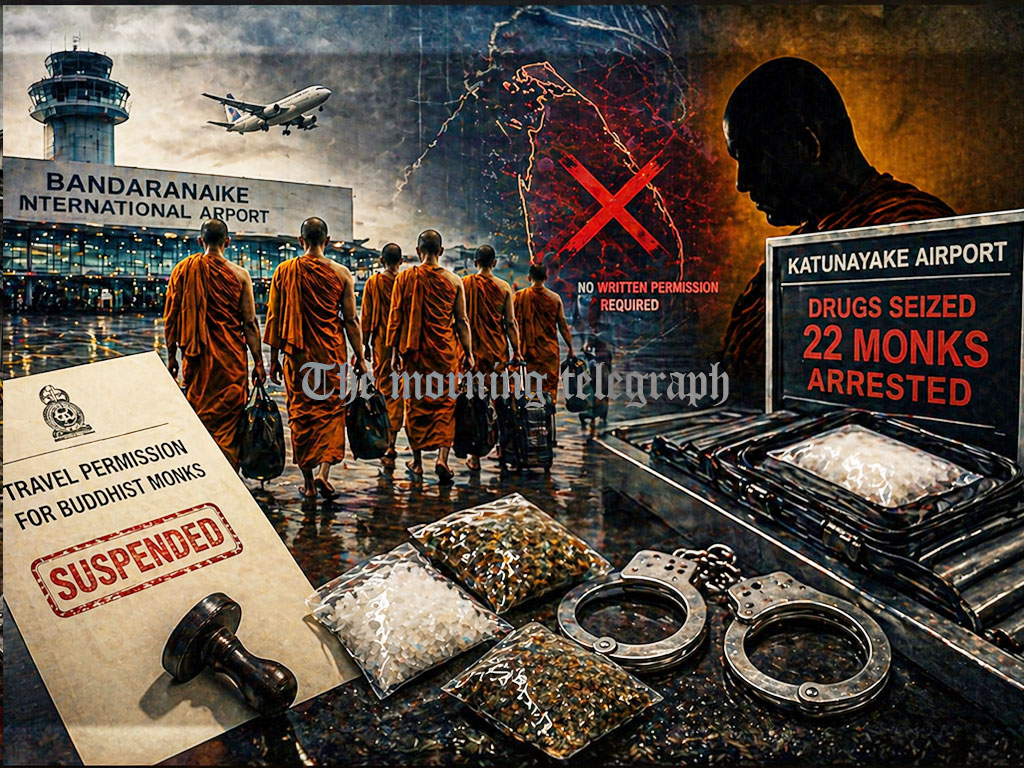
The monk drug arrest at Katunayake Airport has ignited a deeper national debate, with growing suspicion over whether the government’s suspension of monk travel rules may have unintentionally opened the door for a major drug operation.
This case marks what is believed to be the first instance of a Buddhist monk being arrested at Katunayake Airport with narcotics, a development that has shocked both authorities and the wider religious community. The controversy has intensified further amid reports that another group of around 10 monks had traveled abroad in a similar manner within the same period.

For years, Sri Lanka enforced a strict requirement that Buddhist monks obtain written permission from the Most Venerable Prelates before leaving the country. This process served as a key safeguard, ensuring discipline, accountability, and verification within the Sangha.
However, in a sudden and largely unexplained move, the current government abolished the need for this written approval. Commissioner General of the Department of Buddhist Affairs, Gamini Senarathna, later clarified that the process had only been suspended temporarily.
However, questions remain about the timing. The suspension appears to have coincided directly with the period during which 22 monks were arrested at the airport with drugs, raising concerns about whether a critical layer of oversight was removed at the wrong moment.
This raises concerns about whether the absence of this approval process created a gap that could be exploited. Reports indicate that the group of robed suspects did not obtain permission from the Most Venerable Prelates, further strengthening doubts about how they were able to travel without scrutiny.
Adding to the controversy is the claim that the chief robed suspect who allegedly led the group had previously supported the current government’s rise to power. While there has been no official confirmation of this connection, the allegation has intensified public suspicion and fueled political debate.
The sequence of events has left many observers questioning how such developments unfolded in such a short timeframe. A long-standing regulatory safeguard is suspended, multiple monks travel abroad without oversight, and a major drug arrest follows soon after.
This raises concerns about oversight, accountability, and whether institutional checks were weakened at a critical juncture. It also places pressure on authorities to clarify whether this was merely a coincidence or a systemic lapse.
What happens next could be critical. The government may now be compelled to explain the reasoning behind the suspension and whether safeguards will be reinstated to prevent future misuse.
As investigations continue, the country is left confronting a troubling question that goes beyond a single incident and strikes at the intersection of governance, religion, and national security.