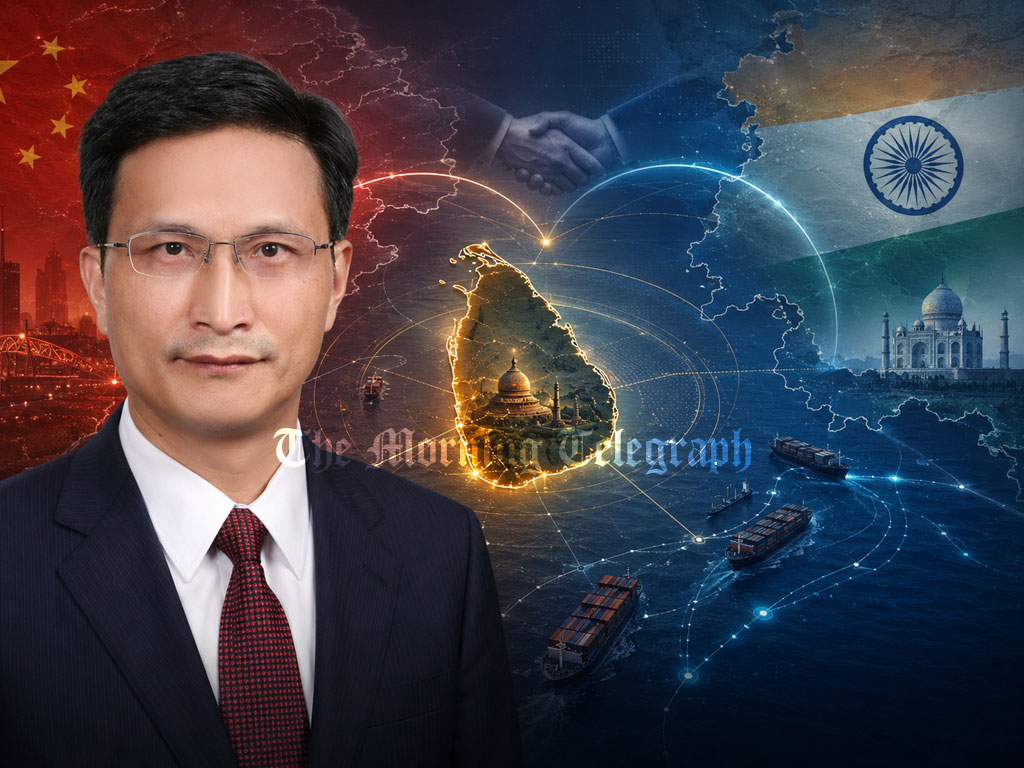
China India Sri Lanka cooperation call by Qi Zhenhong raises fresh questions over Beijing’s setbacks, India’s influence and Colombo’s shifting policy.
China India Sri Lanka cooperation has returned to the spotlight after Chinese Ambassador Qi Zhenhong again pushed the idea of a trilateral framework involving the three countries.
Last March, China’s Ambassador to Sri Lanka, Qi Zhenhong, proposed a China-India-Sri Lanka trilateral cooperation arrangement within Sri Lanka. He said such cooperation would be important for the progress of the region. His statement came after India removed restrictions it had earlier imposed on direct Chinese foreign investments. More recently, the Chinese ambassador once again stressed the importance of trilateral cooperation between China, India, and Sri Lanka.

Qi Zhenhong has been one of the longest-serving Chinese ambassadors in Sri Lanka. He assumed duties during the period when Gotabaya Rajapaksa became President, at a time when China had placed strong hopes in him. Even before entering the presidency, during his years as Defence Secretary, Gotabaya had experienced tensions with India. Between 2015 and 2019, while in the opposition, he visited China several times and also participated in an educational programme there.
However, contrary to China’s expectations, Gotabaya Rajapaksa adopted a policy more favourable to India after becoming President. He selected India for his first state visit and declined China’s invitation to visit, citing COVID-19 as the reason. This move deeply disappointed China.
As with Gotabaya, China had also placed high hopes on Anura Kumara Dissanayake. The reason was the long-standing party-level relationship between China and the Janatha Vimukthi Peramuna. Beyond that, there were also ideological similarities between the Chinese Communist Party and the JVP.
However, like Gotabaya, after becoming President, Anura also moved toward a more India-friendly policy. Most notably, he was unable to get the ban on Chinese research vessels entering Sri Lanka lifted.
The Chinese ambassador has now served under three Sri Lankan presidents: Gotabaya Rajapaksa, Ranil Wickremesinghe, and Anura Kumara Dissanayake. It was Ranil who imposed the ban on Chinese research vessels.
Gotabaya halted the Chinese-proposed energy projects on the northern islands. He also embarrassed China by rejecting a shipment of imported fertiliser, saying it was of poor quality.
Ranil later imposed the research vessel ban. However, he allowed a Chinese investment project, the oil refinery project, which has still not become operational under Anura’s government.
Taken together, these developments show the difficult position of the Chinese ambassador in the face of India’s diplomatic manoeuvres in Sri Lanka. Perhaps that is why he is now speaking more openly about trilateral cooperation.
However, Chinese sources say Beijing has informed the ambassador that his service will be concluded within the next six months.