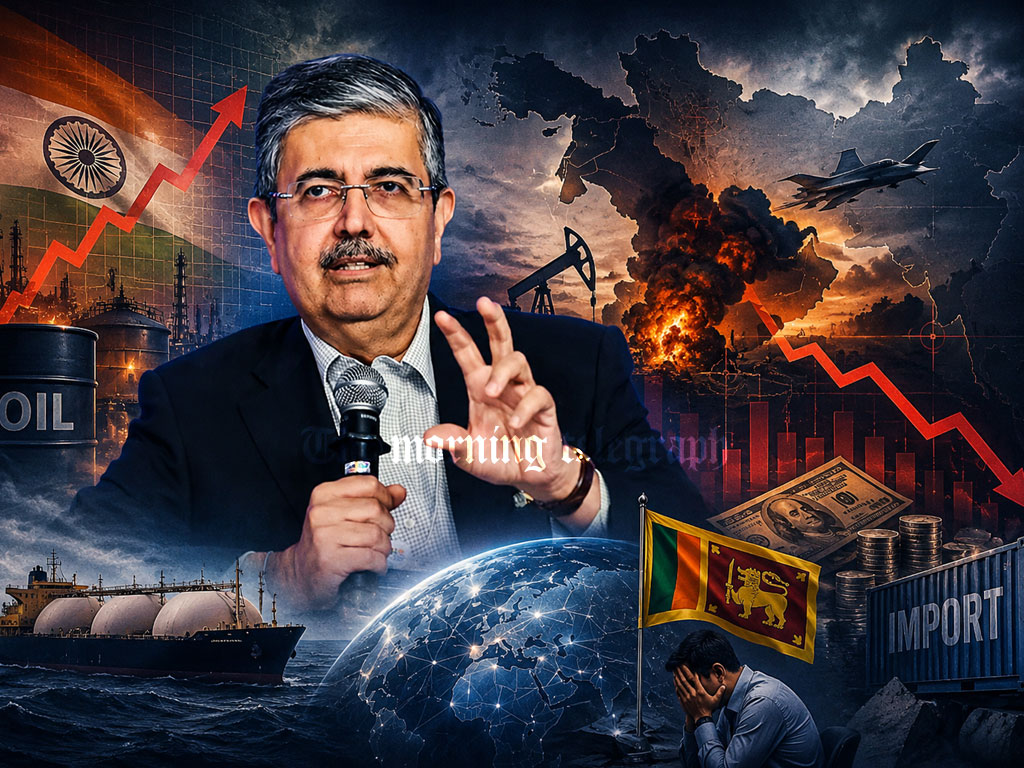
Uday Kotak warns of a global economic shock linked to the Middle East crisis, raising fears over oil prices, inflation and Sri Lanka’s economy.
Uday Kotak’s warning of a looming global economic shock has sent alarm bells ringing across financial markets, with concerns growing over how countries like Sri Lanka could face severe fallout from the escalating Middle East crisis.
Speaking at the “CII” annual summit held in New Delhi on May 12, 2026, one of India’s leading billionaire bankers, Uday Kotak, warned that the world could soon face an unimaginably large economic shock. According to him, the growing instability in the global energy market due to the worsening war situation in the Middle East, particularly involving Iran, is the key trigger behind the danger.

Kotak stressed that while India, the world’s third-largest oil importer, is already feeling the impact as a major “ripple,” smaller and economically vulnerable countries such as Sri Lanka could experience the shock like a “massive beam” crashing directly onto them.
The concerns immediately brought back memories of the historic 1973 Oil Shock, which fundamentally altered the global economy and changed international financial systems for decades. More than fifty years later, Kotak believes the world now stands at another decisive turning point.
He warned that unless the Iran conflict is brought under control quickly, escaping what he described as an approaching economic tsunami would become extremely difficult.
Against this backdrop, Indian Prime Minister Narendra Modi has already begun introducing austerity-style measures and sending strong public signals about the seriousness of the situation. Modi reportedly urged Indian citizens to limit foreign travel and gold purchases for at least one year in order to protect the country’s foreign reserves.
Kotak’s argument that nations must stop living beyond their means has also started reflecting in India’s own policy actions.
Prime Minister Modi reportedly reduced his own security convoy by 50 percent, instructed ministers to use electric vehicles where possible, and encouraged state officials to replace foreign travel with online meetings. These measures are aimed at reducing unnecessary expenditure and preserving foreign exchange reserves during a period of growing uncertainty.
The economic numbers behind the warning have further intensified concerns.
India’s oil import bill has reportedly surged sharply from $137 billion to $174 billion, while foreign exchange reserves fell by approximately $7 billion within just one week during the first week of May.
For Sri Lanka, which has historically struggled with foreign reserve shortages and balance-of-payment crises, the comparison is alarming. India reportedly lost more reserves in one week than Sri Lanka currently holds in total foreign reserves, highlighting the scale of the potential danger.
Kotak warned that although India possesses Strategic Petroleum Reserves sufficient for around 60 days, a prolonged war could rapidly exhaust even those emergency buffers.
That is why Modi’s decision to reduce even symbolic state expenditure is now being interpreted as a larger political and psychological message to the country.
The message, according to observers, is that austerity cannot apply only to ordinary citizens while leaders continue with excess consumption. By visibly reducing state spending at the highest level, Modi is attempting to prepare the Indian public mentally for difficult economic conditions ahead.
The article compares Kotak’s warning to the tragic prophecy of Cassandra from Greek literature.
Before the destruction of Troy, Cassandra repeatedly warned the people of the coming disaster, but no one believed her. The comparison suggests that Kotak may now be playing a similar role in the modern global economy — warning of a crisis whose full severity many people have still failed to grasp.
The warning also draws parallels to classic literary works exploring excess, collapse, and survival during hardship.
In William Shakespeare’s “King Lear,” the king eventually realises during a devastating storm that human beings often seek far more than what is truly necessary for survival. The article suggests Modi’s visible cost-cutting measures reflect an understanding of that same harsh reality before the crisis fully escalates.
Another comparison is made to Ernest Hemingway’s “The Old Man and the Sea,” where the old fisherman Santiago reminds himself to focus not on what he lacks, but on what he can still do with what remains available to him.
According to the article, this is also the core of Kotak’s message: countries must now begin adapting realistically to what they possess rather than continuing unsustainable patterns of spending and consumption.
The warning gains additional weight because of who Uday Kotak is within the global financial world.
Kotak is the founder of Kotak Mahindra Bank, India’s third-largest private bank, and served as its Managing Director and Chief Executive Officer for more than 38 years. He is internationally recognised as one of India’s most influential businessmen and financial strategists, known for his analysis of economic policy and banking systems.
His remarks were delivered at the high-level “CII” annual summit attended by senior government officials, global business leaders, and international policymakers.
Kotak’s personal net worth is estimated at around $12.8 billion, making him one of the wealthiest bankers in the world and giving additional significance to his warning.
The article concludes by stressing that the coming economic storm can no longer be dismissed as speculation, theory, or political fearmongering.
Instead, it argues that the crisis is already beginning to unfold through rising energy prices, reserve pressures, inflation risks, and geopolitical instability.
The final question raised is whether countries such as Sri Lanka are truly prepared for the danger that Kotak is warning about — or whether, like the citizens of Troy, they will continue celebrating until the collapse finally arrives.