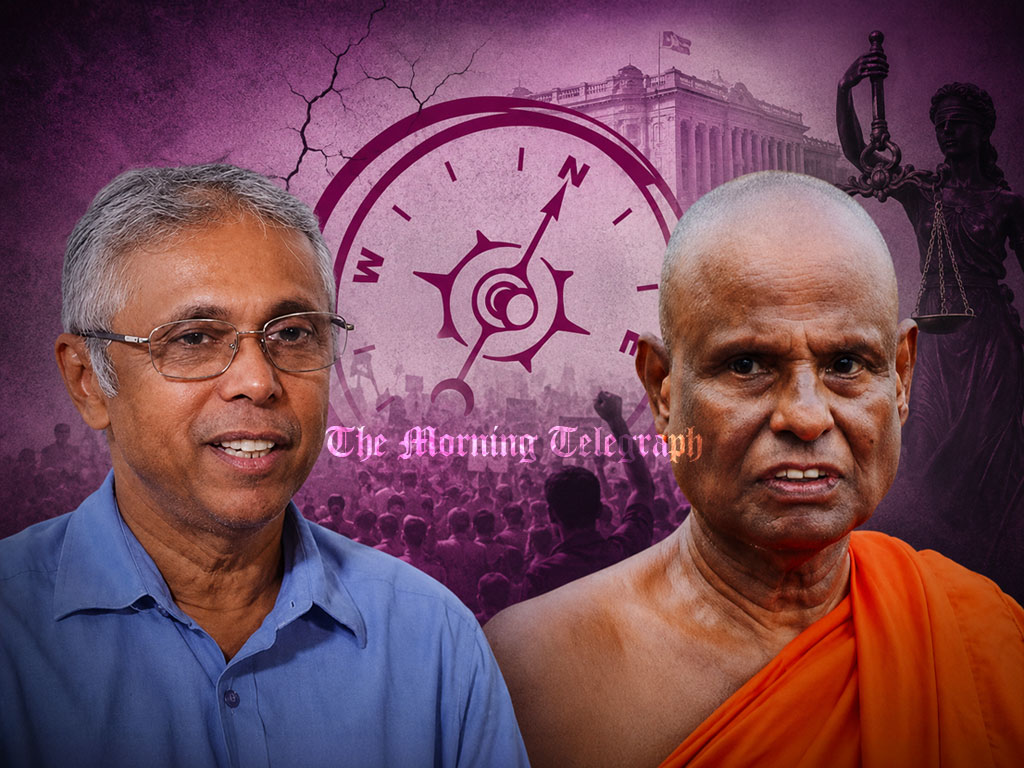
NPP faces a major test over Pallegama Hemarathana Thero allegations as Nirmal questions law equality and women activists’ silence.
NPP law-equality promises are facing a major political test after serious allegations against Pallegama Hemarathana Thero, Dr. Nirmal Ranjith Dewasiri says.
Dewasiri said the National People’s Power government is now facing a massive challenge following the allegations linked to Pallegama Hemarathana Thero.
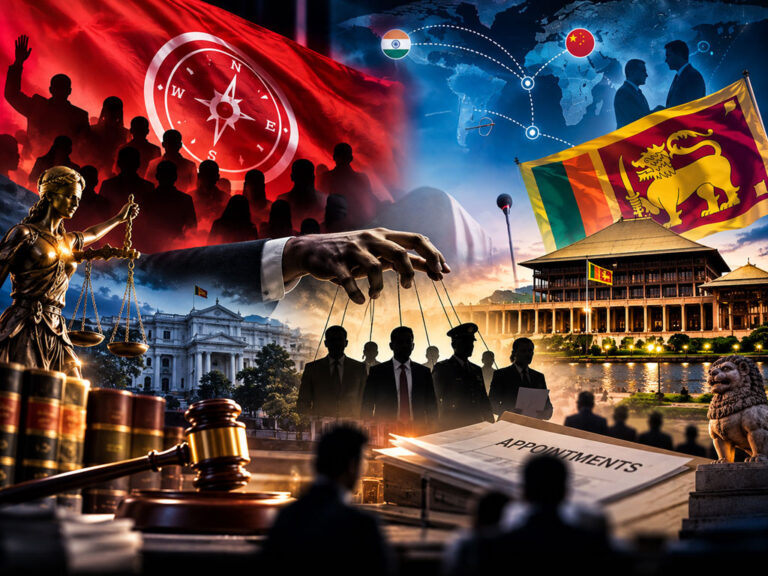
He said the government’s pledge to enforce the law equally for everyone has been severely tested by this case.
According to Dewasiri, the NPP came to power on a strong promise that the law would be applied fairly against any individual.

However, he said the government is now struggling to enforce that principle against a figure such as Pallegama Hemarathana Thero.
He pointed out that Hemarathana Thero is not an ordinary person, but a senior figure at the highest level of the Buddhist clergy with major social influence.
Dewasiri said there is now a wide gap between public expectations and the government’s actual capacity to implement President Anura Kumara Dissanayake’s repeated claim that everyone must be equal before the law.
One of the most striking aspects of the incident, he said, is the silence of the “Women’s Force,” which was a major force behind the NPP’s rise to power.
Although the allegation involves a minor girl, Dewasiri noted that many in society are questioning why NPP female activists have not raised a stronger voice.
He also said the Buddhist clergy remains a politically powerful institution, sometimes stronger than governments themselves.
Dewasiri pointed out that even governments with five-sixths majorities in Sri Lanka’s history have suffered setbacks when clashing with the Sangha.
He said the challenge is even greater because Pallegama Hemarathana Thero is not merely a monk, but the Atamasthanadhipathi, a position that carries deep moral authority and respect, even in artistic and cultural circles.
Because of this, Dewasiri argued that enforcing the law against him has become harder for the government than dealing with political figures such as Ranil Wickremesinghe or Mahinda Rajapaksa.
He also said the mainstream opposition is silent on the issue because it too depends heavily on Sinhala Buddhist ideology.
At the same time, Dewasiri’s analysis suggests that although groups such as the Frontline Socialist Party criticize the government, they also tactically avoid confronting the real challenge of clashing with the Sangha hierarchy.
However, he emphasized that one important development has emerged from the controversy.
A strong public discourse has now begun around the idea that monks should not be above the law.
Dewasiri said that shift can be recognized as an important milestone in Sri Lanka’s political transformation.