By Roy Denish
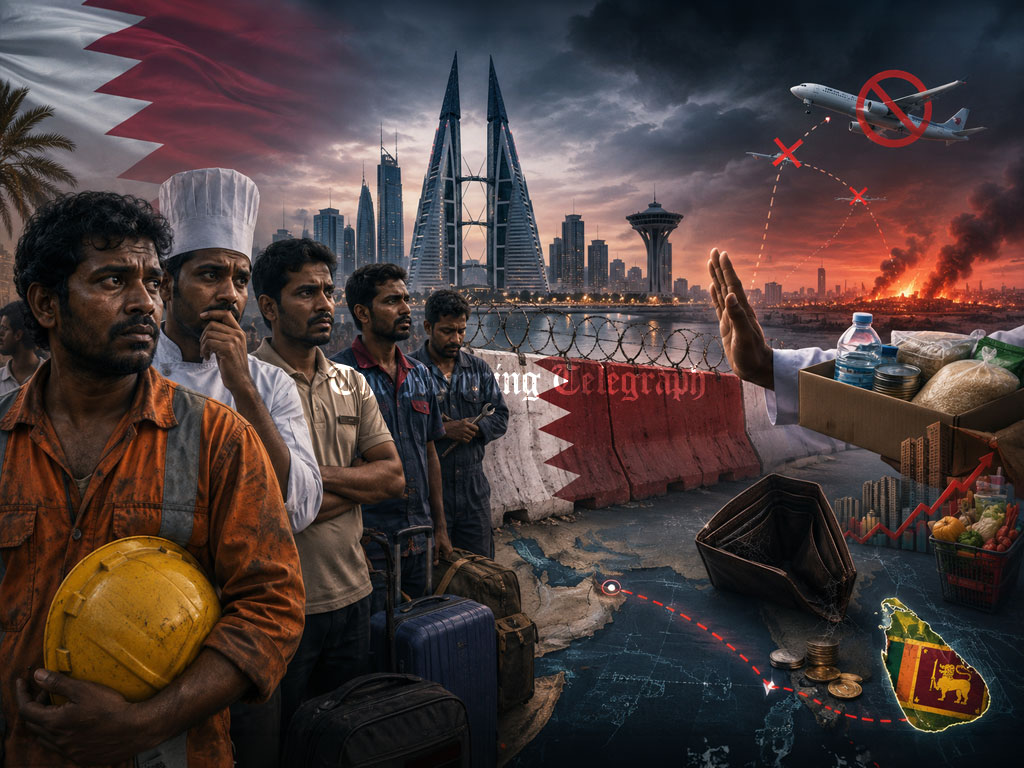
Sri Lankan workers in Bahrain face a desperate fight for survival as war-driven economic shocks, unpaid wages, soaring airfares, and exclusion from emergency aid leave thousands stranded and forgotten.
Sri Lankan migrant workers in Bahrain are facing severe economic devastation and physical danger as the fallout from the regional conflict deepens, advocacy groups say.
Despite contributing to Bahrain’s Unemployment Insurance Fund for years, Sri Lankan laborers, who form a vital part of the island nation’s private-sector workforce, have been excluded from the government’s emergency wage support program. As regional tensions escalate, thousands of Sri Lankans now find themselves trapped between a collapsing job market, rising living costs, and an emergency response system that rights groups argue treats them as invisible.
Following recent military escalations, the Bahraini parliament approved an emergency relief package to pay a full month’s salary to private-sector workers in order to mitigate the economic shock of the conflict. However, Bahraini authorities restricted these funds exclusively to Bahraini nationals. For thousands of Sri Lankans working in hospitality, retail, construction, and service industries, human rights advocates say the exclusion has left vulnerable families without a safety net.

One Sri Lankan mechanic, who spoke on condition of anonymity for fear of retaliation, said workers pay into the national system every month from their hard-earned salaries. He noted that when the economy stalls due to conflict, the government’s decision leaves their families back home unable to afford food.
Activists say this marks a repetition of history. During the 2020 COVID-19 pandemic, Bahrain launched a similar fund that bailed out more than 100,000 citizens while leaving migrant workers to face unpaid wages, job losses, and forced repatriation without compensation.
The current conflict has hit sectors heavily reliant on Sri Lankan labor particularly hard. Tourism-dependent jobs, including car rentals, hotels, and retail, have seen working hours slashed or eliminated completely as travel to the Gulf region plummets.
Furthermore, thousands of Sri Lankans on informal free visas are completely stranded. Because they rely on daily or short-term contract work, the immediate freeze in local business activity has caused their income to vanish overnight. Sri Lankans employed by contractors servicing regional military facilities face equally difficult choices, with employers reportedly giving workers ultimatums to take indefinite unpaid leave, accept severe salary cuts, or pay out of pocket to return home.
For many Sri Lankan families living in Manama, the psychological toll of the conflict has been compounded by sudden price hikes. Laborers report that a safety-driven shift to remote learning for their children has brought additional technology fees they cannot afford on reduced salaries.
Fearing for their safety, many Sri Lankans have tried to flee back to Colombo, only to find themselves priced out of transit. Following airspace disruptions and flight suspensions, standard airline tickets that usually cost around 40 Bahraini dinars, or about 106 dollars, have skyrocketed to as much as 240 dinars, approximately 636 dollars. The price spike has forced some workers to take expensive and exhausting overland routes through Saudi Arabia just to catch an available flight.
Human Rights Watch and other monitoring organizations state that, under international human rights law, governments are obligated to ensure access to social security and fair treatment during times of crisis without discrimination based on nationality. Furthermore, as a signatory to the Global Compact for Safe, Orderly and Regular Migration, Bahrain is committed to protecting the safety and economic rights of its migrant workforce.
Human rights advocates are urging the Sri Lankan government to intervene through its embassy in Manama and demand that Bahraini authorities halt the discriminatory distribution of emergency aid. Until structural reforms are made to include migrant workers in emergency safety nets, advocates warn that Sri Lankan laborers will continue to bear the heaviest burdens of a war they have no part in.