Sri Lanka Metro buses launch with seven low-floor vehicles from Japan, bringing safer, quieter and more accessible urban transport to Colombo.
Sri Lanka Metro buses have marked a new step in the country’s urban transport system, with seven refurbished low-floor buses officially handed over to the government.
For decades, public transport in Sri Lanka has been an uncomfortable experience for many passengers. Poor-quality vehicles, safety concerns and environmental pollution pushed large numbers of commuters towards private transport.
Successive governments introduced various projects aimed at creating a more sustainable system. However, many of those initiatives ended quickly, leaving commuters with the same familiar transport problems.
Against that background, Transport and Highways Minister Bimal Ratnayake has drawn attention for quietly pursuing transport reforms while wider political debates continue around the government.
Another stage of that effort was launched yesterday, September 2.
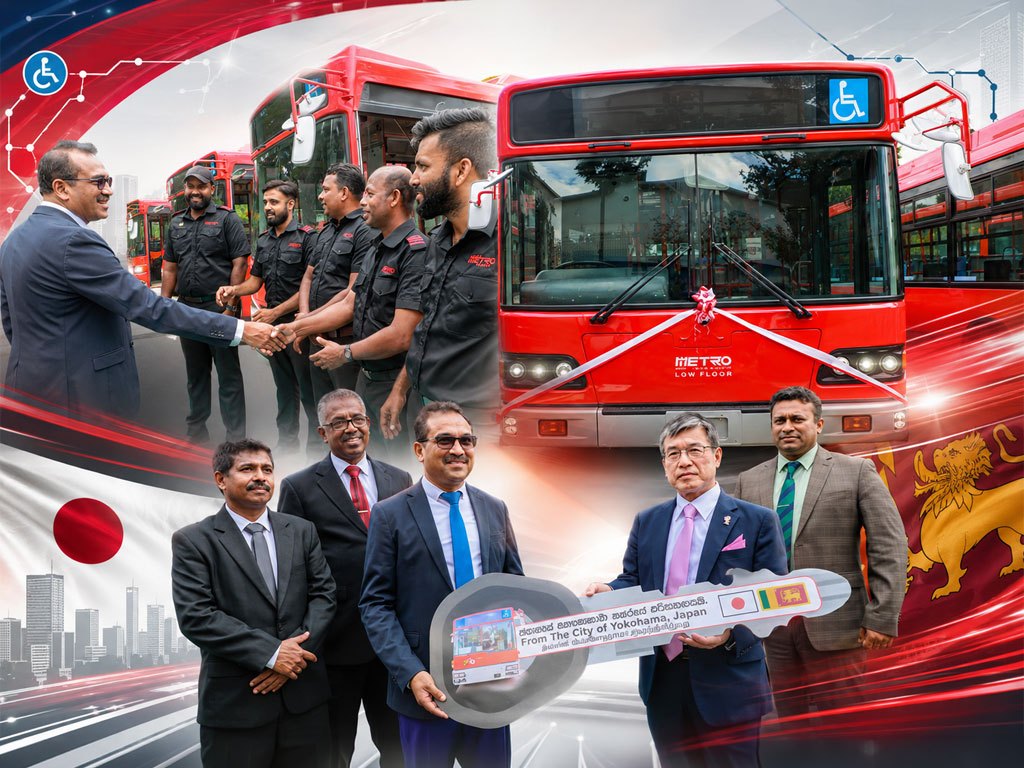
Seven newly refurbished, large low-floor Metro buses were officially handed over to Sri Lanka as a joint donation from the Government of Japan and the citizens of Yokohama.
The ceremony took place at the Lanka Metro Transit integrated depot in Thalangama.
Minister Bimal Ratnayake and Japanese Ambassador to Sri Lanka Akio Isomata attended the official handover.

Sri Lanka Metro Buses Follow Costly LRT Cancellation
The project also arrives against the background of Sri Lanka’s abandoned Light Rail Transit project.
The previous government abruptly cancelled the LRT project, which had been introduced as a solution to Colombo’s severe traffic congestion.
According to the information provided, Sri Lanka subsequently had to pay more than Rs. 840 million in compensation.
The Metro Bus initiative is now being presented as a faster and more cost-effective urban transport alternative.
Japan has supported the project with a grant of Rs. 112 million, equivalent to US$ 362,476, under its GGP programme.
One of the most noticeable features of the buses is the quieter travelling environment.
Unlike conventional buses, the new vehicles operate without excessive engine noise or loud music.
The fully air-conditioned cabins have been designed to operate according to European and Japanese standards.
Speed limiters and GPS systems are also fitted to the buses.
These features are intended to discourage excessive speeding while improving passenger safety and monitoring.
Low-Floor Design Expands Accessibility
The low-floor design is another major feature of the Sri Lanka Metro buses.
Passengers can enter directly from pavement level without climbing steps.
That makes access easier for pregnant women, children and elderly passengers.
The buses also provide dedicated ramps and wheelchair spaces for people with disabilities.
Drivers and assistants are also receiving training in basic Sign Language, providing an additional level of accessibility for passengers who require communication support.
The project therefore attempts to move beyond simply adding more buses to Colombo’s roads.
Instead, it aims to create a transport service that can be used by a wider section of the public without physical barriers.
Technology has also become a central part of the service.
An integrated mobile application called “LMT-GO” has been introduced for passengers.
Through the application, commuters can check the expected arrival time of a bus using live GPS tracking.
Passengers can also pay fares digitally through QR codes.
This system removes the need to carry cash and is intended to eliminate disputes with conductors over change.
Route Network Targets Hospitals and Key Urban Centres
The buses currently operate through a structured route network identified from CM01 to CM08.
The routes cover several important urban locations, including Colombo National Hospital and Maharagama Apeksha Hospital.
English-language announcement systems have also been introduced.
Combined with digital payment options, these features are intended to make the service easier for foreign visitors to use.
The project is therefore also expected to support Sri Lanka’s tourism sector by making urban transport more accessible to international travellers.
Passenger responses have reportedly been positive.
However, the private bus industry has strongly criticised the project.
Supporters of the initiative argue that its wider economic value should be measured beyond fare revenue alone.
Reducing dependence on private vehicles could lower fuel consumption, while more efficient public transport could also save significant travel time.
From that perspective, the project is presented as carrying wider national economic benefits.
Minister Bimal Ratnayake has argued that as urbanisation expands, an efficient transport system should no longer be considered a luxury.
Instead, he views it as a basic public right.
Expansion Planned Beyond Colombo
The seven buses donated by Japan form only one part of a wider transport programme.
More than 100 additional buses are expected to be purchased through the “Clean Sri Lanka” programme.
Plans are also being made to extend the service beyond Colombo.
Major cities including Kandy, Galle and Jaffna are expected to be included in future expansion.
If those plans proceed, the Sri Lanka Metro buses project could become a broader attempt to modernise public transport across the country.
The initiative combines accessible vehicle design, digital technology, passenger safety and a quieter travel environment.
For commuters accustomed to overcrowded and outdated public transport, even seven buses represent a visible shift in direction.
The larger test will be whether the government can expand the model consistently and prevent it from becoming another short-lived transport experiment.