22nd Amendment plan to extend judges’ retirement age triggers legal backlash over judiciary independence and political interference.
The proposed 22nd Amendment has triggered serious concern among Sri Lanka’s legal community, with critics warning that President Anura Kumara Dissanayake’s government is preparing to amend the Constitution to extend the tenure of one individual.
Reports indicate that the government is planning to bring a constitutional amendment to extend the retirement age of superior court judges. If passed, the move would allow current Chief Justice Priyath Padman Surasena to remain in office for a further two years.
The amendment would become the 22nd Amendment to the 1978 Constitution. It has already sparked strong opposition among lawyers who fear that the move could damage judicial independence and constitutional tradition.
It is becoming increasingly clear that the President’s effort to extend the retirement age of superior court judges is aimed at keeping Chief Justice Surasena in office for another two years.
Since Chief Justice Surasena has reached the age of 65, he is due to retire in December this year. If the retirement age is changed before then, he would be able to continue as Chief Justice for two more years.
The retirement age of superior court judges is fixed under Article 107 of the Constitution. A Supreme Court judge must retire at 65, while a Court of Appeal judge must retire at 63. Any change to that age limit requires a constitutional amendment.

The Proposed 22nd Amendment
It is understood that the President is moving firmly toward amending the Constitution. If this takes place, it will become the 22nd Amendment to the 1978 Constitution.
The most significant concern is that the proposed amendment appears to be designed for one central purpose: to keep the present Chief Justice in office for another two years.
Constitutional Changes For Personal Agendas
A bitter truth in Sri Lanka’s constitutional history is that several amendments have been introduced to satisfy individual ambitions or political survival needs.
The 1978 Constitution itself was created to fulfil J.R. Jayewardene’s objective of establishing an executive presidency.
Strange Amendments In The Past
The Jayewardene government introduced the 1st Constitutional Amendment to remove the power of the Court of Appeal to issue writs against decisions of special presidential commissions, transferring that power exclusively to the Supreme Court.
The objective was to prevent a writ application being filed in the Court of Appeal against a decision of a special presidential commission appointed by President Jayewardene to strip former Prime Minister Sirimavo Bandaranaike of her civic rights.
At that time, the Chief Justice was Neville Samarakoon, who had been appointed after the 1978 Constitution came into force. He was also a close friend and former personal lawyer of Jayewardene. As expected, the Supreme Court upheld the 1st Amendment, overriding the authority of the Court of Appeal.
Jayewardene’s 2nd Amendment allowed MPs to cross over from the opposition to the government, but not from the government to the opposition. The Supreme Court under Neville Samarakoon also approved that amendment.
Jayewardene’s attempted 3rd Amendment was even more bizarre. It revealed how dangerously a government with a two-thirds majority could manipulate the Constitution.
The Kalawana Crisis
Abeyratne Pilipitiya was elected from Kalawana for the United National Party at the 1977 general election. Sarath Muttettuwegama of the Communist Party filed an election petition challenging the result.
In 1980, the Court of Appeal annulled Pilipitiya’s parliamentary seat. Although the seat was lost, Jayewardene wanted to preserve his 5/6 majority in Parliament and devised a plan to keep Pilipitiya as an MP.
Following the court ruling, the Election Commissioner prepared to hold a by-election for Kalawana. Before that, Jayewardene nominated Pilipitiya again to Parliament for the Kalawana seat, and he was sworn in as a “nominated MP.”
The Election Commissioner proceeded with the by-election. In January 1981, Sarath Muttettuwegama won Kalawana with a major victory. As a result, there were two MPs for one seat.
To escape the crisis, Jayewardene introduced a constitutional amendment seeking to allow two MPs for Kalawana.
When Even Neville Samarakoon Said Enough
By 1981, the situation had gone so far that even Chief Justice Neville Samarakoon, Jayewardene’s own appointee and close associate, appeared to believe that enough was enough.
The Supreme Court, led by Samarakoon, held that the amendment directly affected the people’s universal franchise and could not be passed only by a two-thirds majority in Parliament. It required a referendum.
Holding a nationwide referendum to save one parliamentary seat was absurd and politically damaging. Jayewardene was forced to abandon the amendment.
However, Parliament still had two MPs claiming one seat. The government was saved from the deadlock by the then Secretary-General of Parliament, who advised Abeyratne Pilipitiya to resign.
When the government side asked whether his resignation would create a vacancy requiring fresh nominations, the Secretary-General gave a famous reply: “Even if Mr. Pilipitiya resigns, there will be no vacancy. Because his appointment as the MP for Kalawana was an illegal appointment created by the Speaker’s imagination from the beginning. Nothing gone leaves a vacancy.”
Eventually, Pilipitiya lost his seat after failing to attend Parliament for three consecutive months. Sarath Muttettuwegama remained the sole legitimate MP for Kalawana.
What later became known as the 3rd Amendment was brought to allow the next presidential election to be held before the end of the President’s first term. That too was designed to allow the sitting President to call an election at the most favourable moment, when the opposition was weak.
The Fate Of Samarakoon
Years later, Chief Justice Neville Samarakoon was summoned before the Bar of Parliament over these developments. An impeachment resolution was prepared against him, but he reached retirement age before it could be implemented.
17th Amendment To Preserve Power
The 17th Constitutional Amendment was introduced at the demand of the Janatha Vimukthi Peramuna as a condition for supporting President Chandrika Bandaranaike Kumaratunga’s government and preventing its collapse.
Had Kumaratunga’s government not faced a survival crisis, the 17th Amendment may never have entered Sri Lanka’s constitutional history.
18th Amendment To Stay In Power
The 18th Amendment was introduced to allow President Mahinda Rajapaksa to hold office for more than two terms. It removed the constitutional restriction limiting a President to two terms.
As a result, a President could call the next election at the most advantageous time and remain in power indefinitely.
20th Amendment To Favour Basil
The 20th Amendment was introduced by President Gotabhaya Rajapaksa to allow his brother Basil Rajapaksa to enter Parliament despite holding citizenship of another country.
That amendment removed the constitutional bar preventing a dual citizen from becoming a Member of Parliament. The 19th Amendment had previously disqualified dual citizens from holding parliamentary seats.
Anura Follows The Same Path
Now, the government of President Anura Kumara Dissanayake and the National People’s Power appears to be following the same path through the proposed 22nd Amendment.
The aim is to grant Chief Justice Priyath Padman Surasena a further two years in office.
Although the extension of the retirement age would technically apply to all superior court judges, critics argue that the real objective is not general judicial reform. The main purpose appears to be keeping the current Chief Justice in his position.
The President’s own public remarks have strengthened this concern. On several occasions, including meetings with judicial officers and BASL lawyers, the President has reportedly stated that to “get this job done” meaning punishing the corrupt, the current Chief Justice must remain in office for at least another two years.
Keeping A Preferred Chief Justice
These remarks suggest that the President wishes to keep a Chief Justice he favours in office for two more years and does not trust whoever may succeed him if the current Chief Justice retires at the end of this year.
That amounts to interference with judicial independence. It is comparable to the shameful step taken by the Mahinda Rajapaksa government to remove former Chief Justice Shirani Bandaranayake after she delivered a judgment the government disliked.
The most dangerous element is the current government’s attempt to amend the supreme law of the country for what appears to be a personal or political agenda.
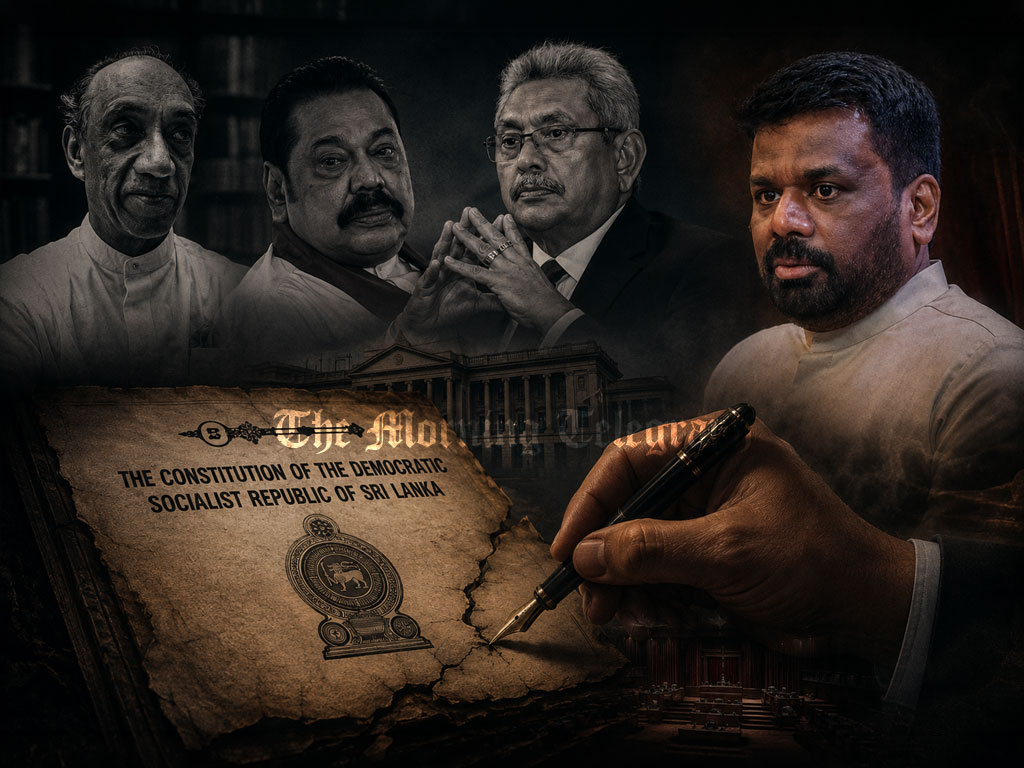
Through this, President Anura Kumara Dissanayake risks becoming no different from J.R. Jayewardene, Mahinda Rajapaksa, and Gotabhaya Rajapaksa.
It is deeply regrettable that a President who came to power promising system change and an end to the curse of the past 76 years is now accused of engaging in the same constitutional tinkering.
The precedent being created is deeply damaging. Like previous governments, the current administration appears to be sending the message that the Constitution can be amended for personal objectives.
This is even more serious because the National People’s Power promised a new Constitution, the abolition of the executive presidency, and a fundamental restructuring of Sri Lanka’s state system.
Instead of fulfilling that promise, a President elected to change the Constitution now appears ready to tinker with it to keep one person in office.
Legal Community Pushes Back
The association of judicial officers, comprising District Judges and Magistrates, has expressed concern over the President’s effort.
The Bar Association of Sri Lanka has already voiced opposition. Several other bar associations, including the Colombo High Court Lawyers’ Association, the Colombo Magistrate’s Court Lawyers’ Association, and the Free Lawyers’ Association, have also opposed the move.
Many senior lawyers and President’s Counsel have publicly expressed concern.
A collective of eminent lawyers and legal academics recently issued a statement warning that the proposed change would lock the judiciary in its present state. They argued that not only would superior court judges be denied promotions, but the entire judicial system would stagnate.
Capturing The Judiciary
The current government already holds executive presidential power and a two-thirds majority in Parliament. But this move suggests that even that is not enough to satisfy its political ambitions.
The proposed amendment can therefore be seen as a destructive attempt to also keep judicial power aligned with the government’s wishes.
If the amendment passes, the country will have, for the next two years, a Chief Justice whose extended tenure was granted by the executive. In such circumstances, critics ask whether the public can realistically expect decisions unfavourable to the government from the Chief Justice and the Supreme Court.
For example, if the government wished to bring a constitutional amendment extending its own term by five years without an election, such a draft could easily pass in Parliament. The next step would be the Supreme Court.
If the Supreme Court then held that no referendum was required and that a two-thirds majority was enough, what remedy would remain? There would be no higher court of appeal.
This government behaves as though it is the only administration ever given a massive mandate to clean up Sri Lanka. Under the banner of “cleaning the country,” it could misuse the law, introduce repressive legislation, and use state power as it pleases.
If a judiciary emerges that approves all such actions, the consequences could be grave. Considering the arbitrary and highly repressive manner in which the government is already using the Prevention of Terrorism Act, the shape of future repression can already be imagined.
What God Will You Call Then?
Another important concern is that this government is, in practice, controlled by a Bolshevik-style party structure based in Battaramulla and Pelawatta.
The General Secretary of that party has already made prejudicial statements regarding provincial council elections and the decision of the Coal Commission.
If future decisions are taken in the same manner from the party office in Pelawatta, the question becomes unavoidable: what God will the country call then?