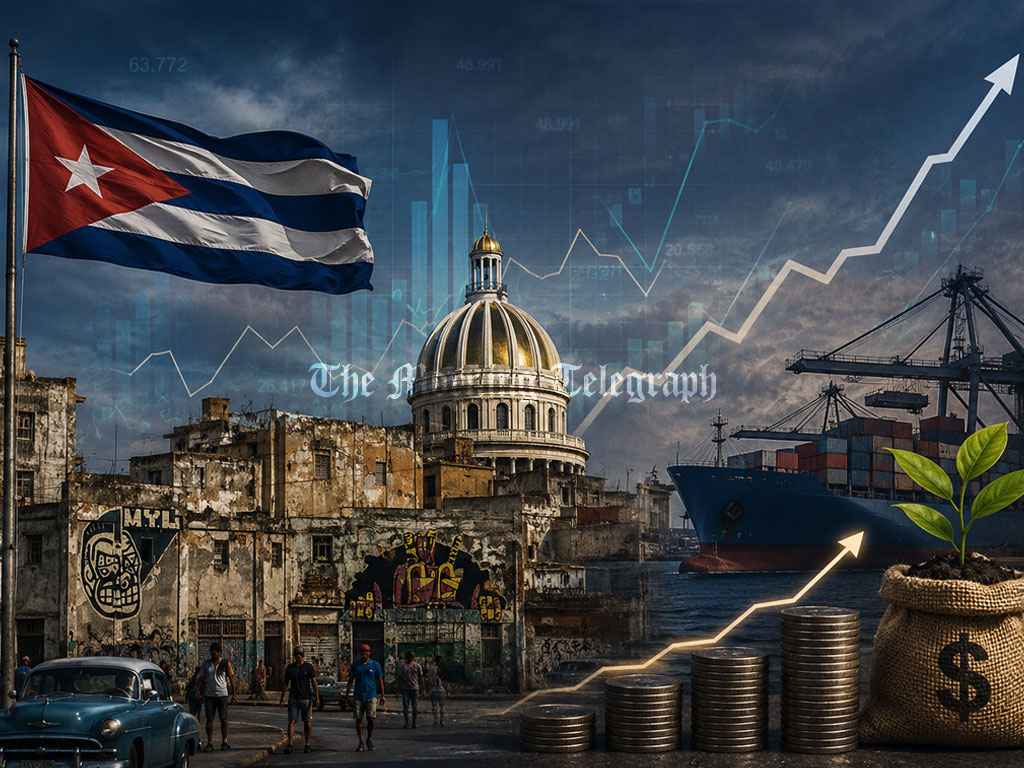
Cuba economic reforms open space for private business, foreign investors and market activity as sanctions deepen the island’s crisis.
Cuba economic reforms have triggered one of the most decisive shifts inside the country’s Communist economic system since the Cuban Revolution.
The Cuban government announced the sweeping free-market measures on Friday, marking a major break from decades of strict state control over production, trade, prices and investment.
The reforms were confirmed in a media interview by Rahul Guillermo Rodríguez Castro, grandson of former President Raúl Castro, who described the move as an essential step forward for Cuba’s struggling economy.

The main goal is to decentralize Cuba’s state-led economic model, which has been badly weakened by tough sanctions imposed during the administration of U.S. President Donald Trump.
The proposed reform package includes 176 measures.
Under Cuba’s long-standing economic system, the government decided what was produced, who produced it, how much goods were sold for, and how the country’s resources were distributed.
Under the new plan, private businesses will receive more room to operate. Companies will be allowed to carry out direct import and export activity without government intervention and will also be able to hire employees more freely.
The reforms will also create opportunities to establish private banks and allow Cubans living overseas to invest inside the country. International fast-food chains will also be permitted to open branches in Cuba.
“The principles that for decades were considered the main pillars of the revolutionary economy—such as the state monopoly on foreign trade and the centralization of productive forces—have now been broken,” said Luis Carlos Batista, a PhD candidate at the University of Salamanca and a Cuban-American political scientist and lawyer.
Former President Raúl Castro had previously attempted limited economic reforms, but those efforts stalled because of state bureaucratic obstacles.
Cuban authorities say the implementation of the new measures may be slow. They also warn that success will be difficult unless the United States removes the energy and financial sanctions imposed on the island.
Since January, severe U.S. energy and financial sanctions have deprived Cuba of fuel, its main energy source, worsening an economic crisis that has already lasted five years.
The country is now facing power cuts lasting up to 20 hours a day, severely disrupting health services, transportation and education.
U.S. President Donald Trump and Secretary of State Marco Rubio have said they are applying maximum pressure to change Cuba’s political and economic system, which has resisted American influence for six decades.
They have not ruled out the possibility of using military force to achieve that goal.
However, in a video interview Friday with The National newspaper, published in the United Arab Emirates, Rahul Guillermo Rodríguez Castro stressed that Cuba poses no threat of any kind to the United States.
He said the Cuban government hopes to build an economic model that is unique to Cuba.
“As our country moves toward economic development, it is absolutely necessary to diversify the economy and change the way business is done and investments are made,” he said.
Cuban President Miguel Díaz-Canel said the proposed measures were shaped after studying the economic models of Vietnam and China, both Communist countries that operate market-based economies.
According to Lee Schlenker, a research fellow at the Quincy Institute in Washington, the biggest obstacle facing the reforms is U.S. sanctions.
“The real results of these new measures will only materialize if U.S. bans and sanctions are gradually lifted,” he said.
Analysts say that without sanctions relief, many of the reforms may be nearly impossible to implement because investors doing business with Cuba could face penalties inside the U.S. financial system.
Potential investor distrust and Cuba’s inefficient state bureaucracy could also slow or weaken the reform effort.
Still, Paolo Spadoni, Associate Professor of Sociology at Augusta University in Georgia, said the Cuban government has only a short window to prove the reforms can work.
“If Cuban leaders want to escape this unprecedented crisis and U.S. pressure, they must implement these reforms quickly and show tangible results,” Spadoni said.