By Dwayne Ferreira.
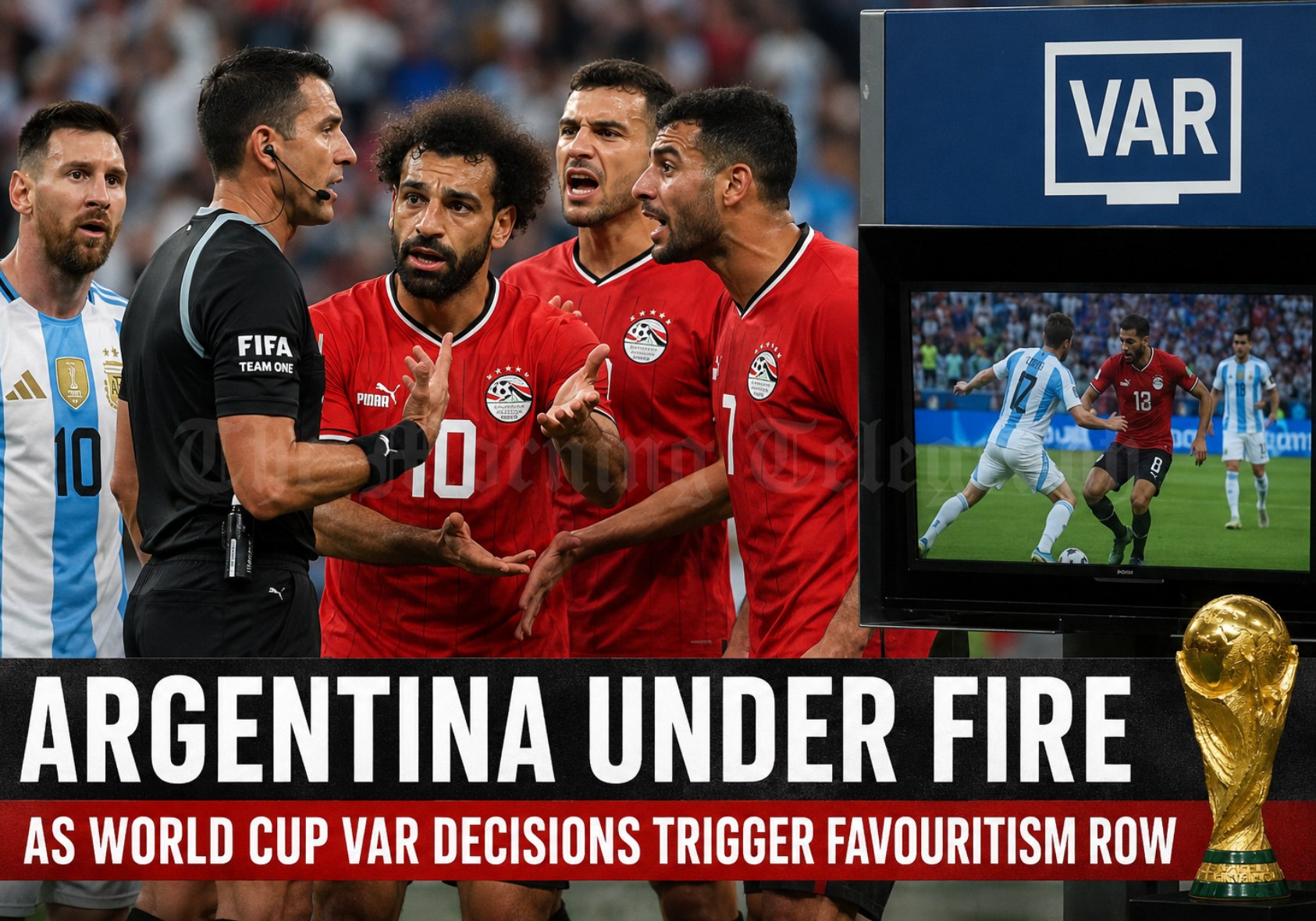
Argentina favouritism claims have intensified after the defending champions survived another tense World Cup knockout match, with VAR decisions, disciplinary calls and Egypt’s furious reaction placing their campaign under fresh scrutiny.
Argentina are back in the World Cup quarter-finals. However, their run is no longer being discussed only through resilience, Lionel Messi’s influence or the defending champions’ ability to survive pressure.
Instead, their 3-2 comeback win over Egypt has opened a fierce debate over whether football’s most high-profile national team is receiving the benefit of the doubt in decisive moments.
The controversy erupted after Egypt’s painful Round of 16 defeat in Atlanta, where the Pharaohs led Argentina before a dramatic late collapse. Egypt believed they had strengthened their grip on the match when Mostafa Zico found the net, only for the goal to be ruled out after a VAR review identified a foul in the buildup.

That decision became the major flashpoint of the match. Egypt’s players, staff and supporters reacted angrily, while several former players and pundits questioned whether VAR had gone too far back into the attacking phase to cancel the goal.
Egypt’s frustration grew late in the game when they appealed for a penalty after a challenge involving Mohamed Salah. The referee waved away the appeal, and Argentina later scored the winner in stoppage time.
The Egyptian Football Association has since criticised the officiating and submitted a complaint to FIFA. It argued that several key decisions directly affected the result. Reuters reported that the EFA raised concerns over the “consistency and fairness” of decisions during the match, while FIFA had not publicly responded at the time of reporting.
Egypt Anger Fuels Argentina Favouritism Debate
The anger around the Argentina-Egypt match has grown because of the scale of the moment.
Egypt stood close to one of the biggest shocks of the tournament. They had the defending champions under pressure, with Salah’s side threatening to end Argentina’s title defence before the quarter-finals.
Instead, Argentina produced a stunning late comeback. Cristian Romero pulled one goal back, Messi equalised, and Enzo Fernandez completed the turnaround with a stoppage-time winner.
For Argentina, it looked like another example of champion mentality. For Egypt, it felt like a night shaped by officiating decisions as much as football.
Al Jazeera reported that the match featured a disallowed Egypt goal, multiple yellow cards for Egypt and contrasting emotions between the two captains after full-time. The report also noted that VAR protocol allows reviews for attacking offences in the buildup to a goal, even though the decision remained deeply controversial among viewers and analysts.
That distinction matters. The decision may have been defensible under VAR protocol. But the debate is not only about whether the law allowed the review. It is also about whether officials apply the same level of scrutiny to both teams.
Disciplinary Questions Add Pressure
The Egypt match has fed into a wider perception that Argentina are receiving lenient treatment during the tournament.
Some critics have pointed to Argentina’s disciplinary record. They claim the team has committed a high number of fouls while receiving relatively few yellow cards. The Sun reported that Argentina had received only three yellow cards despite committing 59 fouls, a ratio that has fuelled claims of lenient officiating compared with other teams.
Those numbers do not prove bias. Different fouls carry different levels of severity, and referees must judge context rather than count offences.
However, perception matters in a World Cup knockout environment. When a powerful and commercially significant team benefits from close decisions, every incident becomes magnified.
Messi’s presence adds another layer to the debate. For many fans, Argentina’s run carries the emotional weight of a football icon trying to defend the crown he won in 2022. For critics, that same narrative raises uncomfortable questions about whether the game’s biggest stars receive more protection on the biggest stage.
That is why the Argentina favouritism row has moved beyond one match. It now sits at the centre of a wider argument over consistency, technology and how officials handle pressure around elite teams.
FIFA Officials Defend VAR Process
Despite the backlash, FIFA’s refereeing leadership has defended the role of VAR.
Pierluigi Collina, FIFA’s Chief Refereeing Officer, reportedly backed the controversial VAR decision in the Argentina-Egypt match. He stressed that “a foul is a foul” and that officials must apply the laws regardless of public pressure.
That defence will not satisfy everyone.
Supporters of VAR argue that the system exists to correct major incidents that referees may have missed. If an attacking foul occurred in the buildup to a goal, they argue, the goal should not stand simply because the move later became dramatic or entertaining.
Opponents see the matter differently. They argue that VAR has become too intrusive. In their view, it is no longer correcting only clear and obvious errors. Instead, it is re-refereeing long passages of play and creating confusion over what officials will review.
The Argentina-Egypt controversy has become a clear example of that tension. One side sees technology protecting fairness. The other sees technology disrupting the game and helping a favourite survive.
Argentina’s Route Comes Under Scrutiny
Argentina’s knockout path has also added to the noise.
They survived a tense Round of 32 match against Cape Verde, winning 3-2, before edging Egypt by the same scoreline in the Round of 16. Their next test comes against Switzerland in the quarter-finals.
On paper, Argentina have done what champions often do. They have found ways to win under pressure, even when they have not fully controlled matches.
But the repeated drama has created a different narrative. Instead of being seen only as survivors, Argentina are now being viewed by some as beneficiaries of key moments.
That does not mean their victories are undeserved. Messi’s influence, Argentina’s experience and their ability to punish opponents late in matches remain central to their campaign.
Yet the debate will not disappear unless Argentina win more convincingly or refereeing standards become less controversial in their matches.
FIFA Faces a Trust Test
For FIFA, the issue is bigger than Argentina.
The World Cup depends on public trust. When fans believe decisions are inconsistent, every major result becomes vulnerable to suspicion.
VAR was introduced to reduce controversy. However, the Argentina-Egypt match shows how technology can sometimes shift the argument rather than end it. Instead of debating only the referee’s call, fans now debate the review process, the footage selected, the length of the buildup and the consistency of intervention.
That complexity can damage confidence, especially when a global powerhouse is involved.
Argentina remain alive in the tournament. Their supporters will argue that the champions are being targeted because of their status. Their critics will argue that status is exactly why they are being protected.
The truth may sit somewhere in the middle. There is no clear evidence that Argentina are being deliberately favoured. But there is enough controversy, inconsistency and anger from opponents to make the question impossible to ignore.
As Argentina move toward the quarter-finals, the pressure is no longer only on Messi and his teammates. It is also on FIFA, VAR officials and referees to prove that the World Cup is being decided by football, not suspicion.