By Dwayne Ferreira.
Haredi rioters breached an IDF base housing a military prison and courts as Israel’s ultra-Orthodox conscription crisis escalated.
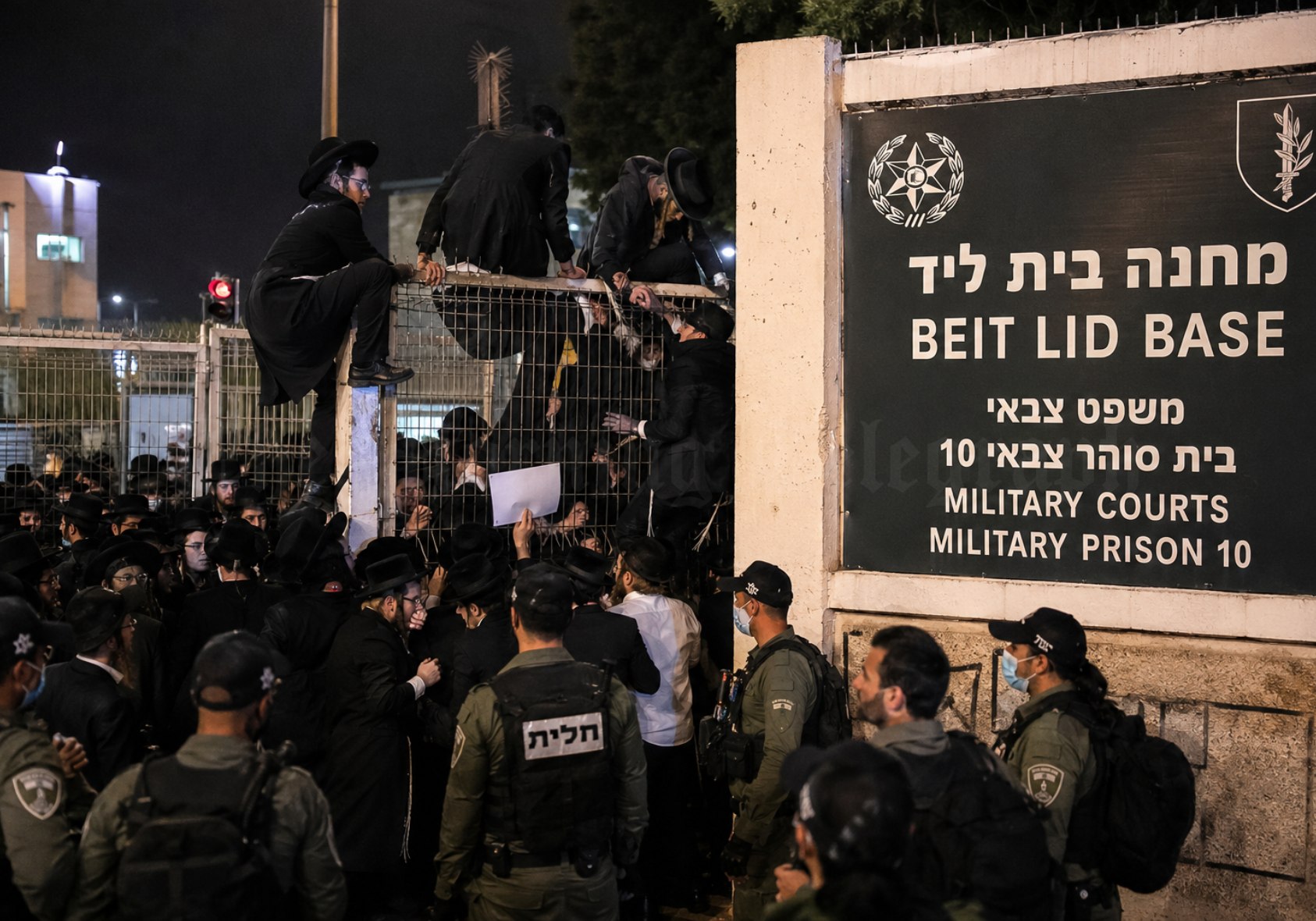
Haredi rioters have breached an Israeli military base housing a major military prison and court complex, sharply escalating the confrontation over ultra-Orthodox military conscription.
Protesters entered the IDF’s Beit Lid base during unrest linked to the arrest of a Haredi draft evader. The breach forced Military Police forces to intervene and remove those who entered the restricted military area.
The base houses the Neve Tzedek military prison, also known as Prison 10. It also contains military courts and other sensitive military facilities.
According to the IDF, the demonstration outside the base was unauthorized. The military said protesters acted violently before entering the military compound.
Military Police forces responded inside the facility. They eventually removed all protesters who had breached the base.
The IDF later said the incident had concluded.
The breach represents one of the most serious incidents so far in an escalating wave of protests against efforts to enforce military conscription among Israel’s ultra-Orthodox, or Haredi, community.
Haredi Rioters Enter Restricted Military Area
The immediate confrontation centred on Beit Lid, a military complex that has repeatedly become a focal point for demonstrations over the detention of alleged Haredi draft evaders.
The latest protest was linked to opposition to the arrest of a draft evader held at Prison 10.
However, the breach dramatically changed the nature of the demonstration. Instead of remaining outside the facility, protesters crossed into a restricted military area. Their entry prompted an immediate response from military personnel.
The incident has raised fresh questions about security at sensitive military facilities during increasingly confrontational demonstrations.
Beit Lid is more than an ordinary military barracks. The complex includes detention and judicial facilities that play a central role in Israel’s military justice system.
Therefore, the presence of protesters inside the base created a potentially serious security situation. However, the IDF said Military Police eventually cleared the facility and brought the incident to an end.
There were no immediate official reports of serious injuries or major damage resulting from the breach.
Beit Lid Becomes Focus of Growing Draft Anger
The latest incident did not emerge in isolation.
Beit Lid has increasingly become a symbolic destination for ultra-Orthodox demonstrations because authorities have detained alleged draft evaders at the military prison there.
In June, large demonstrations took place in and around the area. Protesters demanded the release of detained draft evaders.
Previous demonstrations have involved confrontations with security personnel, pressure on checkpoints and attempts by protesters to reach areas around the military prison.
Meanwhile, the unrest has spread beyond the prison complex.
Haredi protesters have blocked major roads, disrupted traffic and clashed with police during demonstrations in several parts of Israel. In Jerusalem, previous anti-draft protests have also disrupted public transport and led to confrontations with police.
The latest breach, however, marks a significant escalation because protesters succeeded in entering an active military base.
Why Israel’s Haredi Draft Crisis Is Escalating
At the centre of the confrontation is one of the most divisive questions in Israeli society. The dispute concerns whether ultra-Orthodox men studying in religious seminaries should serve in the military.
For decades, many Haredi men received military service exemptions or deferments while studying at yeshivas.
However, the arrangement became increasingly controversial as the ultra-Orthodox population grew and Israel’s military manpower requirements expanded.
The dispute became even more politically explosive after Israel’s Supreme Court ruled in June 2024 that there was no legal basis for continuing broad military service exemptions for ultra-Orthodox men.
Since then, attempts to issue draft orders and arrest those accused of ignoring them have triggered growing resistance.
Thousands of ultra-Orthodox men who have refused to comply with draft orders face the possibility of arrest. As a result, individual detentions have become flashpoints for wider demonstrations.
The arrest of alleged draft evaders has repeatedly brought protesters onto the streets. Religious leaders and activists have portrayed the conscription drive as a threat to the Haredi way of life and the religious education system.
Supporters of wider conscription argue that the existing system is unfair to Israelis who serve in the military. Many of those Israelis also spend long periods performing reserve duty.
That argument has become increasingly powerful during years of sustained military operations and heightened regional tensions.
Military Service Dispute Becomes a Security Challenge
The breach at Beit Lid highlights how a political and religious dispute is increasingly becoming a direct challenge for Israel’s security institutions.
Police and military personnel now face the difficult task of enforcing conscription rules while controlling demonstrations that can mobilise large numbers of people.
Recent weeks have seen anti-draft protesters block highways and cause significant traffic disruption. Earlier demonstrations around Beit Lid have also led to clashes between protesters and security personnel.
During one major protest in June, thousands of demonstrators gathered in the Beit Lid area. Meanwhile, police elsewhere in Israel used dispersal operations and made arrests during other protests.
The demonstrations have created an increasingly volatile cycle.
Each arrest of an alleged draft evader can trigger another protest. Those demonstrations can then lead to confrontations, more arrests and further anger within sections of the Haredi community.
The ability of Haredi rioters to enter a military base now represents a new security concern within that cycle.
Political Pressure Over Conscription Continues to Build
The Haredi conscription dispute has also placed enormous pressure on Israel’s political system.
Ultra-Orthodox political parties have long pushed for legislation that protects the status of yeshiva students from compulsory military service.
However, attempts to resolve the issue have repeatedly faced legal, political and social opposition.
The question has become increasingly difficult to contain because it touches several fundamental divisions within Israeli society. These include the relationship between religion and the state, equality of obligation and the distribution of the burden of national defence.
For many secular and national-religious Israelis, the issue centres on fairness.
For many Haredi leaders, however, compulsory military service threatens a religious system centred on Torah study. They also fear its impact on a community structure that has remained largely separate from mainstream military culture.
Those competing positions have hardened as enforcement efforts have increased.

Base Breach Marks a Dangerous New Stage
The removal of protesters from Beit Lid brought the immediate incident to an end. However, the confrontation surrounding Haredi conscription remains unresolved.
The latest breach shows how quickly protests over individual arrests can escalate into direct confrontations at sensitive military sites.
For the IDF and police, the challenge now extends beyond enforcing draft orders. Authorities must also prevent future demonstrations from creating security breaches at military prisons, bases and other restricted facilities.
For Israel’s political leadership, the larger problem remains unchanged.
The state must decide how to enforce military service requirements while confronting organised resistance from a large and politically influential section of society.
The breach at Beit Lid lasted only briefly.
Its political and security consequences may last much longer.