By Dwayne Ferreira.
Gulf missile attacks put Bahrain and Kuwait on high alert as air defences engage threats and the US-Iran conflict spreads across the region.
Gulf missile attacks have put Bahrain and Kuwait on high alert as the renewed confrontation between the United States and Iran rapidly spreads across the region.
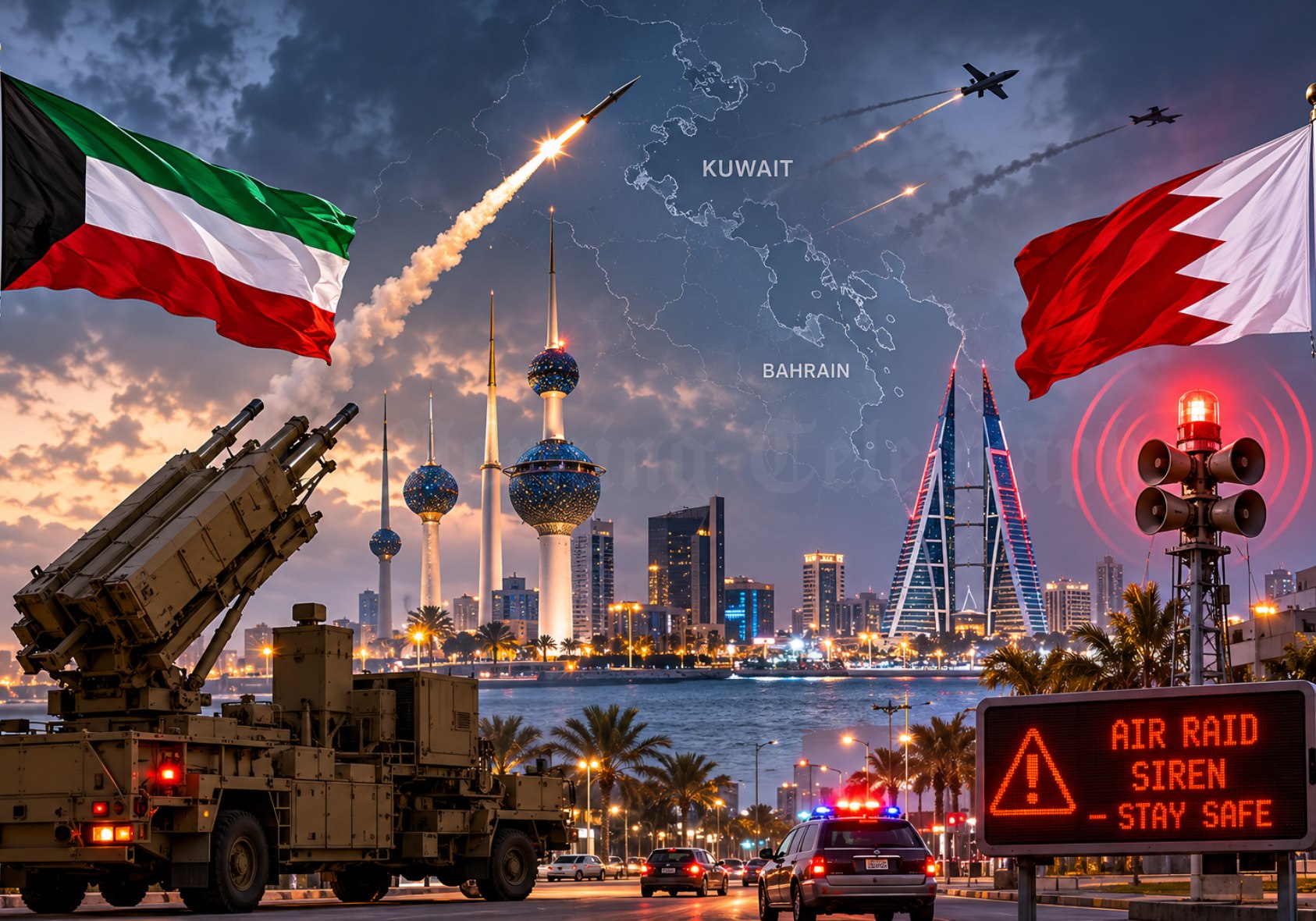
Air raid sirens sounded across Bahrain. Meanwhile, Kuwait’s air defences moved to intercept hostile missiles and drones as the security situation deteriorated.
The latest escalation has placed two of Washington’s closest regional partners back on the front line of a conflict they have repeatedly sought to contain.
Kuwait’s military said its air defence systems were responding to hostile missile and drone attacks. It also warned that explosions heard across the country could result from interception operations.
At the same time, warning sirens sounded in Bahrain as authorities responded to the renewed threat of Iranian retaliation.
The developments followed an announcement from Iran’s Islamic Revolutionary Guard Corps. The IRGC said it had launched attacks against US military facilities in Bahrain and Kuwait in response to renewed American strikes on Iranian territory.
The confrontation marks a dangerous expansion of the latest round of hostilities. The crisis began with attacks on commercial shipping in the Strait of Hormuz, followed by US military retaliation. Now, Gulf states hosting American forces again face the risk of becoming active battlefields.

Gulf Missile Attacks Put Two States on the Front Line
Bahrain and Kuwait occupy critical positions within the US military architecture across the Gulf.
Bahrain hosts the headquarters of the US Navy’s Fifth Fleet. Kuwait, meanwhile, has long served as a major logistical and military hub for American forces operating across the Middle East.
That military presence has made both countries strategically important to Washington. However, it has also exposed them to Iranian retaliation whenever confrontation between Tehran and the United States intensifies.
The latest attacks highlight the difficult position facing Gulf governments.
Bahrain and Kuwait maintain close security relationships with the United States. However, both countries are geographically vulnerable to missiles and drones launched from Iran or by Iran-aligned groups operating elsewhere in the region.
For civilians, the renewed escalation has brought back unmistakable signs of war. Warning sirens, air defence activity and the danger of falling debris from interceptions have again become immediate concerns.
Iran Says American Military Facilities Were the Targets
The IRGC said its operations targeted American military facilities rather than the Gulf states themselves.
However, any missile or drone attack entering Bahraini or Kuwaiti airspace risks widening the conflict, regardless of the intended target.
Interception operations can produce falling debris. At the same time, unsuccessful defensive engagements create the risk of strikes on military facilities, infrastructure or nearby civilian areas.
Iran has threatened to expand its attacks if US military operations continue.
That warning raises the possibility of further attacks against the network of American bases and facilities across the Gulf. As a result, several regional governments could come under increasing pressure.
The escalation also comes as Washington continues military operations against Iranian targets following attacks on commercial vessels in the Strait of Hormuz.
US Central Command forces have carried out renewed strikes against Iranian military infrastructure. President Donald Trump has also warned Tehran against further attacks on shipping.
From the Strait of Hormuz to a Wider Battlefield
The speed of the escalation has renewed fears that the Strait of Hormuz crisis could develop into a much wider regional confrontation.
The waterway is one of the world’s most strategically important energy corridors. Therefore, disruption to commercial traffic can have immediate consequences for global oil markets, shipping costs and supply chains.
However, the latest developments show that the danger is no longer confined to ships at sea.
With missiles and drones again threatening countries that host US military forces, the conflict is expanding across multiple fronts.
Kuwait’s decision to activate air defences demonstrates the immediacy of the threat. Meanwhile, the sounding of sirens in Bahrain shows how quickly military escalation can affect civilian life.
Gulf states have spent years trying to balance security cooperation with Washington against the need to avoid direct confrontation with Tehran.
That balancing act is becoming increasingly difficult.
Every new US strike on Iran creates the possibility of retaliation against American military assets across the region. Meanwhile, every Iranian attack directed towards those facilities places the security and sovereignty of the host country at risk.
Bahrain and Kuwait Face a Dangerous Reality
For Bahrain and Kuwait, the latest escalation presents a reality that has become increasingly difficult to avoid.
Neither country is a principal combatant in the confrontation between Washington and Tehran. However, geography and military alliances mean both can still become part of the battlefield.
The presence of American forces provides a powerful security guarantee. At the same time, it creates fixed targets that Iran can threaten when seeking to retaliate against Washington.
This leaves Gulf governments facing difficult decisions over air defence, civilian protection and diplomatic engagement.
The renewed attacks could also complicate efforts to revive diplomacy following the breakdown of the fragile ceasefire arrangement that had temporarily reduced direct hostilities.
Regional governments have repeatedly warned that a prolonged confrontation would have consequences far beyond Iran and the United States.
Those warnings are now being tested.
As Kuwait’s air defence systems track hostile threats and sirens warn residents across Bahrain, the latest escalation is sending a stark message throughout the region.
The Gulf states are no longer watching the US-Iran confrontation from the sidelines.
Once again, they are standing directly in its path.