Sri Lanka healthcare reforms will focus on global standards, digital hospitals, medicine supply, telemedicine and stronger primary care.
Sri Lanka healthcare reforms must go beyond policy changes and transform the country’s health system to meet international quality standards, President Anura Kumara Dissanayake has said.
The President stressed that the government is ready to allocate the necessary financial resources to achieve that goal. He called for a broad transformation of public healthcare, combining stronger primary care, modern technology and improved hospital infrastructure.
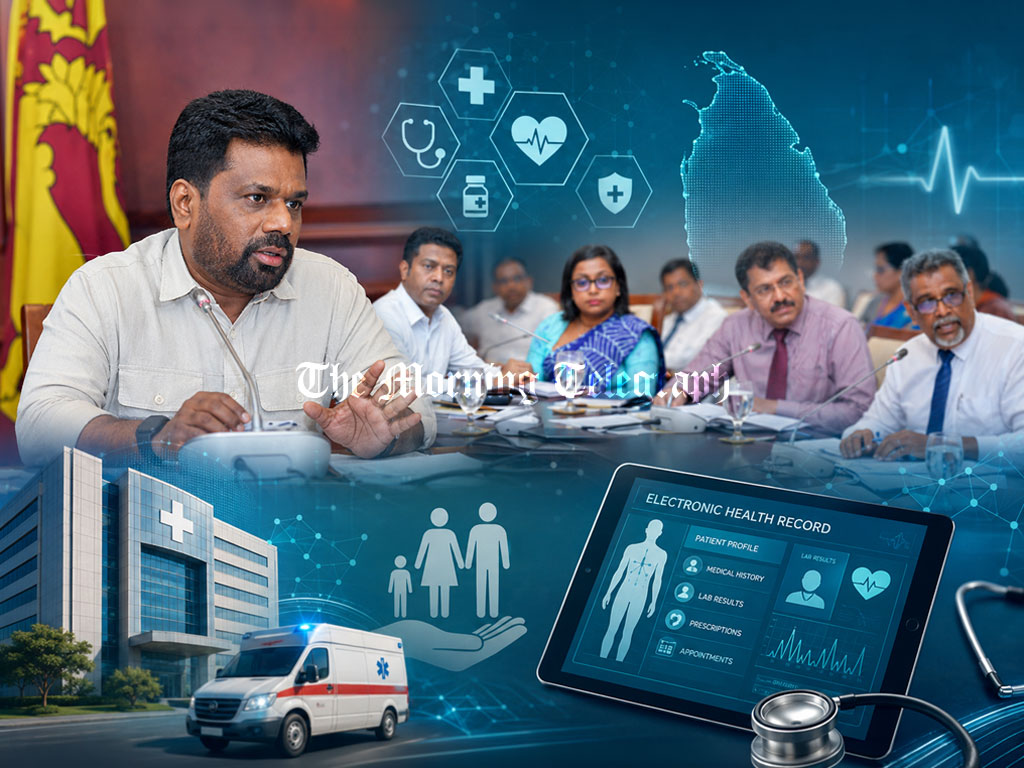
President Dissanayake made the remarks yesterday (08) afternoon during a pre-budget discussion at the Presidential Secretariat. The meeting reviewed projects implemented through the 2026 budget allocations for the Ministry of Health and Mass Media.
Officials also discussed proposals and financial requirements for the 2027 budget.
During the discussion, participants reviewed progress on the programme to establish “Health Care Centers” to strengthen primary healthcare services. The President instructed officials to give greater priority to developing and strengthening primary healthcare facilities across the country.
Officials separately reviewed the progress of projects implemented by each department under the Ministry of Health and Mass Media. They also examined funding requirements for the 2027 budget.

Sri Lanka Healthcare Reforms Focus on Technology
President Dissanayake instructed officials to submit strategic proposals based on scientific evidence without delay. He said these proposals should focus on improving the overall quality of healthcare services across the country.
The meeting also gave special attention to the planned technological transformation of Sri Lanka’s hospital system.
The President highlighted the importance of creating technologically advanced healthcare facilities that people can access across the island. He said such improvements would significantly raise the quality of healthcare services.
According to the President, these developments would allow citizens to receive efficient and standardized care through the government hospital system. At the same time, better public services could reduce the heavy financial burden on people who seek treatment from private healthcare institutions.
The discussion also focused on strengthening the Suwaseriya ambulance service.
Officials examined plans to ensure that hospitals procure only high-tech ambulances that meet international standards in the future, rather than traditional vans.
The meeting revealed that the government has restarted 26 large-scale health sector construction projects. Previous governments had halted the projects after suspending capital expenditure.
The restarted projects include the five-storey building complex at Monaragala District Hospital. They also include emergency and treatment units at hospitals in Trincomalee, Ampara and Chilaw.
Officials further revealed that 48 construction projects are currently underway.
Medicine Supply and Digital Health Network Reviewed
The meeting also examined technical solutions to problems affecting medicine procurement. The aim is to maintain an uninterrupted supply of essential medicines to hospitals.
Officials also considered ways to expand the Ministry of Health’s capacity to conduct medicine quality testing.
In addition, the discussion covered programmes implemented with support from organizations including the United Nations Development Programme (UNDP) and the United Nations Children’s Fund (UNICEF).
Digital transformation formed another major part of the review.
Officials assessed the progress of the “Patient Health App” and telemedicine services. They also reviewed plans to establish a unified healthcare network through a National Electronic Health Record system.
The proposed system would allow authorized access to patient information from any hospital within the network. This initiative forms part of the broader digital transformation of the health sector.
The meeting also decided to conduct a formal staff review within the health service.
Officials will address problems faced by newly appointed doctors during the review process. They will also discuss matters related to healthcare staff recruitment with the Ministry of Finance.
Media, Postal and Printing Services Face Modernisation
The discussion extended beyond the Sri Lanka healthcare reforms and also reviewed several programmes under the mass media portfolio.
Officials examined the progress of programmes designed to provide physical resources to the government film sector. They also reviewed journalist training initiatives and the establishment of school media clubs.
Attention was further given to a proposal to establish a special media operations room. The proposed facility would allow journalists and the government to exchange information more efficiently.
Furthermore, President Dissanayake stressed the need to abandon outdated practices and modernise the Department of Posts Sri Lanka and the Government Printing Department through modern technology.
The discussion brought together senior political and administrative officials responsible for health, media, finance, energy and government planning.
Minister of Health and Mass Media Nalinda Jayatissa attended the meeting alongside Deputy Minister of Mass Media Kaushalya Ariyaratne and Deputy Minister of Health Hansaka Wijemuni.
Secretary to the President Dr. Nandika Sanath Kumanayake and Chief of Staff to the President Prabath Chandrakeerthi also participated.
Other attendees included Secretary to the Ministry of Finance, Planning and Economic Development Dr. Harshana Suriyapperuma and Secretary to the Ministry of Energy and Senior Additional Secretary to the President Russell Aponso.
Senior Additional Secretary to the President Kapila Janaka Bandara also attended.
Secretary to the Ministry of Health and Mass Media Specialist Dr. Anil Jasinghe and Director General of Health Services Dr. Asela Gunawardena participated alongside officials from the Ministry of Finance and the Ministry of Health and Mass Media.
The discussions signal a broad government push to connect infrastructure investment with digital technology, stronger primary care and better medicine management. The challenge now is turning those plans into accessible, standardized and internationally competitive public healthcare services across Sri Lanka.