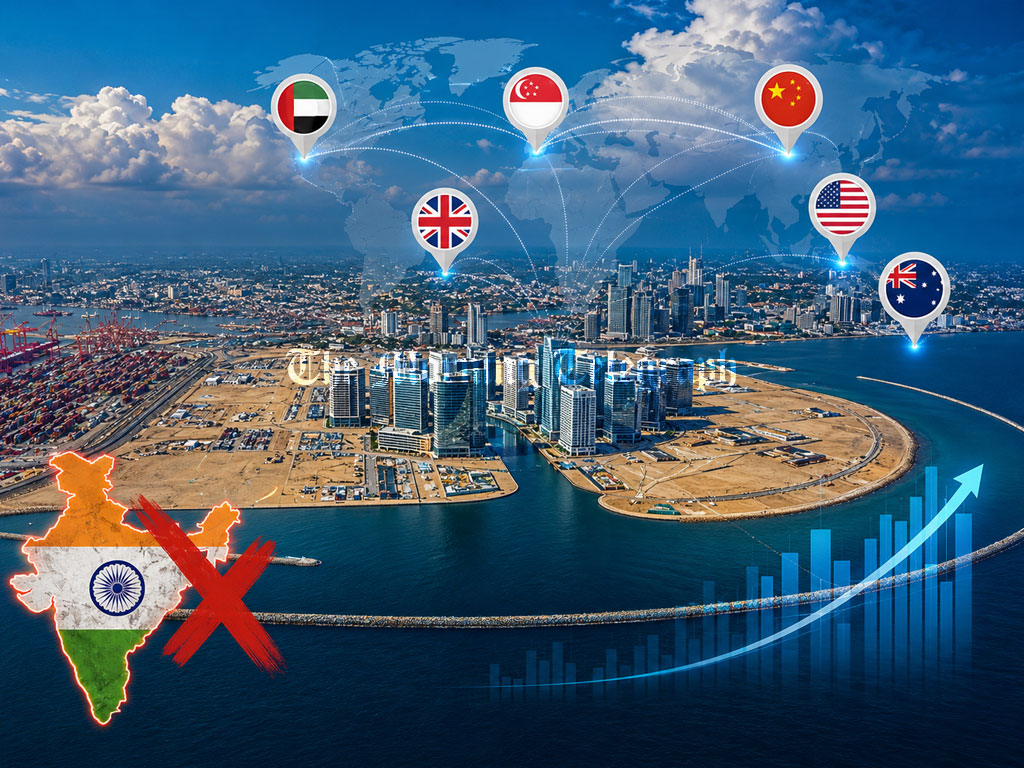
Colombo Port City investors from global markets as India remains largely absent from the Special Economic Zone
Colombo Port City investors are increasingly arriving from major global markets, but India’s absence continues to stand out in the project’s investment profile.
Businesses from the United Arab Emirates, Singapore, China, the United Kingdom and the United States are showing growing interest in the Special Economic Zone.
However, neighbouring India and the wider South Asian region remain largely missing from its leading investor base.
The latest data shows that the UAE accounts for 19% of foreign investor interest. Singapore, China and the UK each account for 13%.
The United States contributes 10%, while Australia represents 9%.
Together, these figures suggest that Port City Colombo is attracting interest from established financial and commercial centres. Investors in those markets are already familiar with cross-border business opportunities.
However, India’s absence raises important questions about the development’s regional appeal.

Colombo Port City Investors Come From Global Hubs
India is South Asia’s largest economy and one of Sri Lanka’s closest trading partners.
Despite that relationship, Indian companies have not emerged as major participants in the Port City Colombo investment pipeline.
Port City Colombo Deputy Managing Director Thulci Aluwihare believes the challenge relates more to awareness than competitiveness.
According to him, authorities should not promote the project simply as an investment destination within Sri Lanka.
Instead, they should present it as an internationally competitive platform capable of supporting regional and global business operations.
Port City Colombo differs from a conventional property development.
It operates under a separate regulatory framework established through the Colombo Port City Economic Commission Act.
Investors can access streamlined approvals through a single-window system. The framework also permits unrestricted foreign ownership.
Transactions can take place in 16 designated foreign currencies. Investors also receive enhanced capital mobility and long-term fiscal incentives for qualifying projects.
For multinational companies, these features aim to reduce bureaucracy.
They are also intended to create conditions comparable with globally recognised business centres such as Dubai, Singapore and Abu Dhabi.
Why India Has Yet to Enter in Force
The challenge now is turning regulatory advantages into actual South Asian investment.
India continues to expand as one of the world’s fastest-growing economies. It is also producing companies with strong regional and global ambitions.
Yet Indian businesses have not become leading Colombo Port City investors.
This disconnect may show that incentives alone are not enough.
Building confidence often requires sustained engagement and stronger commercial partnerships.
Investors may also want clear evidence that successful businesses are already operating within the Special Economic Zone.
The current investor profile still offers encouraging signs.
Interest from several advanced international markets suggests that global investors recognise the project’s long-term potential.
This interest has continued despite wider economic uncertainty across the region.
However, regional participation remains important if Port City Colombo hopes to become a genuine South Asian business hub.
South Asia Could Define the Next Growth Phase
As Colombo Port City strengthens its position as an international financial and commercial centre, its next phase may depend on nearby markets.
Attracting distant investors remains valuable. However, convincing Indian and other South Asian businesses may prove even more important.
Port City Colombo could offer those companies a platform for international operations and cross-border expansion.
To achieve that, the project must demonstrate that its regulatory system, incentives and business environment work effectively in practice.
It must also deepen direct engagement with companies across India and the wider region.
The key question is whether Port City Colombo can become a gateway for South Asian businesses seeking international markets.
The answer could determine how quickly the project moves beyond ambitious development plans and becomes a fully functioning regional commercial centre.