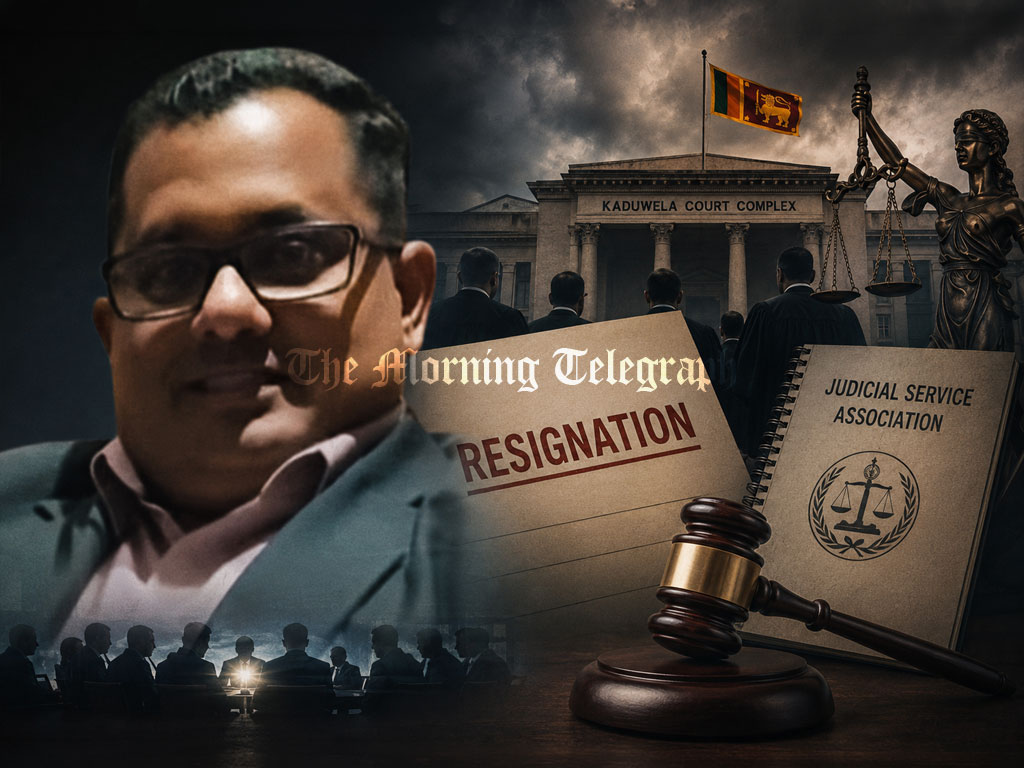
Pasan Amarasena resignation deepens the JSA crisis as he alleges altered minutes, insufficient participation and an unlawful judges’ meeting.
The Pasan Amarasena resignation has plunged the Judicial Service Association into a deeper crisis hours before its controversial Special General Meeting.
Amarasena, the Fort Magistrate and President of the Judicial Service Association, resigned as the meeting was due to begin today (11) at the Kaduwela Court Complex.
In a lengthy letter to members, he accused JSA Secretary Suranga Munasinghe and sections of the Executive Committee of breaching professional ethics, altering meeting records and attempting to conduct an unlawful gathering.
The controversy centres on a proposal to extend the retirement age of superior court judges, including Chief Justice Surasena.
Amarasena alleged that the meeting lacked the required participation and approval. However, Munasinghe rejected all accusations and confirmed that the meeting would proceed as scheduled.

Pasan Amarasena Resignation Follows Serious Allegations
Amarasena said the JSA traditionally seeks the concurrence of the Judicial Service Commission before convening a Special General Meeting.
However, he alleged that the Secretary and other officials abandoned that practice because they feared the Commission would prevent the meeting.
He also raised questions about participation.
According to established JSA procedure, one-third of its members must request a Special General Meeting. Alternatively, the Executive Committee may propose one if at least one-third confirm their attendance.
Amarasena said that threshold amounted to at least 86 members. However, only 46 had confirmed participation before the deadline.
Despite this, he alleged that Munasinghe altered Executive Committee decisions and minutes to force the meeting to proceed.
Amarasena claimed those actions served political interests and individuals opposing the proposed retirement-age extension.
He also said the Kaduwela Magistrate had not obtained permission from the Judicial Service Commission to use an open courtroom on a Saturday.
Therefore, he said he could not chair what he described as an unlawful meeting.
Secretary Rejects Claims and Says Meeting Will Proceed
Within hours of the resignation letter becoming public, JSA Secretary Suranga Munasinghe issued an urgent notice to members.
Munasinghe rejected all allegations directed at him and the Executive Committee.
He also maintained that the JSA Special General Meeting would proceed today at the Kaduwela Magistrate’s Court.
According to his notice, he holds two documents formally notifying the JSC Secretary about the meeting.
The conflicting accounts have exposed a major internal division within the association.
While Amarasena says the meeting violates established traditions and participation requirements, Munasinghe insists that the organisers followed the necessary notification process.
The dispute has intensified an already serious controversy within Sri Lanka’s judiciary over the proposed extension of judges’ retirement ages.
Amarasena Explains the JSA’s Role
In his full letter, Amarasena addressed all members of the Judicial Service Association.
He said the association was established to support the welfare of judicial officers.
He stressed that the JSA had never functioned as a trade union and lacked the legal capacity to operate as one.
Amarasena also said the JSA was neither registered nor governed by a written constitution.
Instead, he described it as an association consisting only of Sri Lanka’s District Judges and Magistrates. It operates through established traditions and precedents, he said.
According to Amarasena, the association has historically performed a respected role in defending judicial independence.
Every JSA member serves as a judicial officer under the Judicial Service Commission.
He said the association had maintained professional values and independence throughout its history, with the Commission’s support and approval.
How the Special General Meeting Was Proposed
Amarasena said the JSA Executive Committee met on June 27, 2026.
At that meeting, the committee decided to seek members’ views on the widely debated proposal to extend judges’ retirement ages.
It therefore considered holding a Special General Meeting on July 11, 2026.
Amarasena said that before every previous special meeting, the JSA had first informed the Judicial Service Commission of the Executive Committee’s concerns.
The association had either met the Commission or communicated through the JSC Secretary before moving forward.
It then proceeded only after receiving the Commission’s concurrence.
However, Amarasena said his proposal to follow that procedure on this occasion received no support from the Executive Committee.
He claimed members rejected it without reasonable justification.
According to his letter, they argued that consulting the JSC would result in the Commission ordering the association not to hold the meeting.
Amarasena said he had attended every JSA Special General Meeting since 2010. He therefore explained the established procedures clearly to the Executive Committee.
Participation Threshold Becomes Central Dispute
Amarasena said the association could hold a Special General Meeting only under two circumstances.
First, one-third of the total membership could submit a request for the meeting.
Second, if there was no such request, the Executive Committee could propose one. However, at least one-third of all members would still need to confirm their participation.
Because one-third of the membership had not requested the July meeting, Amarasena said the Executive Committee agreed to proceed only if the required participation was confirmed.
The Secretary then posted a message in the official JSA members’ WhatsApp group on July 2, 2026.
The message asked members to confirm whether they would attend.
According to Amarasena, 86 confirmations were required.
However, only 46 members had confirmed when the participation period ended.
He argued that, under the association’s established practices, the meeting could not proceed.
Amarasena then accused the Secretary, some Executive Committee members and a small group of others of attempting to hold the meeting regardless.
He alleged they wanted to pass a resolution opposing the retirement-age extension despite failing to secure the required participation.
Allegation That Meeting Minutes Were Altered
Amarasena said the Secretary had announced that the meeting would proceed before the confirmation period had ended.
He described this as evidence that organisers intended to hold the gathering regardless of the final participation figure.
More seriously, Amarasena alleged that the Secretary deliberately altered Executive Committee decisions and meeting minutes to suit his agenda.
He said the meeting was scheduled for a Saturday inside an open courtroom.
However, according to Amarasena, the Kaduwela Magistrate had not obtained the Judicial Service Commission’s approval to use the venue.
He argued that conducting the meeting without the JSC’s approval would violate established tradition.
He also said proceeding without one-third participation would disrespect the 212 members who had not confirmed attendance.
Amarasena therefore informed members that he could not chair the meeting scheduled for July 11.
He said he would not accept responsibility if another person organised or conducted the meeting under those circumstances.
President Says He Lost Confidence in Leadership
Amarasena strongly criticised the conduct of the Secretary and certain Executive Committee members.
He described their recent actions as unprofessional and unethical.
His accusations included altering Executive Committee minutes and misrepresenting decisions taken at meetings.
He also claimed that some Executive Committee members who had not attended particular meetings made false statements about what had occurred.
Amarasena said he had lost confidence in the Secretary and the majority of the Executive Committee.
He therefore resigned from the JSA presidency with immediate effect.
However, he thanked Executive Committee members and other judicial officers who had expressed their views honestly and without fear.
He also thanked the full membership for unanimously electing him as President at the previous Annual General Meeting.
Retirement-Age Dispute Drives Judicial Turmoil
The Pasan Amarasena resignation comes amid intense debate over extending the retirement age of senior judges.
Critics have described the proposal as an attempt to extend the tenure of Chief Justice Surasena.
Supporters and opponents within the judiciary appear deeply divided over whether the JSA should formally take a position.
The dispute now involves accusations of political agendas, procedural manipulation, altered documents and attempts to obstruct or force the meeting.
However, Munasinghe has firmly denied those claims.
The immediate outcome of the Special General Meeting could determine whether the association adopts an official position on the retirement-age proposal.
It may also shape confidence in the JSA’s leadership, procedures and role in protecting judicial independence.
With its President gone and its Secretary pressing ahead, the association now faces one of the most serious internal confrontations in its history.
The reply letter sent to the members by the Secretary of the Judicial Services Association, Judge Suranga Munasinghe, refuting the allegations made by the President of the Judicial Services Association, is published below.
Dear colleagues,
It is respectfully inform you that the Execetive Committee of the JSA has given me the authority to send this message to all of you.
EXCO has vehimently denied all the contents of the message of the President JSA on this group which is posted only 13 hours before the SGM scheduled tomorrow.
Hence I kindly and respectfully inform all the members that the SPECIAL GENERAL MEETING will be held on 11.07.2026 – 10 AM at the MAGISTRATE COURT, Kaduwela.
Further I attach two letters sent by the JSA informing the Secretary JSC about the SGM upon the decision taken by the EXCO.
Thanking you.
Secretary JSA