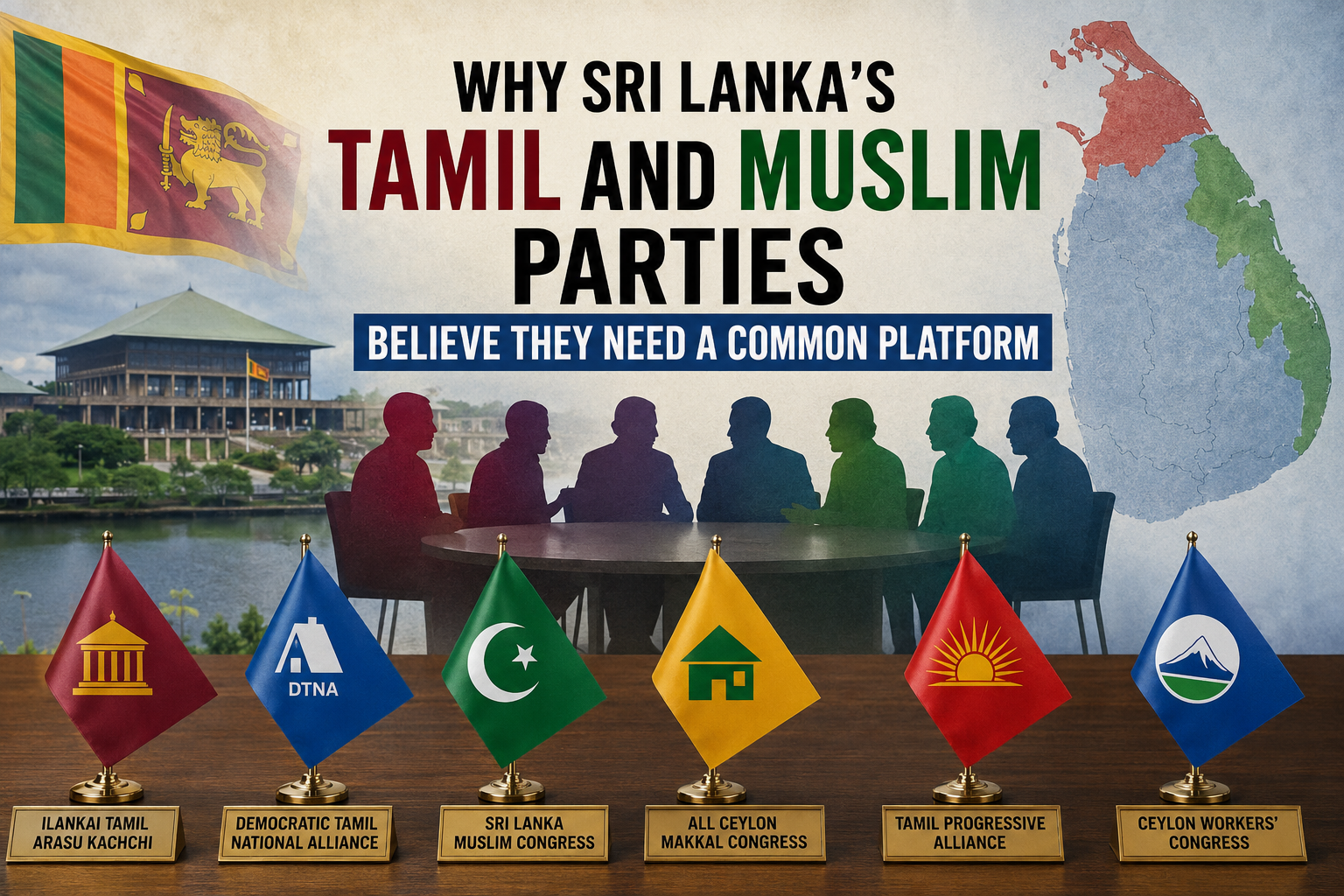
The Sri Lanka minority parties platform unites six Tamil-speaking parties around land, devolution, elections and minority rights.
Six parties representing Tamil-speaking communities have formed a Sri Lanka minority parties platform, reviving a central political question: why is such a grouping necessary when Tamil and Muslim politicians already work with the country’s major national parties?
The answer goes beyond a simple ethnic disagreement.
Tamil and Muslim communities do not collectively oppose the National People’s Power government, the Samagi Jana Balawegaya or Sri Lanka’s Sinhalese majority. Many minority voters support national parties. Several minority politicians also work within wider opposition alliances.

However, the six parties argue that long-standing regional and minority concerns repeatedly lose priority inside larger political movements.
The platform includes the Ilankai Tamil Arasu Kachchi, Democratic Tamil National Alliance, Sri Lanka Muslim Congress, All Ceylon Makkal Congress, Tamil Progressive Alliance and Ceylon Workers’ Congress.
During a joint media briefing in Colombo, their leaders said they would cooperate on common concerns. These include constitutional reform, provincial council elections and land disputes. They have not announced a formal merger or joint electoral alliance. Instead, each party plans to retain its identity while working together on agreed issues.
Are Minority Communities Being Shut Out?
Tamil and Muslim citizens do not face legal exclusion from Sri Lanka’s national political parties or state institutions. They vote, contest elections, hold public office and participate in national political movements.
The 2024 parliamentary election also showed that many minority voters were willing to move beyond traditional ethnic parties.
The NPP won 159 of Parliament’s 225 seats, while the SJB secured 40. It also made notable gains in the north and east, where Tamil and Muslim parties had traditionally held stronger influence. Official election results show that ITAK, Parliament’s largest Tamil party, won eight seats. The SLMC secured three seats, while the ACMC won one.
That outcome weakened the argument that only community-based parties can represent minority voters.
Tamil and Muslim citizens also face many of the same daily pressures as other Sri Lankans. These include the cost of living, unemployment, corruption, weak public services, taxation, education problems and economic insecurity. The NPP’s national message attracted voters frustrated with both traditional national parties and established minority leaders.
Therefore, the new grouping does not necessarily prove that larger parties reject minority communities.
Instead, it may show that traditional minority parties fear losing political relevance.
Why a Sri Lanka Minority Parties Platform Still Appeals
Although Tamil and Muslim voters share national concerns, some political questions affect particular communities more directly.
Northern and eastern Tamil parties continue to seek greater regional power-sharing and the full use of Tamil in public administration. They also demand answers for families of missing persons, the return or release of disputed land and accountability for abuses linked to the civil war.
Muslim parties highlight land disputes, representation in the Eastern Province, religious discrimination and the treatment of Muslim communities after the 2019 Easter Sunday attacks.
Northern Muslims also carry the unresolved legacy of their forced expulsion from the Northern Province in 1990. Many families displaced to Puttalam spent years or decades seeking resettlement, recovering property and rebuilding livelihoods.
Meanwhile, Malaiyaha Tamils in plantation regions face a different set of problems. These include low wages, insecure housing, limited land ownership, unequal educational access and poor public infrastructure.
Major national parties may acknowledge these issues in principle. However, minority leaders say such concerns often receive attention during elections, then disappear behind broader national priorities.
That claim provides the main justification for the common platform.
A government or opposition can ignore one small party or negotiate with it separately. However, six parties taking the same position may have a stronger chance of forcing a national response.
Is the Group Opposing the NPP Government?
The parties have avoided portraying the initiative as an anti-government front.
Their leaders say they plan to discuss their concerns with the government, opposition parties, civil society organisations and religious leaders. Their immediate priorities include restoring provincial council elections, which have faced years of delay, and advancing constitutional reform.
However, the platform still places political pressure on the NPP.
The NPP’s success in Tamil and Muslim areas gave the government a powerful argument. It can say minority voters no longer see ethnic parties as their only representatives.
The six-party initiative answers with a different message. Winning Tamil and Muslim votes does not mean the government has resolved every problem affecting those communities.
Therefore, the relationship is better understood as political competition, not ethnic hostility.
Could the Platform Weaken the SJB?
The grouping may create an even more immediate challenge for the SJB-led opposition.
Several major figures in the platform, including Mano Ganesan, Rauff Hakeem and Rishad Bathiudeen, have held important roles within the broader opposition camp. CWC General Secretary Jeevan Thondaman’s participation is also significant because he entered Parliament through a different national alliance.
None of the parties has formally withdrawn from its current arrangements.
Still, the creation of a separate platform suggests they do not want to rely entirely on Sajith Premadasa, or any other national leader, to express their concerns.
Collective negotiation could allow them to approach the NPP, the SJB or another future political force from a stronger position.
That possibility helped fuel speculation about divisions within the opposition.
How Much Political Power Could It Gain?
The Sri Lanka minority parties platform cannot threaten the government through parliamentary numbers alone.
The NPP holds 159 seats and can pass ordinary legislation without minority-party support. Parliament’s official composition gives ITAK eight seats, the SLMC three, the ACMC one and the DTNA one. Some MPs linked to the TPA and CWC entered Parliament through larger alliances. As a result, calculating the platform’s exact strength as a separate bloc remains difficult.
However, its influence could matter beyond routine parliamentary votes.
The parties retain concentrated support in the north, east and central plantation districts. That support could become important during provincial council elections, local elections or a closely fought future presidential election.
Their strongest weapon is not the power to defeat the government. It is their ability to organise voters, influence debate and negotiate collectively rather than as six competing organisations.
Contradictions Could Test the Alliance
The coalition also contains serious weaknesses.
Its members do not represent a single, identical community. Northern Tamil nationalism, eastern Muslim politics and plantation Tamil concerns have different histories, demands and political priorities.
Some member parties have competed bitterly against one another. Tamil and Muslim communities have also faced political disputes over land, administration and representation in mixed areas.
The platform will face difficult tests if those disagreements return.
It must also persuade voters that the initiative serves the public rather than protecting political careers.
Traditional minority parties have often faced criticism for switching alliances, accepting ministerial positions and raising community grievances during elections without delivering lasting solutions.
The six parties may now be joining forces because they recognise that the NPP has weakened their traditional hold over minority voters.
Why Community-Based Parties Can Still Be Legitimate
There is nothing inherently improper about parties organising around the concerns of a region, language group or community.
Farmers, workers, businesses and professional bodies also organise to influence public policy. Minority communities have the same democratic right to act collectively.
The decisive question is whether the platform advances equal citizenship or deepens ethnic division.
A constructive grouping would offer practical solutions, recognise the suffering of every community and work within a united Sri Lanka. It would also confront difficult issues inside its own constituencies. These include the displacement of northern Muslims and disputes between Tamil and Muslim communities.
A damaging platform would depend on fear, grievance and ethnic mobilisation while offering little beyond speeches and electoral bargaining.
For now, the six-party initiative is neither a serious numerical threat to the government nor proof of a nationwide ethnic crisis.
It is a political response from smaller parties that believe their traditional influence is fading, even as many of the issues they were formed to address remain unresolved.
Whether they genuinely need to exist will ultimately depend on their results.
Clear proposals and measurable progress on land, provincial elections, housing and equal public services could give the platform a useful democratic role.
However, if the effort ends with photographs, press conferences and private deals, voters may reach a harsher conclusion. They may decide its main purpose was not to protect Tamil and Muslim communities, but to protect the politicians who claim to represent them.