Sri Lanka budget surplus claims face criticism over higher taxes, falling reserves, rising debt and reduced spending on public needs.
The Sri Lanka budget surplus celebrated by the government is being presented as a major economic achievement. However, critics argue that ordinary people have paid the real price.
The government’s approach, according to this criticism, resembles saying: “When people become malnourished, they lose weight, and that is good for their health.”
In recent days, government leaders have highlighted what they describe as Sri Lanka’s first “overall budget surplus” since 1970.
The figures sound impressive. The government has pointed to a Rs. 197 billion surplus during the first five months of 2026. It has also highlighted a 30.6% increase in state revenue.
However, the central question remains: what lies behind this overflowing Treasury?
Does it reflect genuine economic development, or has the government balanced its accounts by placing a heavier burden on the public?

Higher Taxes Drive the Sri Lanka Budget Surplus
Government tax revenue reportedly rose by 23.9% to Rs. 2.32 trillion. Critics argue that this increase did not come from higher national production or rapid industrial growth.
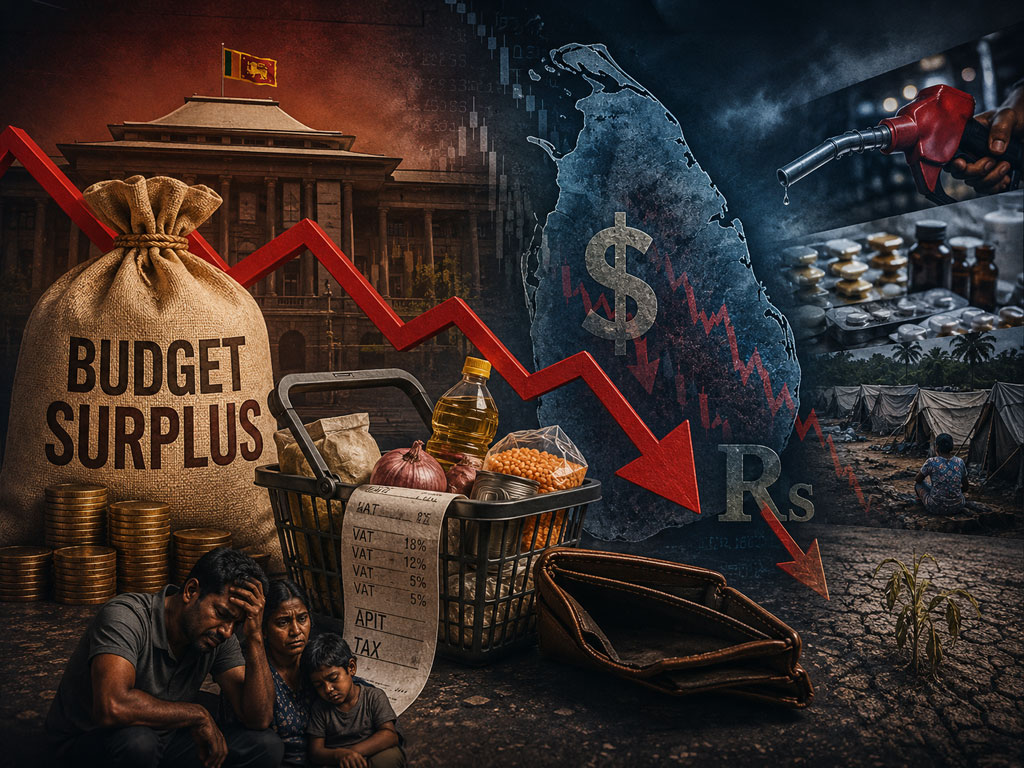
Instead, they say excessive Value Added Tax has pushed up the cost of everyday goods and services. As a result, the government has collected more revenue while ordinary households struggle with rising prices.
The criticism is that the state has filled the Treasury by striking directly at the budgets of low-income families.
Meanwhile, the Advance Personal Income Tax, or APIT, continues to reduce the salaries of middle-class professionals. Engineers, doctors, private-sector employees and other salaried workers face deductions from their monthly earnings.
Many now find it increasingly difficult to meet household expenses.
Can this be called an achievement?
Reducing the public’s purchasing power and collecting more taxes cannot, by itself, represent genuine economic progress.
Critics also accuse the government of cutting capital expenditure while raising revenue. By reducing spending on development projects, the administration can show a stronger budget balance.
However, even a small shopkeeper could create a surplus by increasing income while refusing to invest in improvements.
Foreign Reserves Fall as the Rupee Weakens
The external economy presents a less encouraging picture, according to the figures cited in the commentary.
While the government displays a surplus measured in billions of rupees, Sri Lanka’s foreign financial position remains under pressure.
Official foreign reserves reportedly stood at $6,881 million at the end of May 2026. By the end of June, they had fallen by $431 million, or 6.2%, to $6,450 million.
The value of official gold reserves also declined.
Gold reserves reportedly fell from $215.8 million at the end of May to $191 million by the end of June. That represents an 11.7% fall during June alone.
Meanwhile, the Sri Lankan rupee reportedly lost between 7.9% and 8% against the US dollar during the first half of the year.
The dollar selling rate has reached approximately Rs. 341.
A weaker rupee raises the local cost of imported goods. This includes fuel, medicine, cooking gas and many other essentials.
Therefore, further price increases could follow if the currency continues to depreciate.
Public Debt Continues to Rise
The government’s total debt burden has not fallen despite the celebrated Sri Lanka budget surplus.
According to the figures presented, total government debt increased to Rs. 30.19 trillion, or Rs. 30,193,178 million, by the first quarter of 2026.
Domestic borrowing through Treasury bills and bonds has also continued.
Critics warn that repeated borrowing from local banks has pushed domestic debt to an increasingly dangerous level.
Meanwhile, the government’s total foreign debt reportedly remains around $37.5 billion, or $37,468 million, despite the ongoing restructuring process.
A surplus in one part of the government’s accounts therefore does not mean the country’s wider debt problem has disappeared.
Cyclone Survivors Remain in Temporary Shelters
The commentary also accuses the government of neglecting communities devastated by the Ditwa cyclone and floods at the end of November 2025.
Nine months after the disaster, many affected people reportedly remain in temporary shelters.
The cyclone and floods affected more than 2.2 million people, representing over 10% of Sri Lanka’s population.
Official figures cited in the article state that more than 646 people died, while hundreds remained missing.
Nearly 6,000 homes were completely destroyed. More than 100,000 houses suffered damage.
Thousands of displaced families in Badulla, Kandy, Nuwara Eliya and the Eastern Province reportedly continue living in tents and camps. Many lack suitable housing and basic necessities.
Critics therefore ask what benefit a Treasury surplus offers when the government does not use those funds to rebuild the lives of disaster victims.
Farmers Face Fertiliser Costs and Low Paddy Prices
Sri Lanka’s farming community is also facing severe economic pressure.
The government stands accused of failing to provide fertiliser and agrochemicals at the right time and at subsidised prices.
High fertiliser prices have reportedly pushed cultivation expenses to three or four times their previous levels.
After paying those costs and producing a harvest, farmers still struggle to secure a fair guaranteed price for paddy.
Middlemen and large-scale rice mill owners allegedly purchase paddy at extremely low prices. Meanwhile, the government has not taken sufficient action to protect producers.
As farmers fall deeper into debt, government revenue figures continue to rise.
That contrast has strengthened criticism that the surplus exists on paper while rural households absorb the real economic losses.
Healthcare Cuts and the Dengue Threat
The consequences of expenditure reductions are also visible in the public health system.
Hospitals continue to face shortages of essential medicines, life-saving drugs and medical equipment.
The Government Medical Officers’ Association has warned that a dengue outbreak is developing across the country.
According to the Medical Officer of Health, the number of dengue-risk zones has risen alarmingly.
However, critics say the government has failed to provide enough funding or implement adequate control programmes.
A budget surplus offers little comfort if hospitals lack medicine and authorities cannot contain a preventable public health emergency.
The Political Warning From 1970 to 1977
The claim that this is Sri Lanka’s first budget surplus since 1970 also carries a difficult historical comparison.
The government led by Sirimavo Bandaranaike between 1970 and 1977 followed strict financial controls, import restrictions and a closed-economic system.
That administration also asked people to tighten their belts.
Ordinary citizens endured long queues and shortages of basic food, including rice and bread.
Although the government presented its policies as necessary economic management, voters delivered a devastating verdict at the 1977 general election.
The Sri Lanka Freedom Party, which had won a major victory in 1970, secured only eight of the 168 parliamentary seats in 1977.
The Tamil United Liberation Front won 18 seats and became the main opposition. Sirimavo Bandaranaike therefore lost even the position of Leader of the Opposition.
The comparison offers a warning for today’s government.
History suggests that voters do not judge economic success only through Treasury balances and percentages. They also judge whether they can afford food, medicine, transport and housing.
When reserves decline, debt climbs, the rupee weakens and public hardship continues, a surplus filled with impressive numbers provides little relief.
The political fate of the rulers defeated in 1977 remains a lesson for any government that celebrates financial statistics while ignoring the daily suffering behind them.