A second freedom struggle is needed to reform Sri Lanka’s colonial-era institutions and replace hatred-driven politics, analysts argue.
A second freedom struggle is necessary to reform Sri Lanka’s weakened civil institutions and move the country beyond colonial-era systems, two political commentators have argued.
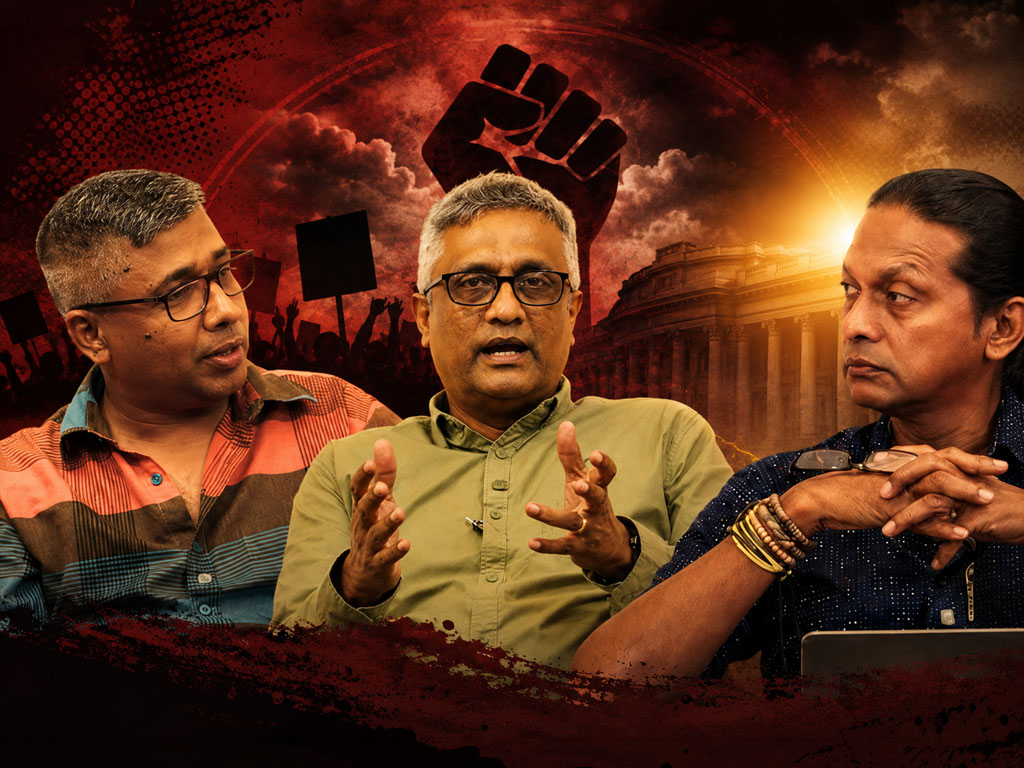
Political analyst Vipula Karunathilaka and Samabima Party leader Diptikumar Gunaratne presented the argument during TV Supreme’s IF – Smart Casual programme.
The special discussion, titled “Why is a second freedom struggle necessary?”, was hosted by journalist Narada Bakmeewewa.
The speakers also argued that elections increasingly depend on exploiting hatred, uncertainty and manufactured enemies rather than presenting policies suited to the country.
They further claimed that the former social dominance of an elite “Brahmin caste” had collapsed. As evidence of that wider change, they pointed to children educated at central schools who now hold senior national positions, including Cabinet office.
Although Sri Lanka gained independence in 1948, they said the state machinery continues to operate through systems created during colonial rule. Therefore, the country needs another struggle focused on institutional and civic reform.

Social Media Reshapes Political Debate
Karunathilaka and Gunaratne said traditional media had restricted serious intellectual discussion for many years.
As a result, they argued, contemporary ideological and political struggles have largely shifted to social media platforms.
The weakening of traditional media’s narrow controls has created new opportunities for citizens to express political views. Social networks now allow almost anyone to become a broadcaster and communicate directly with an audience.
According to the discussion, this transformation has ended the era when political actors could work quietly without explaining their positions publicly.
Instead, those who can present and defend their ideas logically now have a greater opportunity to advance within political debate.
However, the speakers also highlighted a more troubling development. They argued that modern election campaigns often focus less on public policy and more on emotional manipulation.
Political movements increasingly exploit public uncertainty, anger and hatred, they said. Campaigns also create enemies and use those divisions to gather electoral support.
Under this model, elections are won by capitalising on resentment rather than offering policies designed to address Sri Lanka’s long-term needs.
Elite Dominance and Intellectual Debate Decline
The speakers said Sri Lanka now faces a clear shortage of meaningful intellectual discourse, even as society undergoes major structural changes.
Although the internet provides easy access to books and information, the enlightened public debates that once existed have declined, they argued.
At the same time, they claimed that the former dominance of an elite class, which they described as the “Brahmin caste”, had broken down.
That elite influence once extended across medicine, law, universities and public administration.
Today, they said, children from rural farming and labouring families who attended central schools, or Madhya Maha Vidyalayas, occupy some of the country’s most powerful positions.
They pointed to the current Cabinet as an example of that social transformation.
What a Second Freedom Struggle Should Achieve
Sri Lanka achieved political independence from British rule in 1948. However, the speakers argued that many central state institutions still follow systems designed to control colonial subjects.
They identified hospitals, the police, prisons and the judiciary as institutions that have deteriorated because governments failed to reshape them around the needs of a modern civil society.
The central objective of a second freedom struggle should therefore be institutional reform, they said.
Such a movement should redesign public bodies to match the civil and social structures Sri Lanka now seeks to build.
The speakers also emphasised personal liberty, economic freedom, professional rights and privacy.
They called for firm legal penalties when media organisations violate human rights by publishing images of individuals without their consent.
Ultimately, they said Sri Lanka should create a more civilised public culture built on professional responsibility. They referred to the flexible but disciplined conduct expected from professionals such as doctors and teachers in Western countries.
The IF – Smart Casual special programme airs every Tuesday at 9:30 p.m. on TV Supreme.
This article has been compiled by a freelance writer and the writer is responsible for the accuracy of the facts, information, statistics, and sources contained in the article.
🔴 IF – Smart Casual: දෙවන නිදහස් සටනක් අවශ්ය ඇයි?
Source: Ideas front (YouTube) • This is an embedded preview. Click play to watch on this page if your browser supports iframes.
SOURCE:- The Leader