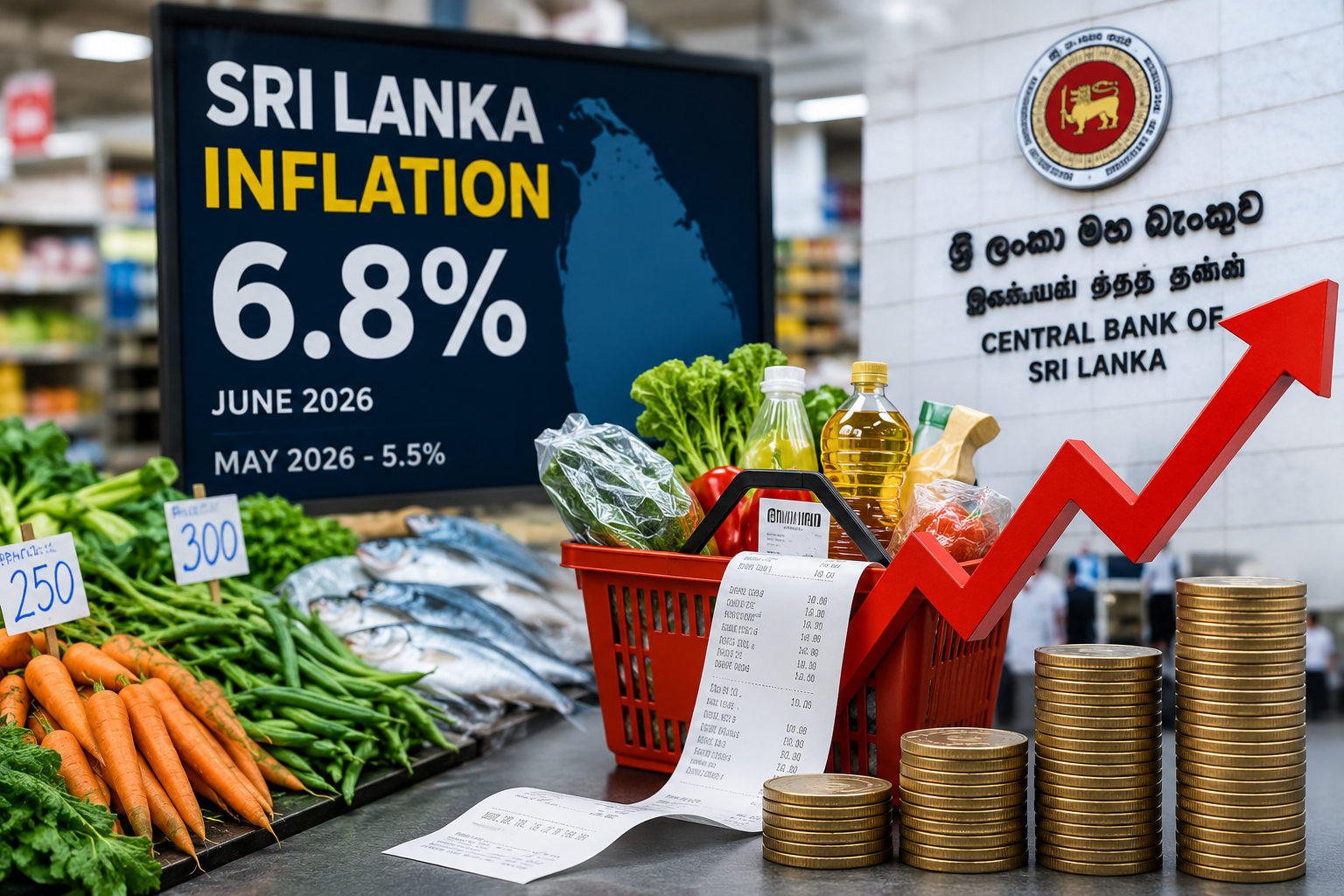
Sri Lanka inflation rose to 6.8% in June as fish, vegetables and higher energy costs placed fresh pressure on household budgets.
Sri Lanka inflation accelerated to 6.8% in June 2026, intensifying pressure on households already struggling with higher food, transport and energy expenses.
The year-on-year Colombo Consumer Price Index rose sharply from 5.5% in May, according to the Central Bank of Sri Lanka. The latest increase placed inflation further above the bank’s 5% target and renewed concerns about the purchasing power of wages, pensions and fixed household incomes.

The Central Bank said continued adjustments to domestic energy prices drove much of the acceleration. Those increases followed higher international petroleum prices linked to the continuing conflict in the Middle East.
Although headline inflation remains below 7%, the June figure shows that the cost-of-living shock has broadened. Food prices, non-food expenses and essential services are now rising together, leaving families with fewer areas in which to reduce spending.
Sri Lanka Inflation Driven by Food and Energy
Non-food inflation climbed to 8.4% in June from 7.8% in May. This category made the largest contribution to the overall annual increase.
Meanwhile, food inflation accelerated much faster. It rose from just 0.9% in May to 3.6% in June, indicating that the pressure had moved beyond fuel and utility-related expenses into household grocery bills.
The Colombo Consumer Price Index also rose 2.1% between May and June alone. Food contributed 1.4 percentage points to that monthly increase, while non-food items added another 0.7 percentage points.
The Central Bank identified fish and vegetables as the main drivers of the monthly food-price increase. These products form an important part of everyday household consumption. Therefore, sharp increases can affect lower- and middle-income families more heavily than wealthier households.
Consumers may also face indirect effects from higher fuel and electricity costs. Businesses often absorb those increases initially. However, transport, refrigeration, production and distribution expenses can eventually feed into the prices charged for food and other services.
The Central Bank had already warned in May that higher global petroleum prices required sharp domestic energy-price adjustments. It said the inflation increase was largely supply-driven, although stronger credit growth and import demand were also creating pressure.
Household Incomes Face a Difficult Test
The inflation rate does not show whether every product increased by 6.8%. Instead, it measures the average annual movement in the basket of goods and services covered by the Colombo index.
However, households experience inflation differently. Families that spend a larger share of their income on food, electricity, transport and cooking energy can face a more severe squeeze than the headline figure suggests.
The central issue is whether salaries, pensions and other income sources have increased at a similar pace. When income growth falls below inflation, households lose purchasing power even when their nominal earnings remain unchanged.
Families may respond by reducing protein-rich foods, delaying healthcare, limiting travel or cutting education-related expenses. Others may rely more heavily on credit to cover routine bills. The official June release did not provide household-income data, so it does not establish how far earnings have kept pace with prices.
Core inflation, which attempts to capture underlying price pressure after excluding some volatile items, rose slightly from 3.9% in May to 4% in June. This suggests that much of the immediate surge remained connected to food and energy pressures rather than a uniform rise across every sector.
Could Interest Rates Rise Again?
The latest inflation figure will place greater attention on the Central Bank’s next monetary policy decision.
On May 26, the Monetary Policy Board increased the Overnight Policy Rate by 100 basis points to 8.75%. The Central Bank cited higher inflation forecasts, energy-price adjustments, private-sector credit growth, import demand and pressure on the external sector.
Higher interest rates can help contain credit demand, support the currency and prevent inflation expectations from becoming entrenched. However, they also increase borrowing costs for households and businesses.
Another increase is therefore possible, but it is not inevitable. The Central Bank said it would assess incoming domestic and global data before taking further action. Its next regular monetary policy statement is scheduled for July 22, 2026.
The bank expects inflation to remain above the 5% target in the near term before easing and stabilising around that level over the medium term. However, it also warned that the Middle East conflict and its wider economic effects had created significant uncertainty.
For Sri Lankan families, the immediate concern is less technical. Food, transport and energy costs are rising at the same time. Unless household incomes adjust accordingly, the June inflation increase could mark the beginning of another difficult cost-of-living squeeze.