The Ukraine drone attack sent more than 400 drones towards Moscow, targeting logistics and oil facilities after Russia’s missile assault on Kyiv.
The Ukraine drone attack sent more than 400 unmanned aircraft towards Moscow and the surrounding region, Russian officials said, in one of the largest reported Ukrainian operations against the Russian capital.
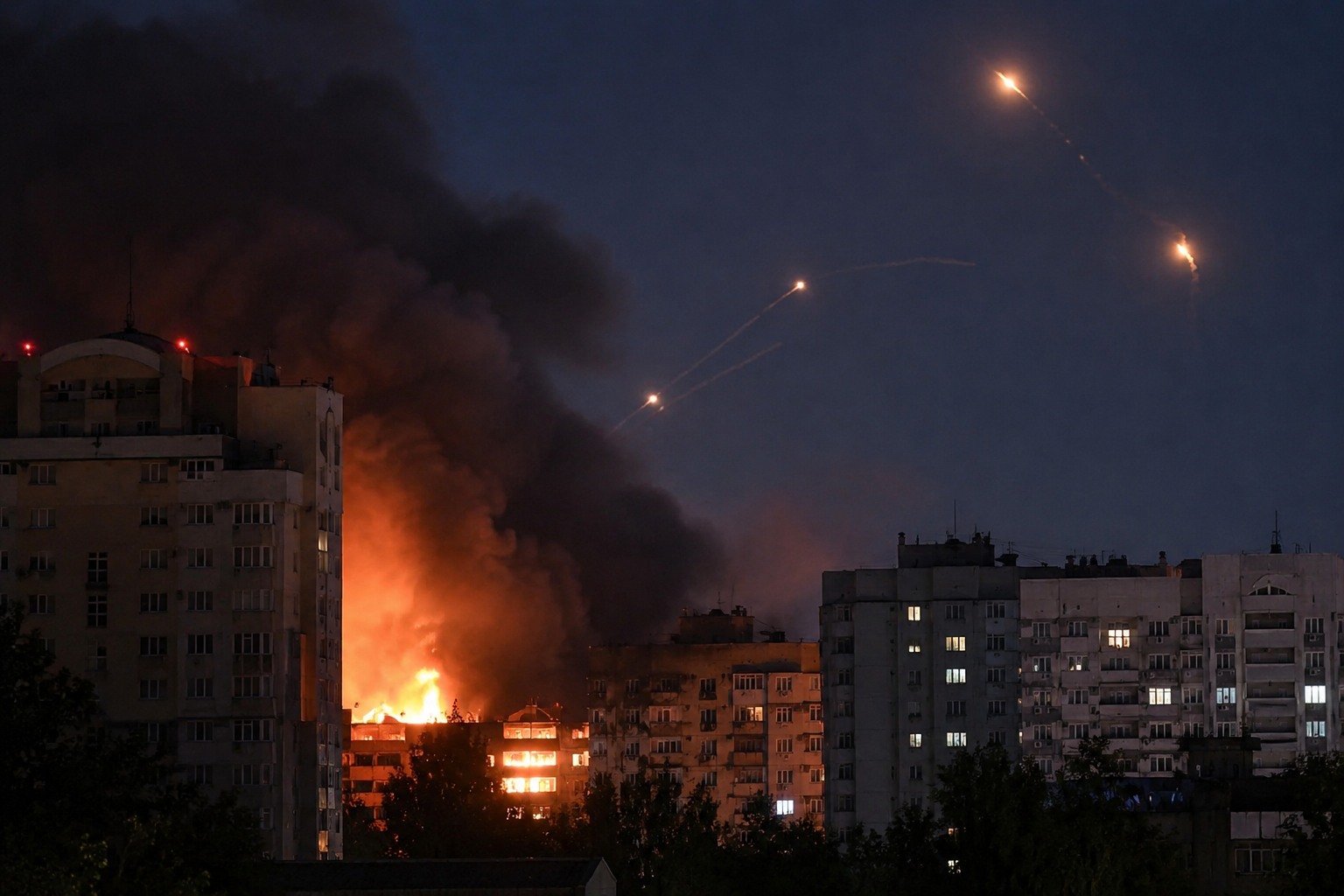
The assault came shortly after Russia launched a major ballistic missile attack against Kyiv and other Ukrainian cities. That Russian barrage killed civilians, damaged buildings and placed further pressure on Ukraine’s limited stock of advanced air-defence interceptors.

The latest exchange shows how the war is moving deeper into both countries. Russia continues to use missiles and attack drones against Ukrainian cities. Meanwhile, Ukraine is increasingly targeting logistics centres, oil facilities and other sites that could support Moscow’s military operations.
Russian authorities said air-defence units intercepted most of the incoming drones. However, officials reported fires, injuries and structural damage in parts of the Moscow region.
The total number of drones and the interception figures came primarily from Russian authorities. Independent observers could not immediately verify the full scale of the operation.
Ukraine Drone Attack Reaches Moscow Region
Russia’s Defence Ministry said its forces intercepted 381 drones across several regions and surrounding waters. It claimed that air defences destroyed 85 drones near Moscow.
The figures suggest that Ukraine launched more than 400 drones during the wider operation. However, it remains unclear how many reached their intended targets or caused damage.
Russian officials reported that 10 people suffered injuries in the Moscow region. The wounded reportedly included three Chinese nationals.
Damage was reported in Domodedovo, near one of Moscow’s major international airports. Fires affected an industrial park, while parts of a residential building also sustained damage.
Authorities temporarily evacuated a logistics centre used by Wildberries, Russia’s largest online retailer. The company’s distribution facilities have faced previous Ukrainian attacks amid allegations that parts of its logistics network support Russian military supply chains.
Ukraine has not released a complete operational account identifying every target. However, Ukrainian President Volodymyr Zelenskyy said logistical facilities and an oil depot near Moscow were among the intended targets.
The statement marked a clear attempt to present the operation as an attack on infrastructure connected to Russia’s war effort rather than a strike directed against Moscow’s civilian population.
Nevertheless, the expanding use of long-range weapons increases the risk to civilians. Falling wreckage from intercepted drones can damage homes, vehicles and industrial buildings even when air defences successfully destroy the aircraft.
Kyiv Assault Triggered Rapid Retaliation
The Ukrainian operation followed Russia’s major overnight assault on Kyiv on July 19.
Russia launched 41 missiles and 125 attack drones and decoys during that attack, according to Ukraine’s Air Force. The weapons included ballistic and hypersonic missiles, which are considerably harder to intercept than slower-moving drones.
At least one person died in Kyiv, while 16 others suffered injuries. Strikes and falling debris damaged apartment buildings, commercial properties, a supermarket and infrastructure near the Lukyanivska metro station.
Ukraine said its forces intercepted or suppressed 18 missiles and 108 drones. However, more than half of the missiles reportedly penetrated the country’s defensive shield.
The attack exposed Ukraine’s shortage of Patriot interceptor missiles and other weapons capable of stopping ballistic threats.
Zelenskyy renewed his appeal for Western allies to accelerate air-defence deliveries. He said protection against ballistic missiles remained Ukraine’s highest immediate priority.
The Moscow operation therefore carried both military and political significance. It demonstrated that Ukraine retained the ability to strike deep inside Russia even while struggling to defend its own cities.
It also sent a message that major Russian attacks on Kyiv could produce rapid retaliation against infrastructure near the Russian capital.
Logistics and Oil Become Central Targets
Ukraine has increasingly used long-range drones to attack Russian oil depots, refineries, warehouses, transport routes and industrial facilities.
These operations seek to disrupt the systems that supply Russian forces and generate revenue for the government. They also force Russia to position air-defence equipment around a growing number of sites far from the frontline.
Protecting Moscow, military bases, refineries, ports and industrial centres across such a large territory creates a difficult challenge. Moving air-defence systems towards one region can leave other locations more vulnerable.
The strikes also impose economic costs. Even when drones fail to destroy a target, authorities may need to halt work, evacuate employees, close airports or inspect damaged infrastructure.
Recent attacks have affected Wildberries warehouses and oil facilities in several Russian regions. Russian officials said earlier strikes killed workers and injured dozens of people.
Ukraine has argued that some logistics hubs play a role in supplying military equipment or components. Russia, however, describes the operations as attacks on civilian and commercial infrastructure.
These competing claims remain difficult to assess independently during an active conflict.
War Moves Further Beyond the Frontline
The Ukraine drone attack illustrates the changing geography of the war.
Frontline battles remain concentrated in eastern and southern Ukraine. However, missile and drone technology allows both countries to strike targets hundreds of kilometres away from direct fighting.
For Russia, long-range missiles provide a way to pressure Ukrainian cities, power systems and military production. For Ukraine, domestically produced drones offer a less expensive method of reaching Russian logistics and energy infrastructure.
The growing scale of these operations could place additional pressure on both air-defence networks. It also increases the danger facing civilians who live near industrial sites, warehouses, airports and transport facilities.
Neither side has shown signs of abandoning its long-range strike campaign.
Russia continues to combine drones with cruise, ballistic and hypersonic missiles in an effort to overwhelm Ukrainian defences. Ukraine, meanwhile, is expanding its ability to launch large drone formations against targets deep inside Russia.
The latest Ukraine drone attack was therefore more than a direct response to the assault on Kyiv. It demonstrated an emerging cycle in which each major strike produces another operation against infrastructure far behind the battlefield.
As that cycle intensifies, Moscow and Kyiv face the same difficult reality: distance from the frontline no longer guarantees protection from the war.