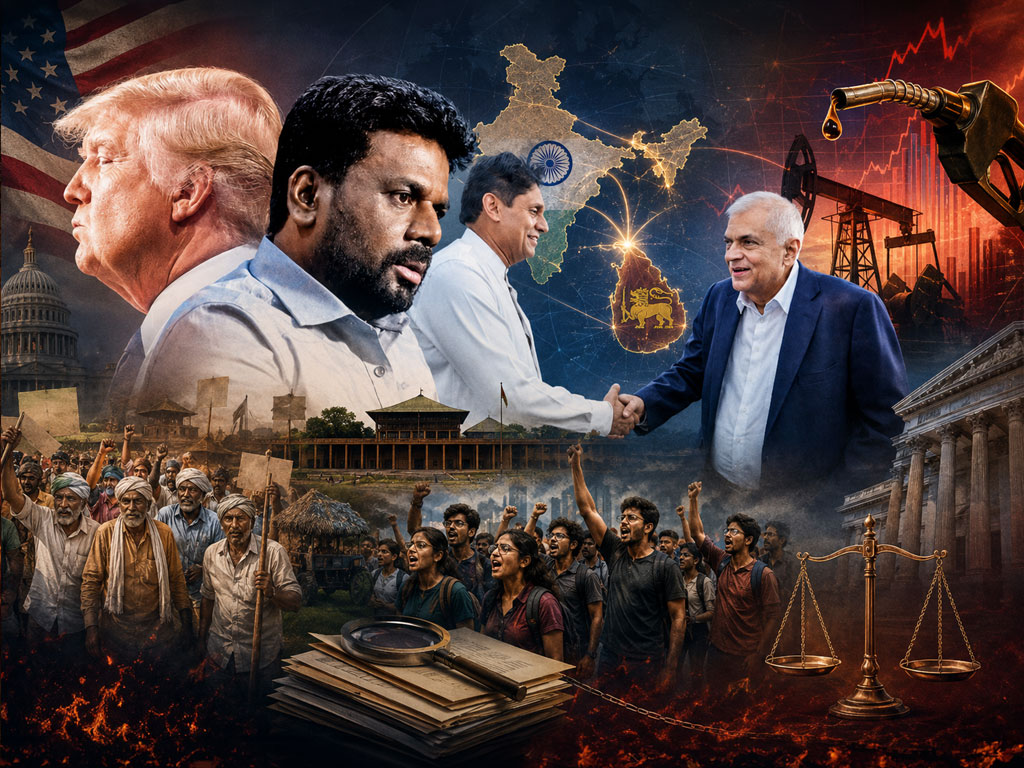
Sajith opposition alliance talks unite rival parties against the NPP as farmers protest and disputes grow over courts, India and investigations.
The Sajith opposition alliance effort has brought together rival political leaders as farmers protest in Sri Lanka and student unrest grows in neighbouring India.
The mass movement that erupted at Colombo’s Galle Face in 2022 under the slogan “Gota Go Home” now appears to have found an echo across the Palk Strait. A major wave of public protests is reportedly gathering momentum against Indian Prime Minister Narendra Modi’s government.
As Sri Lanka experienced three years ago, India’s protest movement has begun developing into a sustained campaign rather than a single demonstration. Film stars, sports personalities and other prominent public figures have also started showing support.
Indian Opposition Leader Rahul Gandhi last Wednesday brought together leaders from opposition parties. The move signalled preparations for a wider political campaign against the Modi administration.
This week’s Inside Politics column begins with India because a similar political pattern appears to be developing in Sri Lanka. While Indian students take to the streets, Sri Lankan farmers are demonstrating against the government.
Likewise, Rahul Gandhi is trying to unite India’s opposition against Modi. In Sri Lanka, Opposition Leader Sajith Premadasa is attempting to bring together forces opposed to the National People’s Power government.

Judicial Proposal Drives Sajith Opposition Alliance
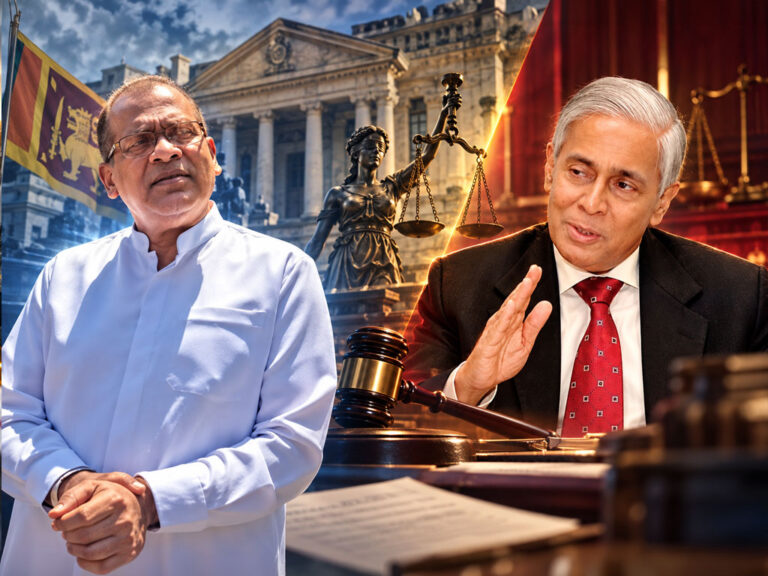
Sajith decided to unite opposition parties after reports emerged about a proposed constitutional amendment affecting the judiciary.
The government is reportedly preparing to extend the retirement age of the Chief Justice and Supreme Court judges by two years.
After the reports surfaced, Sajith moved to bring all parliamentary opposition parties together against the proposal. He arranged a special meeting at the Opposition Leader’s Office in Parliament last week.
The meeting followed strong objections from several legal organisations.
The Bar Association of Sri Lanka publicly criticised the move. The Law Association for Asia and the Pacific, known as LAWASIA, and the Commonwealth Lawyers Association also raised objections.
Associations representing District Court and Magistrates’ Court lawyers opposed the proposed amendment as well. The Judicial Service Association, which represents judges, also expressed criticism.
However, the effort to widen the opposition discussion had begun earlier.
Two weeks before the meeting, Sri Lanka Podujana Peramuna National Organiser Namal Rajapaksa wrote to Sajith. He asked that discussions include political parties and organisations without parliamentary representation.
Sajith responded by planning a broader gathering at the Opposition Leader’s Office. He invited parliamentary and non-parliamentary political leaders.
As reported in last week’s column, Sajith personally telephoned several major figures. They included United National Party leader Ranil Wickremesinghe, Namal Rajapaksa and former President Maithripala Sirisena.
He also contacted several other party leaders and informed them that the discussion would take place on the afternoon of the 23rd.
Venue Dispute Tests Opposition Unity
The location became the first source of disagreement.
Several invitees argued that some political leaders would feel reluctant to attend a meeting at the Opposition Leader’s Office. They proposed a hotel or another neutral venue acceptable to every party.
After receiving those concerns, Sajith explained his position to the leaders who contacted him.
He said the Opposition Leader’s Office was not his private political office. Instead, it was a public institution belonging to the State and available to the opposition as a whole.
Therefore, Sajith argued, a meeting involving all opposition parties should rightfully take place there.
He refused to move the gathering. As a result, the proposal for a hotel or another neutral venue gradually lost support.
Ranil Wickremesinghe also intervened to address the concerns raised by certain leaders.
Ranil urged them not to turn the location into a dispute. He argued that opposition parties gathering at the Opposition Leader’s Office would itself send a powerful political message to the government.
Organisers then faced another question: who should welcome the visiting leaders?
Several suggestions emerged. However, Sajith noted that he had personally extended the invitations.
He said it would therefore be appropriate for him, as Opposition Leader, to receive each leader. The organisers eventually accepted his proposal.
They also discussed how to organise the main table and allocate seats.
The initial plan placed former Presidents Maithripala Sirisena and Ranil Wickremesinghe at the main table. Former Prime Minister Dinesh Gunawardena and Sajith Premadasa were also to sit there.
However, Maithripala later informed organisers that he could not attend. A previously scheduled religious ceremony in Polonnaruwa prevented his participation.
Opposition Leaders Gather at Parliament
After Maithripala withdrew, organisers allocated his seat to Samagi Jana Balawegaya General Secretary Ranjith Madduma Bandara.
The SJB leadership then finalised the remaining seating arrangements.
Senior party members also discussed how to host the visiting political leaders after the formal meeting. Several options were considered.
Most organisers argued that the occasion required refreshments from a reputed hotel. Sajith agreed.
Opposition leaders arrived at the Opposition Leader’s Office last Thursday.
Those attending included Ranil Wickremesinghe, Dinesh Gunawardena, Rauff Hakeem, Namal Rajapaksa and Ravi Karunanayake.
Gajendrakumar Ponnambalam, Mano Ganesan, G.L. Peiris, Palani Digambaram, Arumugam Thondaman and Patali Champika Ranawaka also attended.
Others present included Asanka Navaratne, Chamara Sampath Dasanayake, Nimal Siripala de Silva, Dilith Jayaweera, Wimal Weerawansa and Udaya Gammanpila.
Mahinda Amaraweera, Tiran Alles, Maithree Gunaratne and several other political figures joined the gathering.
Sajith stood at the main entrance and personally welcomed the participants.
Reports described the event as the first public occasion in some time on which Sajith and Ranil shook hands.
The official discussion began after the leaders took their places.
The opposition focused mainly on the proposed amendment concerning senior judges. Participants argued that the government’s plan could weaken judicial independence.
Sajith said political differences and competing party policies should not prevent cooperation.
He pledged that the SJB would stand with democratic forces seeking to protect judicial independence, regardless of party affiliation.
He also warned that previous governments accused of interfering with the courts had faced rejection by the people. Sajith said the current administration could suffer a similar fate.
Ranil Calls for a Joint National Campaign
Ranil Wickremesinghe sat to Sajith’s right and also addressed the gathering.
He said all opposition parties should resist the constitutional amendment reportedly planned by the government.
Ranil noted that the Maha Sangha, civil society organisations and the legal community had already opposed the initiative.
He also argued that matters involving judges should not remain solely for judges to resolve.
Instead, he proposed a united political campaign against the government’s plan.
The other party leaders then presented their positions.
During the meeting, Namal Rajapaksa informed Sajith and Ranil that he had another engagement. He left before the discussions ended.
In Namal’s absence, SLPP General Secretary Sagara Kariyawasam addressed the gathering.
The leaders considered several possible forms of action.
Some proposed launching a major protest march in Colombo involving every opposition party leader.
Others recommended holding joint meetings inside and outside Parliament. Several participants discussed protests that opposition MPs could stage within the parliamentary chamber or complex.
Other suggestions included islandwide public meetings, demonstrations and marches under a common opposition platform.
However, participants did not make a final decision.
After the official session, Sajith invited the leaders to a tea reception.
The atmosphere became more relaxed as participants exchanged greetings and held informal discussions.
Sajith moved around the reception area and spoke personally with the visiting leaders. His light-hearted conversation with Dinesh Gunawardena attracted particular attention.
Sajith jokingly told the former prime minister that the political philosophy he represented now existed within the SJB.
He invited Dinesh to join the party’s political journey.
“The policies that suit you now exist only in our party,” Sajith reportedly said.
“You have always spoken about social democracy, and that is also the policy we follow. So come and join us in politics.”
Dinesh smiled and replied: “Ah, that sounds good.”
Sajith Given Responsibility for the Next Move
Sajith later spoke informally with leaders from parties outside Parliament.
They included Champika Ranawaka, Wimal Weerawansa and Udaya Gammanpila.
By the end of the gathering, participants agreed to give Sajith responsibility for organising the next discussion and deciding how to proceed.
The meeting therefore marked an important stage in the Sajith opposition alliance strategy. However, the parties had not yet agreed on a common programme or protest timetable.
While opposition figures prepared their campaign, questions grew over how the NPP government would respond.
According to information available to Inside Politics, the government has decided to continue with the judicial retirement-age proposal despite organised opposition.
It initially planned to introduce the change gradually.
However, the opposition’s mobilisation may have encouraged the administration to accelerate the process. The government is reportedly considering presenting the amendment to Parliament quickly and securing approval.
Last week, it submitted a concept paper to the Cabinet for the first time.
All Cabinet members reportedly approved the proposal. The administration is now preparing for wider discussions.
The government also received further legal advice last week.
According to that opinion, the Constitution specifies term limits for Supreme Court judges. However, it allegedly does not contain a separate provision dealing specifically with the tenure of the Chief Justice.
The advice reportedly suggested referring to Supreme Court judges when drafting the retirement-age extension. It may not be necessary to mention the Chief Justice separately.
Government sources say officials are examining that legal opinion before taking the next step.
CID and CIABOC Officials Travel to Australia
Another development attracting political attention was the departure of senior Sri Lankan investigators for Australia.
Officials from the Commission to Investigate Allegations of Bribery or Corruption and the Criminal Investigation Department reportedly joined the visit.
Their mission concerns information linked to Priyanka Wijenayake, wife of former SriLankan Airlines CEO Kapila Chandrasena.
Investigators are also examining matters involving Shamindra Rajapaksa, a son of Chamal Rajapaksa. Reports identify him as the third suspect in the relevant case.
The investigation concerns allegations that a French aircraft company paid a USD 2 million bribe during SriLankan Airlines’ 2013 procurement of 10 aircraft.
The Australian visit did not result from a sudden decision.
Sri Lankan investigators had reportedly spent months holding discussions with Australian law-enforcement and legal authorities.
They planned to address several issues involving Priyanka Wijenayake and Shamindra Rajapaksa.
Both are reportedly Australian citizens. They allegedly travelled to Australia without informing Sri Lankan authorities while legal proceedings remained active.
Australia enforces strict laws against money laundering. Since both individuals have faced allegations connected to such provisions, Sri Lankan investigators reportedly considered Australian cooperation essential.
The visiting officials intended to seek information and assistance that could support the investigation in Sri Lanka.
Investigators Seek Statement From Nimal Perera
Investigators also reportedly planned to obtain a statement from businessman W.D. Nimal Perera.
He is said to own a bank account through which the alleged bribe payment passed.
Nimal Perera controls several companies in Sri Lanka. He had recently returned to the country before travelling again to Australia.
Investigators previously questioned him over the Krish case linked to MP Namal Rajapaksa.
CID and CIABOC officials therefore planned to meet him during the Australian mission and record another statement.
Reports indicate that investigators also intended to question Nimal Perera about funds allegedly deposited into his accounts for two proposed hospitals.
One hospital was to be constructed in Nuwara Eliya. The second was reportedly planned for another location.
The funds were allegedly misused, while neither project reached completion.
Investigators reportedly want to establish how much money entered the relevant accounts and why the hospitals were not built.
They also intend to determine what happened to the funds.
The officials carried several additional files to Australia.
These documents reportedly contain information on transactions involving politicians and former senior state officials.
Some of the officials concerned held influential positions under previous administrations.
The files are also said to contain details of properties and land allegedly purchased in Australia by former ministry secretaries and senior government figures.
Investigators reportedly possess information about Australian bank accounts linked to some of those individuals.
Property Deals and a Mountain-Top Mansion
The Australian inquiry is also expected to examine information about a property allegedly purchased by the son of a former powerful president.
Meanwhile, the government has reportedly launched a separate investigation into a luxury mansion.
A former head of a security institution allegedly built the property on the summit of a mountain in central Sri Lanka.
Investigators are examining how the former security chief financed such an extensive development.
They also want to establish how he acquired the land and obtained the funds used for construction.
Authorities are reportedly pursuing several former senior officials who held important positions under earlier governments.
Sources claim that investigators could disclose substantial new information within the coming weeks.
However, the article presents many of these matters as reports, allegations or information attributed to unnamed sources. The investigations have not necessarily resulted in criminal findings against every person mentioned.
The political consequences could nevertheless become significant if investigators produce documentary evidence or initiate new court proceedings.
India Watches Delays in Bilateral Projects
Sri Lanka’s relationship with India also received attention during the week.
Since taking office, the NPP government has maintained cordial relations with New Delhi.
President Anura Kumara Dissanayake followed the practice of previous Sri Lankan leaders and chose India for his first foreign visit after assuming office.
Indian Prime Minister Narendra Modi later visited Sri Lanka.
Both governments agreed to advance several major projects. Some had started under earlier administrations but stalled before completion.
The Sampur power project remains the most prominent example.
The project was first proposed during Ranil Wickremesinghe’s tenure as prime minister after his government took office in 2002.
Planners initially designed the Indian-assisted energy project with a capacity of 120 megawatts.
The original plan involved a coal-fired power station. However, the JVP and several civil society organisations opposed it.
Under the current administration, President Dissanayake announced that work would resume in 2025.
He and visiting Indian Prime Minister Modi later formally launched the project.
It contains two phases. The first phase is expected to generate 50 megawatts.
Although the entire development was scheduled for completion by 2027, even the first phase remains unfinished.
India has reportedly expressed concern that decisions by Sri Lankan authorities caused delays.
The Sri Lankan government says a disagreement over pipeline dimensions created the problem.
Sri Lanka wants wider pipelines that could also support future projects.
Despite the dispute, the administration reportedly intends to proceed once both countries reach a final agreement.
Sri Lanka Rejects Part of Indian Relief Package
India also pledged a USD 450 million reconstruction and relief package following the destruction attributed to Cyclone Ditwah.
Indian External Affairs Minister S. Jaishankar announced the arrangement under the oversight of President Dissanayake.
The package contained two components.
India offered USD 350 million through concessional loans and USD 100 million as grants.
The assistance was expected to support the reconstruction of roads, bridges, homes, healthcare facilities and agricultural infrastructure.
However, nearly eight months later, India has reportedly questioned the slow pace of reconstruction.
Indian officials allegedly blamed administrative inefficiencies within the Sri Lankan government.
Following internal discussions, Sri Lanka has reportedly decided not to accept the USD 350 million loan component.
Officials cited the loan’s comparatively high interest rate.
Meanwhile, the Cabinet approved a proposal to obtain 22 diesel locomotives for Sri Lanka Railways through an Indian grant.
India had expressed willingness to provide the locomotives.
However, Sri Lankan authorities reportedly failed to submit their detailed requirements and proposals properly.
The delay has raised additional questions about administrative coordination.
India has also expressed concern over problems affecting the long-standing Indo-Sri Lanka Free Trade Agreement.
Both sides have complained about non-tariff barriers, unilateral restrictions and limits affecting supplies.
New Delhi reportedly believes these obstacles have restricted the growth expected from the agreement.
According to information attributed to Rajya Rahas, India is increasingly concerned about delays and complications affecting wider bilateral trade.
Iran Conflict Disrupts Planned Fuel Reduction
The government had also reportedly prepared a major fuel-price announcement.
According to the column, officials secretly decided to reduce petrol prices by Rs.100 per litre during the revision scheduled for the end of the month.
The administration planned to announce the reduction at midnight on July 31.
It also intended to lower prices across other fuel categories, allowing consumers to wake on August 1 to substantially cheaper fuel.
However, the government reportedly withdrew the plan after the collapse of a peace agreement between the United States and Iran and the resumption of hostilities.
When officials initially considered the reduction, international crude prices had reportedly fallen below USD 60 per barrel.
Following the renewed conflict, prices allegedly climbed above USD 100.
The government is now discussing whether to raise domestic fuel prices in line with global markets.
Another option would involve retaining current prices despite higher international costs.
The reversal could create political difficulties because the planned Rs.100 reduction would have provided immediate relief to households, transport operators and businesses.
However, announcing such a reduction before global prices stabilise could also expose the State to additional financial pressure.
Why ITAK Stayed Away From Sajith’s Meeting
The Ilankai Tamil Arasu Kachchi was the only opposition political party that did not attend Sajith’s gathering.
The SJB extended several invitations to M.A. Sumanthiran and other ITAK MPs.
However, ITAK representatives reportedly cited objections in the North to the involvement of certain nationalist political parties.
They feared that sitting with those parties could trigger criticism from Tamil voters.
ITAK informed the SJB that it remained willing to hold a separate discussion about national issues.
The party reportedly planned a special meeting for the following Monday.
Meanwhile, Tamil and Muslim parties representing the North, East and plantation communities had formed a separate alliance ahead of the Provincial Council elections.
The group was preparing to campaign for elections and a new Constitution.
Its first discussion took place at the Parliamentary Complex two weeks earlier. Organisers scheduled a second meeting for Friday the 24th.
Alliance coordinator Shanakiyan Rasamanickam approached the Speaker during parliamentary sittings and requested a committee room.
The Speaker said Parliament could not provide one without a written request signed by all participating party leaders.
Rasamanickam objected, arguing that similar meetings had previously occurred in committee rooms without that condition.
However, the Speaker rejected the request.
Rasamanickam raised the issue again during the Committee on Parliamentary Business meeting. The Speaker repeated his decision.
He suggested using the Opposition Leader’s Office or rooms assigned to parliamentary parties.
Heated Exchange With the Speaker
Rasamanickam appeared angered by the response.
“If we wanted, we could have held this at the Opposition Leader’s Office,” he reportedly told the Speaker.
“But we don’t want to take this alliance there. This is not an alliance connected to either the government or the opposition.”
He described it as a common alliance established to discuss issues affecting its constituent communities.
Rasamanickam said the group therefore needed a neutral venue.
He also complained that rooms allocated to political parties had not been cleaned for a long time.
“They are not even suitable to sit in, let alone hold meetings,” he reportedly said.
The Speaker replied that he could intervene and have the offices cleaned.
That response reportedly angered Rasamanickam further.
“You are the Speaker. You should do your duty,” he replied. “Do not try to do the work of a PHI.”
Rasamanickam then left the meeting.
Around an hour later, a senior government minister reportedly telephoned him.
The minister advised him not to take the Speaker’s remarks too seriously. He also said Parliamentary Committee Room No. 8 could be provided.
The Tamil and Muslim parties therefore held their second meeting there on Friday afternoon.
Sumanthiran’s Tamil Nadu Visit Explained
Northern political leaders had also travelled to Tamil Nadu.
The column previously reported that some met Tamil Nadu Chief Minister Thalapathy Vijay.
During the same period, a photograph appeared showing M.A. Sumanthiran with Tamil Nadu Opposition Leader M.K. Stalin.
Many viewers assumed that while other Northern leaders met Vijay, Sumanthiran had separately held political talks with Stalin.
No reports emerged at the time about a meeting between Sumanthiran and Vijay.
However, enquiries by Inside Politics reportedly found that Sumanthiran travelled for a family-related event rather than to meet Stalin.
His wife is an Indian national who obtained her law degree from a university in Tamil Nadu.
The university invited her to an anniversary celebration, and Sumanthiran accompanied her.
He reportedly met Stalin briefly because of their long-standing friendship.
According to the information received by the column, the two did not discuss politics.
They instead exchanged personal updates and held a general conversation.
Presidential Secretariat Restores Foreign Contact Rule
The government has also revived a policy governing official contact with foreign diplomats.
During the NPP administration’s early months, officials decided that Cabinet ministers, senior public servants, ministry secretaries and heads of state bodies could not independently meet ambassadors.
They also required officials seeking foreign support for projects to work through a special unit at the Presidential Secretariat.
The rule did not apply to the prime minister or foreign affairs minister.
Authorities enforced it strictly at first. However, implementation later appeared to weaken.
The government has now decided to apply the policy firmly again.
Ministers, ministry secretaries and heads of state institutions must reportedly notify the Presidential Secretariat’s foreign-assistance coordination office before approaching ambassadors.
Officials must also use the office when requesting foreign assistance for projects.
The government has decided that no official should independently maintain relations with foreign missions or discuss matters without following the procedure.
The policy appears intended to centralise communication and prevent ministries or officials from making uncoordinated commitments.
However, effective implementation will require clear procedures that do not unnecessarily delay legitimate international cooperation.
Mahinda Samarasinghe’s Final Diplomatic Move
The column concludes with Mahinda Samarasinghe’s departure as Sri Lanka’s ambassador to the United States.
Inside Politics had previously reported that he planned to retire after serving during a difficult diplomatic period.
The column also credited him with securing several achievements for Sri Lanka.
According to its earlier reporting, Samarasinghe helped reduce a 44% tariff imposed on Sri Lankan exports by the Trump administration to 20%.
He then continued discussions aimed at obtaining another reduction.
Last week, the US administration reportedly lowered the tariff further to 10%.
The column described the decision as especially significant because Sri Lanka had not signed a formal written tariff agreement with Washington.
Bangladesh had already entered a tariff-related agreement with the United States, while Sri Lanka remained at the discussion stage.
Despite that difference, supporters regard the 10% rate as a major achievement.
Sri Lanka’s decision to prohibit imports of goods produced through forced labour reportedly played an important role.
Samarasinghe had held several rounds of discussions with the government about the measure.
President Anura Kumara Dissanayake issued the relevant gazette notification last week.
The US government then reportedly reduced the tariff to 10%.
Samarasinghe therefore ended his diplomatic tenure after what the column described as a final successful intervention on Sri Lanka’s behalf.
From farmers’ protests and judicial controversy to opposition unity, foreign investigations and diplomatic negotiations, the week revealed several emerging pressure points for the government.
The Sajith opposition alliance may have succeeded in gathering an unusually broad group of leaders. Its greater challenge will be turning that symbolic meeting into a coherent campaign capable of surviving deep ideological and personal rivalries.