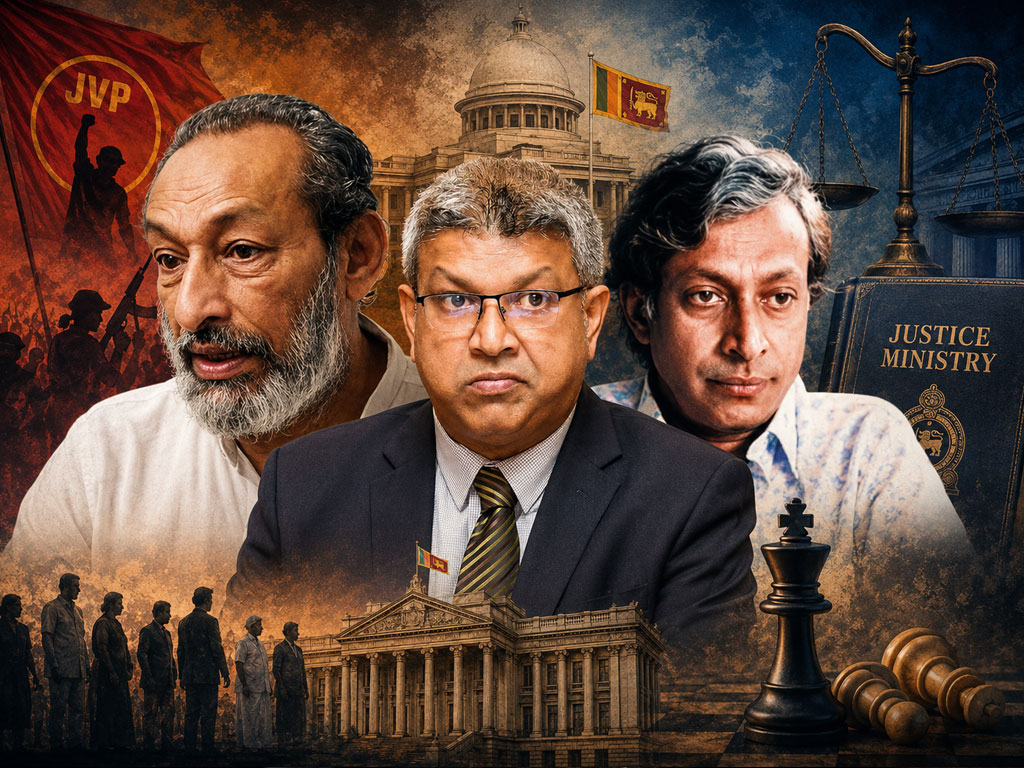
The Nanayakkara political dynasty moved from armed conflict with the JVP to seeing Harshana Nanayakkara serve as Justice Minister.
The Nanayakkara political dynasty has travelled one of Sri Lanka’s most remarkable political paths, moving from bitter conflict with the JVP to serving in a government led by the same party.
“A Yasapalitha Production… A Feast of Entertainment” was the familiar promotional slogan used for films directed by Yasapalitha Nanayakkara, father of current Justice Minister Harshana Nanayakkara.
The family emerged from a wealthy plantation-owning background in Galle. Yasapalitha’s father, Francis Nanayakkara, was a successful businessman with interests in wholesale trading, transport and plantations.
He had four sons, including Yasapalitha, Hemakumara Nanayakkara and Vasudeva Nanayakkara.
The family traditionally supported the United National Party. At the time, wealthy plantation and transport business owners often aligned with the UNP.
However, left-wing politics became increasingly attractive to the sons of affluent families. Although Francis remained a committed UNP supporter, Yasapalitha, Hemakumara and Vasudeva embraced the political left.

Film Success and the Family’s Entry Into Politics
Yasapalitha entered the film industry during the 1960s by producing Vasanthi. In 1973, he directed Thushara, which broke Sri Lankan box office records.
Meanwhile, Vasudeva entered Parliament after winning the 1970 general election as a Lanka Sama Samaja Party candidate.
By then, the two brothers had established very different public identities. Vasudeva had become a radical left-wing politician, while Yasapalitha ranked among Sri Lanka’s most successful film directors.
Yasapalitha’s close friendship with actor Vijaya Kumaratunga developed after Thushara transformed Vijaya into a major box office star.
Vijaya initially entered politics through the UNP. However, he joined the Sri Lanka Freedom Party before the 1977 general election.
As Vijaya became more politically active, he drew several friends from the film industry into public life. Yasapalitha entered politics mainly through that friendship, rather than because of Vasudeva.
After entering Parliament in 1970, Vasudeva broke with the LSSP over the United Front government’s suppression of the 1971 JVP insurrection.
He believed the government’s actions were wrong.
Vasudeva and several colleagues left the LSSP and established the New Sama Samaja Party. They openly challenged Prime Minister Sirimavo Bandaranaike’s administration and even carried a funeral wreath into Parliament as a symbolic protest.
However, the NSSP suffered defeat at the 1977 general election.
Vasudeva later joined Vijaya Kumaratunga’s effort to build a broad left-wing alliance around the SLFP. He contested the 1982 presidential election as the NSSP candidate but received only about 17,000 votes.
After Vijaya left the SLFP, Yasapalitha and Vasudeva became two of his closest political allies.
Nanayakkara Political Dynasty Confronts the JVP
Following the 1983 Black July violence, President J.R. Jayewardene’s government banned both the JVP and Vasudeva’s NSSP.
Despite the restrictions, Vasudeva and Yasapalitha secretly supported the Mahajana Party led by Vijaya and Chandrika Kumaratunga.
The political divide became more dangerous after the Indo-Lanka Accord was signed in 1987.
The Mahajana Party, LSSP, Communist Party and Vasudeva’s group formed the United Socialist Alliance and supported the agreement. That decision placed them in direct confrontation with the JVP.
During this period, the JVP reportedly branded supporters of the Accord as traitors.
Yasapalitha, his children and Vasudeva allegedly lived under continuous threat. The two brothers obtained weapons from the government and organised armed groups to defend themselves against possible JVP attacks.
The assassination of Vijaya Kumaratunga then left Yasapalitha and Vasudeva politically isolated.
Their brother Hemakumara subsequently entered active politics. At the 1989 general election, Vasudeva contested under the United Socialist Alliance, while Hemakumara represented the SLFP. Both won parliamentary seats.
During the same period, Vasudeva and Mahinda Rajapaksa travelled to Geneva. They raised concerns about families affected during the suppression of the JVP under the Jayewardene and Premadasa administrations.
When Chandrika Kumaratunga emerged as the SLFP’s future leader in 1994, Vasudeva supported her. He returned to Parliament under the People’s Alliance.
Yasapalitha and Hemakumara instead backed Anura Bandaranaike before eventually joining the UNP. Hemakumara later became a UNP parliamentarian.
Vasudeva eventually left Chandrika’s government because he opposed its open economic policies and privatisation programme.
Brothers Move Between Rival Political Camps
Yasapalitha had died by the time Mahinda Rajapaksa became President in 2005.
Vasudeva joined Mahinda’s political camp, while Hemakumara initially remained with the UNP.
In 2007, Hemakumara joined 16 other UNP MPs who crossed over to support Mahinda’s administration. He later received a ministerial appointment.
Vasudeva unsuccessfully contested the Colombo Municipal Council election under the SLFP. He later returned to Parliament in 2010, while Hemakumara served as one of Mahinda’s advisers.
The brothers again separated politically during the 2015 presidential election.
Vasudeva supported Mahinda Rajapaksa. Hemakumara backed Maithripala Sirisena and later received a governorship after Sirisena’s victory.
Following Mahinda’s defeat, Vasudeva worked with Wimal Weerawansa, Udaya Gammanpila and Dinesh Gunawardena to rebuild Mahinda’s political movement.
By the 2019 presidential election, both Vasudeva and Hemakumara supported Gotabaya Rajapaksa.
While his father and uncles moved through decades of political conflict, Harshana Nanayakkara had initially remained outside that world.
Yasapalitha hoped his son would become a film star.
Harshana appeared as a child actor in Age Adara Kathawen, directed by his father. He later acted opposite Sangeetha Weeraratne in Yasasa.
However, his acting career did not succeed. Instead, he entered politics through the JVP-led National People’s Power alliance.
From Anti-JVP Conflict to a JVP-Led Cabinet
The final turn in the Nanayakkara political dynasty carries deep historical irony.
The JVP has now entrusted the Justice Ministry to a member of a family that once fought a bitter political struggle against it.
Vasudeva, who maintained a long political rivalry with the JVP, now praises the government in which his nephew serves.
Hemakumara stepped away from active politics to make space for his son.
Former Northern Province Chief Minister C.V. Wigneswaran also became connected to the family through his son’s marriage to Vasudeva’s daughter. He too has spoken positively about the government in which his relative holds the Justice portfolio.
Harshana recently faced a no-confidence motion over allegations that he failed, as Justice Minister, to manage the prison unrest.
The JVP, once accused of attempting to eliminate his father and uncle, rallied to defend him against that motion.
Many Sri Lankans believed dynastic politics had reached its end. Yet the Nanayakkaras have produced another political successor within the very movement that came to power promising to dismantle family-based politics.
The result is a striking paradox. A family once threatened by the JVP now holds one of the most powerful legal offices in a government led by that same political movement.