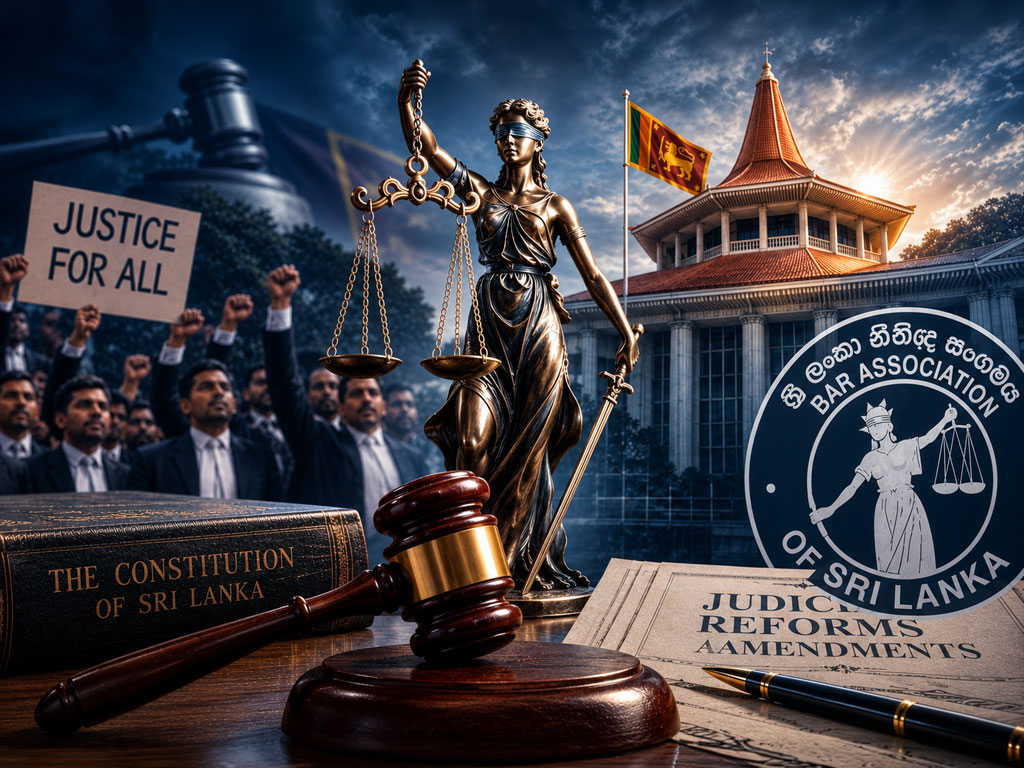
Judicial retirement age reforms have triggered opposition from Sri Lankan lawyers, who warn of protests and possible constitutional challenges.
Sri Lanka’s proposed judicial retirement age changes have set the Government and the legal profession on course for a major confrontation after Cabinet approved plans to amend the Constitution and the Judicature Act.
Ministers describe the proposal as an administrative reform intended to improve judicial efficiency. However, legal organisations across the country say it raises serious constitutional concerns and could affect the balance between the Executive and the Judiciary.
The plan would raise the retirement age of Supreme Court judges from 65 to 67. It would also increase the retirement age of Court of Appeal judges from 63 to 65.
Justice Minister Harshana Nanayakkara has defended the initiative. He says experienced judges are needed to help address a backlog of more than one million pending cases while the Government implements wider justice-sector reforms.
The legal profession’s response has so far been unusually unified.
The Bar Association of Sri Lanka, which represents approximately 26,000 lawyers, has begun consultations with the Justice Minister. At the same time, it is preparing for large-scale professional action if the Government proceeds without meaningful engagement with stakeholders.
Get Breaking News First
on WhatsApp

Lawyers Unite Against Judicial Retirement Age Changes
Regional bodies have also backed the BASL’s position. They include the Colombo High Court Lawyers’ Association, the Gampaha Lawyers’ Association and Free Lawyers Sri Lanka.
Several groups have warned that demonstrations in Colombo remain possible if Parliament attempts to fast-track the legislation.
At the centre of the dispute is the argument that the Government should not alter judicial tenure without broad constitutional agreement.
BASL President Rajeev Amarasuriya has said reforms affecting constitutional structures require transparency and public participation. The association also maintains that an amendment of this nature should go before a national referendum if the Constitution requires one.
Judicial appointments have become another major concern.
Legal organisations argue that extending the service of current judges could delay new appointments to the Supreme Court and Court of Appeal. That could also slow promotions across the wider judicial hierarchy.
According to the Judicial Service Association, such delays could damage morale among lower-court judges and weaken confidence in the judicial system.
Critics have also pointed to eight existing vacancies in the superior courts. They argue that the authorities should fill those positions before changing the retirement ages of serving judges.
Political Pressure and Court Challenges Loom
The dispute has quickly entered the political arena.
Opposition MP M.A. Sumanthiran has criticised Justice Minister Nanayakkara, while opposition parties have increased pressure following unrelated controversies involving the Justice Ministry.
Parliament defeated a no-confidence motion against the Minister by 152 votes to 36. However, opposition parties continue to challenge the Government’s approach to judicial reform.
Attention has also turned to the impending retirement of the current Chief Justice. Some civil society groups and legal commentators have questioned whether the timing of the amendments could influence the future leadership of the Supreme Court.
The Government has repeatedly said the proposal aims to improve institutional efficiency and does not seek to benefit any individual.
Legal experts expect constitutional challenges if Parliament passes the amendments. Former BASL President Saliya Peiris, PC, has indicated that opponents may argue the legislation violates constitutional principles connected to the sovereignty of the people.
A proposal presented as a way to retain experienced judges has therefore become a broader constitutional test.
The coming weeks may show whether negotiations between the Government and the legal profession can narrow the divide. Otherwise, Sri Lanka could face a prolonged institutional confrontation involving Parliament, the courts and the country’s legal community.