By Roy Denish.
Sri Lanka police crisis deepens amid disputed appointments, court clashes and controversies involving three successive police chiefs.
COLOMBO — The Sri Lanka police crisis has deepened into an unprecedented institutional confrontation involving disputed appointments, judicial intervention, executive resistance and the removal of police chiefs.
At the centre is the office of the Inspector General of Police, once regarded as the highest symbol of law enforcement authority. It has instead become the focus of legal battles, constitutional disputes and historic parliamentary action.
Get
Breaking News
First
on WhatsApp
Follow The Morning Telegraph for instant alerts, top stories and exclusive updates delivered straight to your phone.

Structural Weaknesses Behind the Sri Lanka Police Crisis
The recurring turmoil reflects deep weaknesses in Sri Lanka’s oversight system. Disputes often emerge during appointments through the Constitutional Council, where divided votes and deadlocks raise questions over whether selections meet constitutional and legal requirements.
Meanwhile, the command structure remains fragmented. Institutions such as the National Police Commission were created to protect law enforcement from political interference.
However, critics say the arrangement has also produced administrative delays and divided responsibility between ministries, independent bodies and police headquarters during national emergencies.
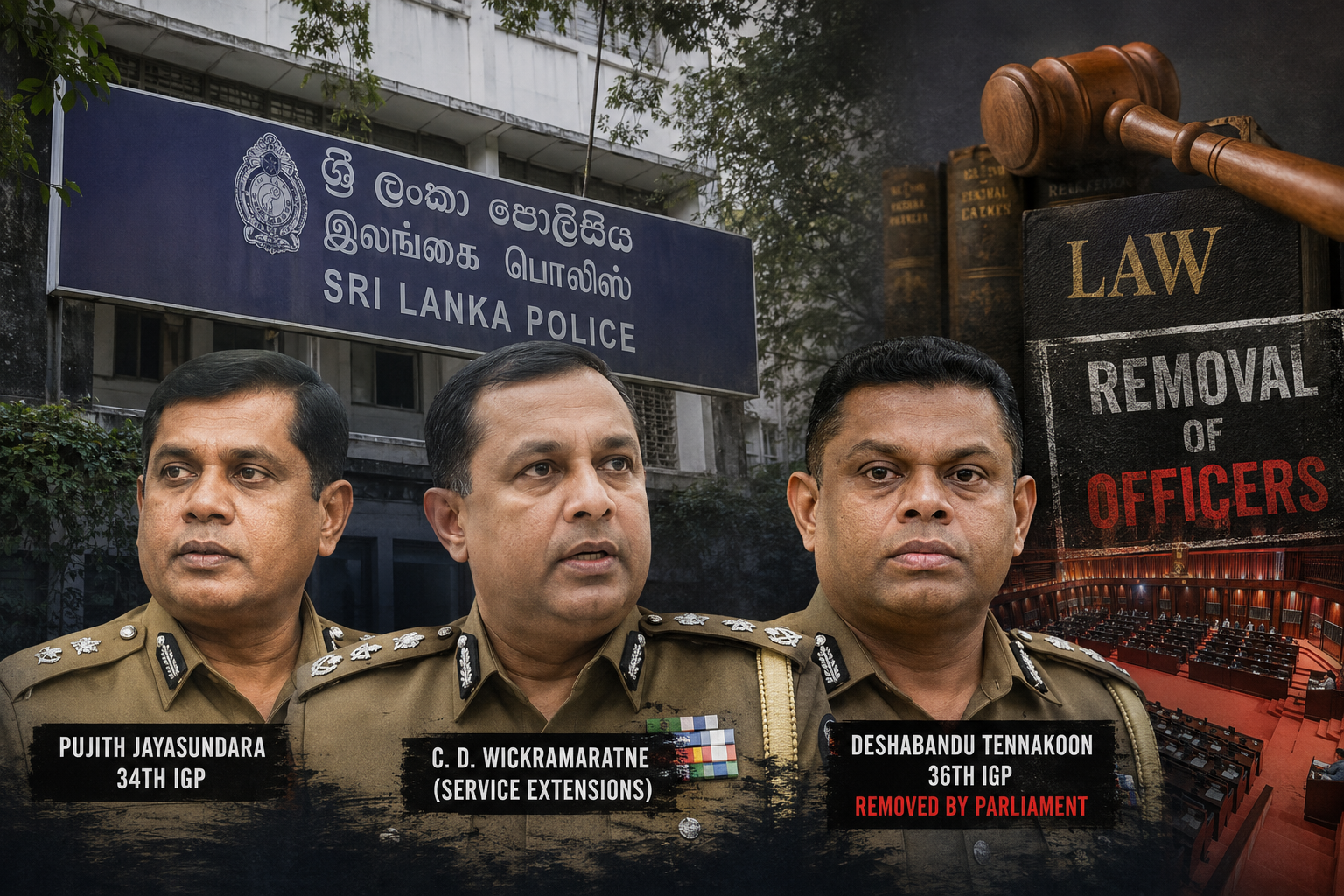
The human, political and legal consequences of these weaknesses can be seen through the careers of three successive police chiefs. Their tenures came to define the wider crisis facing the department.
Three Police Chiefs at the Centre of the Turmoil
The breakdown first became visible under Pujith Jayasundara, Sri Lanka’s 34th IGP. His tenure became closely associated with the intelligence failures that preceded the 2019 Easter Sunday terrorist attacks.
Years of litigation and judicial review followed over allegations of dereliction of duty. The case eventually resulted in criminal convictions and severe penalties imposed by a Permanent Trial-at-Bar.
The outcome signalled an unprecedented level of accountability for failures at the highest level of law enforcement.
After those disruptions created leadership gaps, the state increasingly relied on temporary measures. C. D. Wickramaratne continued to lead the police through repeated service extensions instead of a lasting structural appointment.
Those short-term extensions generated sustained legal and political controversy over constitutional compliance. They also reflected the state’s failure to establish stable, reform-focused leadership within the police force.
The Sri Lanka police crisis reached another peak under Deshabandu Tennakoon, the 36th IGP. His appointment triggered an immediate confrontation between the executive and the judiciary.
Fundamental rights rulings implicated Tennakoon in custodial torture. The Supreme Court later issued interim suspension orders, while criminal investigations intensified over a failed police raid in Weligama.
Parliament then entered new constitutional territory. Using the Removal of Officers procedure, lawmakers voted overwhelmingly to impeach and dismiss Tennakoon.
It was the first time Sri Lanka’s legislature formally removed a serving police chief.
Calls for Reform and Institutional Accountability
Legal analysts and civil society organisations, including the Bar Association of Sri Lanka, have repeatedly warned about the pattern.
Unheeded intelligence warnings, repeated service extensions and executive-judicial clashes over criminal accountability have exposed deep flaws in the management of the country’s top police office.
As policymakers consider reforms to strengthen the National Police Commission and depoliticise senior appointments, the legacy of the three IGPs remains a stark warning.
The Sri Lanka police crisis shows why institutional integrity, lawful appointments and clear accountability can no longer be delayed.