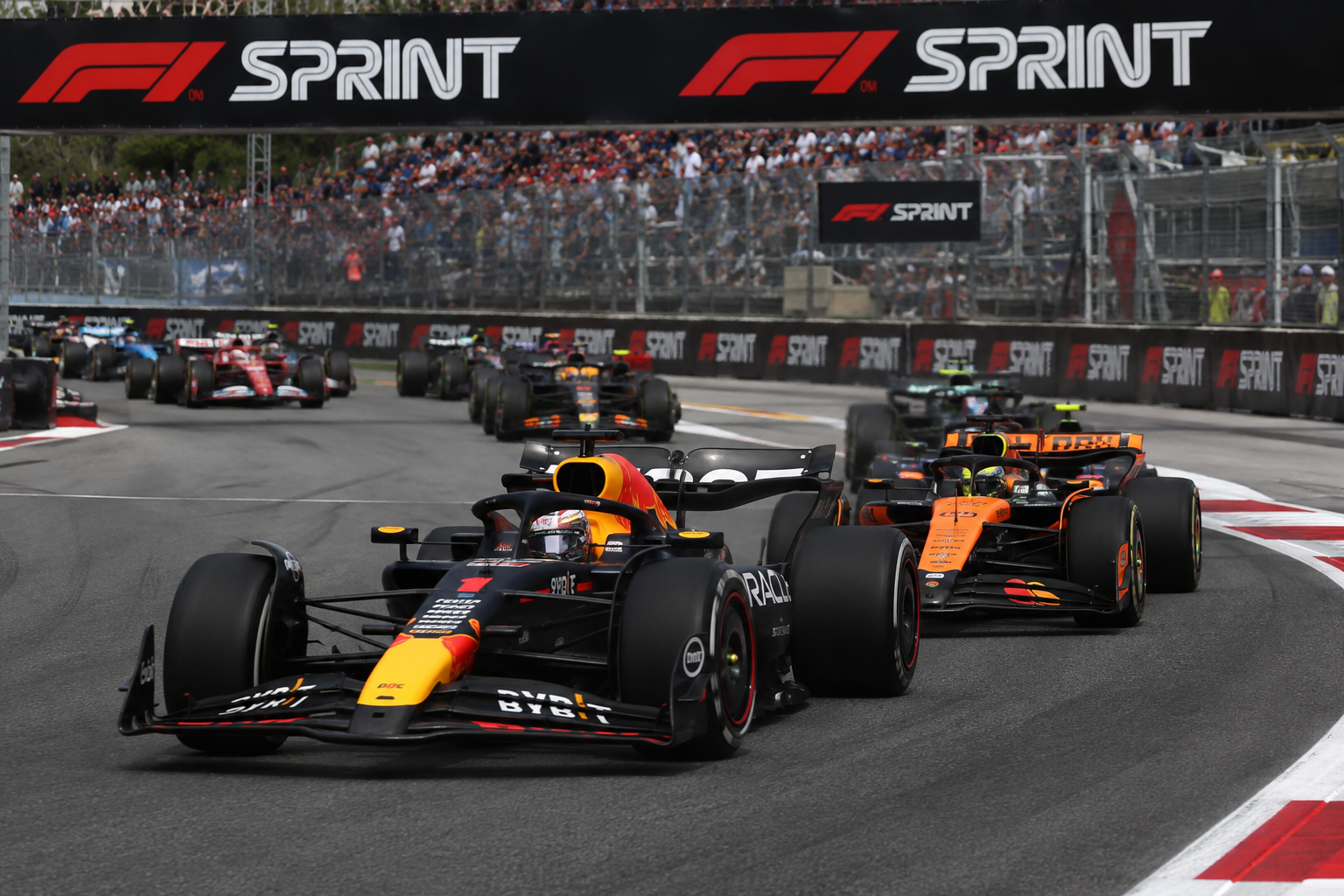
Formula One sprint races will increase in 2027 as Stefano Domenicali targets stronger crowds while protecting the format’s exclusivity.
Formula One sprint races will play a bigger role in the championship from 2027 as the sport pushes to deliver more competitive action throughout Grand Prix weekends.
Formula One president and chief executive Stefano Domenicali confirmed that the number of sprint events will rise above the current six per season. However, Formula One has not announced the final number or selected host circuits.
Domenicali said organisers expect to provide further details about the expanded 2027 sprint calendar soon.

“Our sprint format continues to drive higher Friday attendances and stronger daily attendances through our race weekend,” Domenicali told analysts after Formula One owner Liberty Media released its second-quarter results.
Domenicali also stressed that Formula One would expand the format carefully. He said holding sprints too frequently could reduce the scarcity that makes the events commercially valuable.
Formula One Sprint Races Add Competitive Action
Formula One introduced sprint racing in 2021 as an experiment aimed at making each day of a Grand Prix weekend more meaningful.
A conventional race weekend usually includes three practice sessions, qualifying and Sunday’s Grand Prix. A sprint weekend gives drivers only one practice session before sprint qualifying takes place on Friday.
The sprint race follows on Saturday before regular qualifying determines the starting grid for Sunday’s main event.
Each sprint covers about 100 kilometres, roughly one-third of a full Grand Prix distance. The format does not include a mandatory pit stop. As a result, drivers can race from start to finish unless damage, tyre wear or changing weather forces them into the pits.
The first eight drivers score championship points. The winner earns eight points, while the eighth-placed driver receives one point.
Formula One argues that the format gives spectators four meaningful competitive sessions across the weekend. A standard weekend usually offers only qualifying and the Grand Prix as sessions that directly affect the championship.
The sport also says sprint weekends increase interest in Fridays, which traditionally feature practice sessions focused on car development and technical preparation.
Formula One and the FIA selected six venues for the 2026 sprint calendar. Shanghai and Miami remained on the schedule, while Silverstone returned after hosting Formula One’s first sprint event in 2021.
Montreal, Zandvoort and Singapore joined the sprint calendar for the first time.
Domenicali Wants Expansion Without Losing Exclusivity
The expected increase in Formula One sprint races represents the format’s most significant expansion since organisers settled on six events per season.
However, Domenicali does not support immediately adding a sprint to every Grand Prix. He believes Formula One must protect the format’s special status instead of making it a routine feature at all venues.
“If commercially we would go everywhere, of course that’s not anymore a value,” he said.
Flavio Briatore, executive adviser at Renault-owned Alpine, has taken a different position. He argued that Formula One should hold a sprint during every race weekend because spectators want more competitive action.
“I’d do it every race,” Briatore told The Race.
Briatore said Friday practice sessions provide limited entertainment for spectators because drivers often complete short technical runs before returning to their garages.
“With the sprint race, at least you have two races, two starts, and the driver is driving for something,” he said.
Briatore proposed holding 24 sprint races across a full 24-round championship. However, Formula One’s current approach remains far more cautious.
Sprint Expansion Continues to Divide Formula One
Despite Formula One’s positive attendance figures, the sprint format continues to divide drivers, teams and traditional supporters.
Supporters believe sprint weekends create meaningful action on Friday and Saturday. Teams also receive less practice time, which can make car preparation more difficult and increase the possibility of unexpected results.
However, critics argue that Saturday’s sprint can reveal which cars have the strongest race pace before Sunday’s Grand Prix. That knowledge may reduce uncertainty surrounding the main event.
Additional racing also increases the risk of crashes and costly car damage. Teams must repair any damage quickly before qualifying and the Grand Prix.
Some circuits may also struggle to produce entertaining sprint races because overtaking opportunities remain limited. Formula One must therefore select venues that can support close competition without weakening Sunday’s main event.
The 2027 Formula One calendar has not yet been published. Domenicali said the championship expects to return to 24 rounds after a likely 23-race season in 2026. Regional uncertainty has continued to affect planning for some Middle Eastern events.
The planned expansion shows that Formula One no longer views sprint racing as a temporary experiment. It now sees the format as an important sporting and commercial product.
However, the challenge remains clear. Formula One must increase competitive action without allowing the sprint format to overshadow the history, importance and anticipation surrounding Sunday’s Grand Prix.