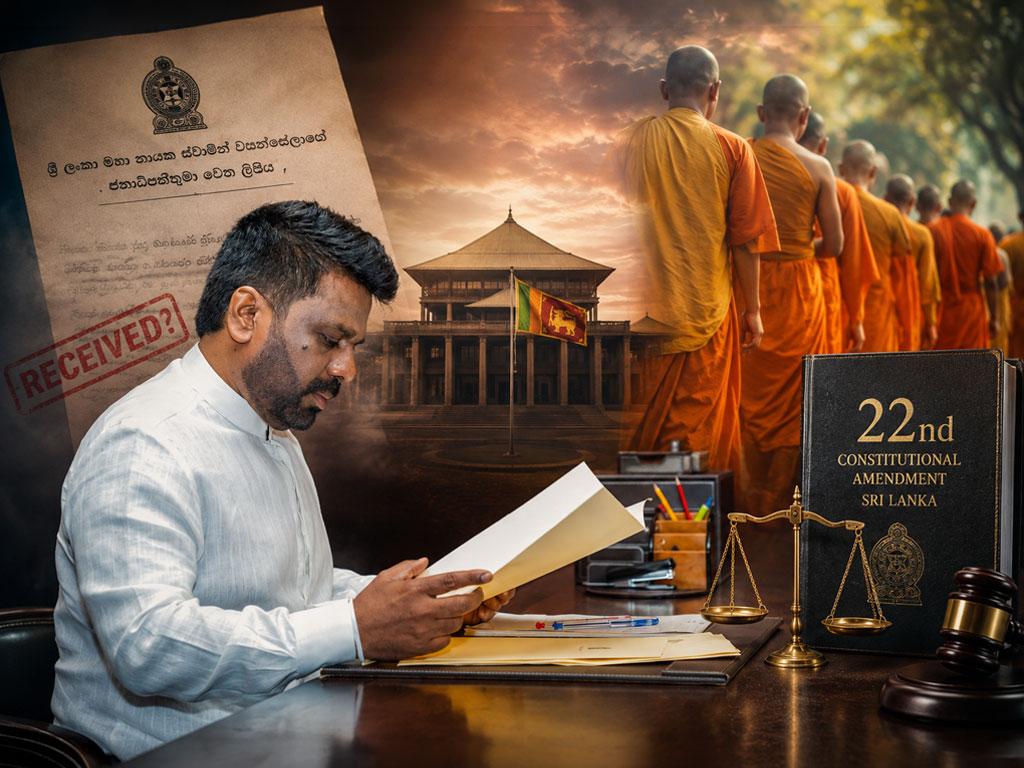
22nd Amendment Sri Lanka debate deepens over judges’ retirement age, the Maha Nayaka letter and the Government’s use of its majority mandate.
The 22nd Amendment Sri Lanka debate has entered a decisive stage after the Government gazetted its proposed constitutional changes despite strong resistance from lawyers, religious leaders and other critics.
August 2026 therefore represents more than another chapter in constitutional politics. It provides a revealing test of how President Anura Kumara Dissanayake’s administration intends to use its parliamentary mandate when confronted by traditional centres of influence.
However, one distinction is essential. The Twenty-Second Amendment has not yet become law merely because the Bill was gazetted. The gazette begins the formal legislative process. The existing Constitution still fixes Supreme Court judges’ retirement at 65 and Court of Appeal judges’ retirement at 63.
The proposed Bill would raise those ages to 67 and 65 respectively. It also proposes a special retirement rule for the Chief Justice.
Against that backdrop, the Government’s handling of opposition to the proposal has become almost as politically significant as the amendment itself.
Get
Breaking News
First
on WhatsApp
Follow The Morning Telegraph for instant alerts, top stories and exclusive updates delivered straight to your phone.

The Maha Nayaka Letter and the Politics of Silence
Perhaps the most striking episode involves the letter reportedly sent to President Dissanayake by senior Maha Nayaka Theras opposing the judicial retirement-age changes.
For days, controversy surrounded whether the Presidential Secretariat had received such a communication.
On August 8, the Mahanayake of the Malwatte Chapter, Most Venerable Thibbatuwawe Sumangala Thera, confirmed that senior prelates had written to the President regarding the proposed amendment. However, he said he could not confirm whether the letter had actually reached the President.
That distinction makes claims that the Government deliberately “made the letter disappear” impossible to establish as fact.
Politically, however, the absence of a direct confrontation worked in the Government’s favour.
Rather than entering a prolonged public dispute with religious leaders, the administration continued with the constitutional process while arguments over the missing or unacknowledged letter dominated public discussion.
The result was politically significant. While opponents debated whether the letter had been received, the Government proceeded with gazetting the Bill.
Whether this amounted to deliberate “strategic silence” cannot be proven from the available evidence. Yet as political strategy, the administration’s refusal to allow the dispute to halt the process demonstrated a willingness to proceed despite pressure from influential institutions.
22nd Amendment Sri Lanka Tests the Majority Mandate
The Government’s strongest political defence lies in its electoral and parliamentary mandate.
Supporters of the amendment argue that elected governments must ultimately make policy through constitutional institutions rather than surrender decision-making authority to unelected professional or religious bodies.
The Bar Association of Sri Lanka formally urged President Dissanayake not to proceed with an amendment extending senior judges’ retirement age. It warned that such changes could affect confidence in judicial independence.
The Commonwealth Lawyers Association also cautioned that constitutional amendments affecting judges should not be introduced in a piecemeal or ad hoc manner and called for adequate consultation.
Those objections deserve consideration.
But they do not amount to a constitutional veto.
Sri Lanka’s Parliament remains the country’s supreme legislative body, while constitutional amendments must proceed according to the procedures imposed by the Constitution itself.
The Government has argued that extending judicial service can contribute to addressing pressures within the justice system. Critics dispute both the policy and the reasoning behind it.
The real democratic test, therefore, is not whether the Government may ignore criticism. It is whether it can defend the reform publicly, follow every constitutional safeguard and ultimately secure the parliamentary support required.
Challenging Traditional Political Influence
The 22nd Amendment Sri Lanka controversy also raises a larger question about the relationship between elected government and traditional authority.
Sri Lankan governments have historically given considerable political weight to the views of Buddhist religious leadership.
The present administration appears more willing to distinguish consultation from control.
That does not mean religious leaders should be excluded from national debate. Nor should opposition from lawyers or civil society be dismissed merely because those groups are unelected.
Their role is to scrutinise power.
Yet their objections must exist alongside the constitutional authority exercised by elected representatives.
Seen from that perspective, the Government’s decision to continue with the Bill signals a more assertive approach to state decision-making.
Its supporters may interpret that as the supremacy of the popular mandate.
Its opponents may see it as insufficient consultation on a change affecting judicial independence.
Both interpretations will now face a more important test inside the constitutional process itself.
The Gazette Is a Beginning, Not the End
The political achievement for the Government is therefore narrower than the original claim that the amendment has already “become a reality.”
What has become real is the Bill.
The Government resisted pressure, approved the proposal and brought it formally into the legislative process.
It has not yet completed the constitutional amendment.
That difference matters because the debate now moves beyond the Maha Nayaka letter, political strategy and public statements.
The amendment must ultimately stand or fall through Sri Lanka’s constitutional mechanisms.
If the Government succeeds, the episode may indeed mark an important shift in the balance between elected authority and traditional institutional influence.
If it fails, the controversy surrounding consultation and judicial independence will become part of the explanation.
Either way, the Government has already demonstrated one political reality: it is prepared to use its mandate to pursue constitutional reform even when powerful religious, professional and political voices demand that it retreat.