by Roy Denish.
Sri Lanka Navy collision off Angulana leaves one officer dead after a Super Dvora strikes the submerged wreck of the MV Thermopylae Sierra.
ANGULANA, SRI LANKA – A Sri Lanka Navy collision off Angulana turned deadly at 11:40 AM on Saturday when a Super Dvora Mk III Fast Attack Craft struck the submerged wreck of the MV Thermopylae Sierra.
The turquoise waters three nautical miles off the Angulana coast looked deceptively calm. A light haze hung over the Moratuwa shoreline, but visibility remained clear. Moving at high speed was the heavily armed Super Dvora Mk III, delivered from Israel in 2011 to protect Sri Lanka’s Exclusive Economic Zone.
Twelve sailors were on board, combining youth with experience. Eleven had joined the Navy after the war ended in May 2009 and had served in an institution shaped by peacetime operations. Command, however, rested with a seasoned veteran who had survived some of the country’s fiercest maritime battles.
The craft was returning to base after a routine patrol. Its engines roared as the hull cut through the swell, while the crew expected to disembark within the hour.
None of them knew they were heading toward a forgotten graveyard beneath the sea.
The Wreck Waiting Beneath the Surface
Directly ahead, only meters below the surface, lay the twisted and decaying remains of the MV Thermopylae Sierra.
Shin Nipponkai Heavy Industries built the 155-meter bulk carrier in Toyama, Japan, in 1985. For years, it worked the world’s shipping lanes. But in 2009, a legal dispute over cargo and wages trapped the vessel off Sri Lanka’s western coast.
A court order placed the ship under arrest. Its owners later abandoned it, leaving the crew stranded for months without wages, food, or fresh water. Eventually, the crew left as well, while the 15,612-ton vessel deteriorated in the salt air.

For three years, corrosion weakened the ship. Then, during a powerful monsoon storm on August 23, 2012, its rusted hull gave way. Water poured into the forward holds. The bow sank into the waves, and the bulk carrier settled on the shallow seabed off Panadura and Moratuwa.
For more than a decade, the wreck remained an underwater danger. Local fishermen and coastal residents repeatedly asked maritime authorities to place a visible warning buoy above the jagged remains because boats crossed the area every day.
Those appeals produced no physical warning marker. Although official hydrographic nautical charts showed the wreck as a fixed symbol, nothing on the surface warned vessels approaching the site.
Sri Lanka Navy Collision Turns Fatal
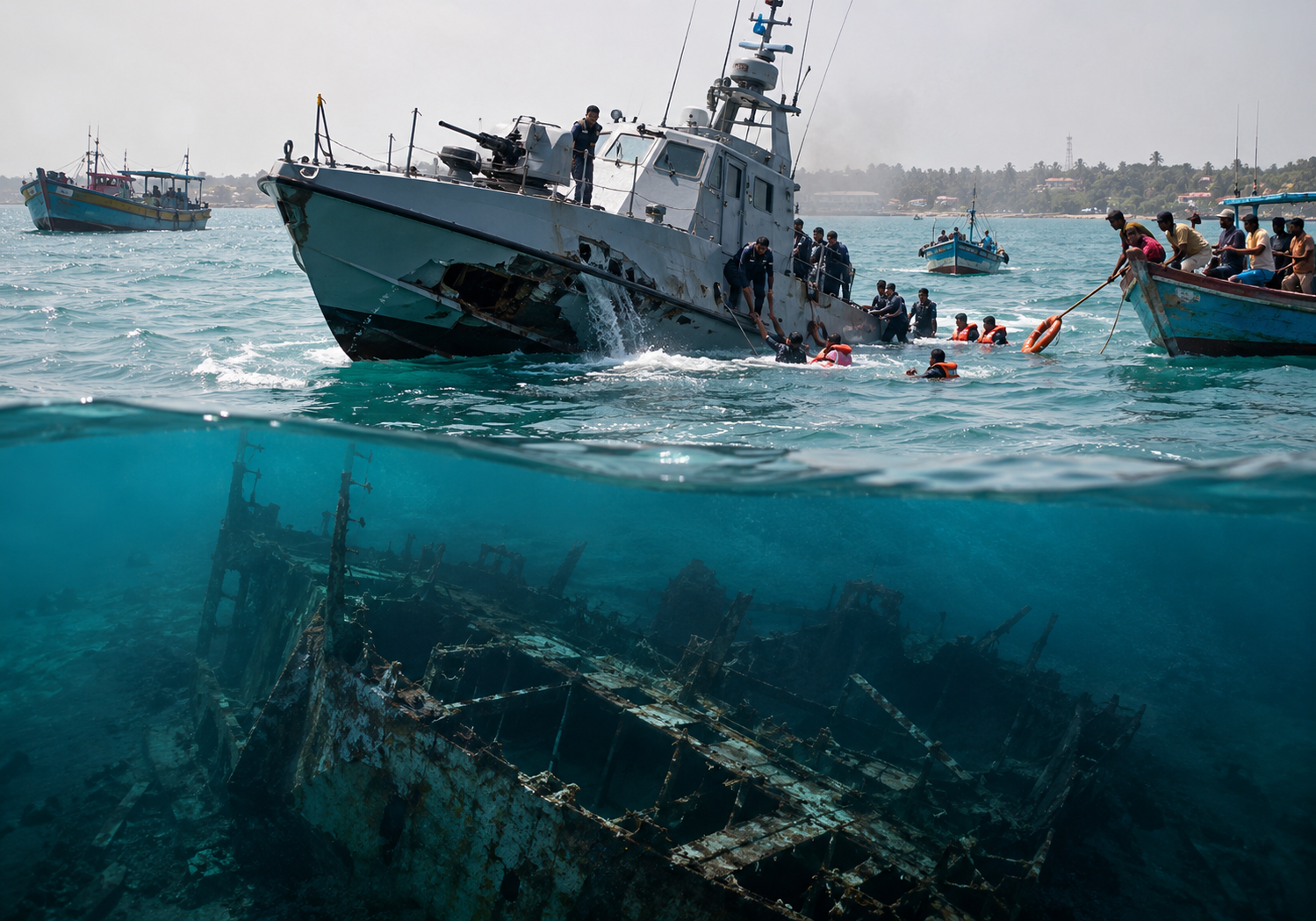
At 11:40 AM, the Super Dvora’s hull struck the sunken freighter’s iron superstructure at speed.
The impact produced a deafening screech of tearing metal that travelled through the patrol craft like an explosion. The violent deceleration hurled sailors against bulkheads and instrument panels.
Below deck, sharp steel from the Thermopylae Sierra tore into the patrol boat’s underside. Seawater rushed into the engine compartments within seconds.
The crew scrambled toward the deck as the vessel began listing. Foam and sea spray turned crimson around the damaged craft. From shore, fishermen operating off Angulana heard the collision and saw the patrol boat taking on water.
They immediately powered their small boats toward the scene. Navy and Police rescue units also arrived as the emergency unfolded.
Rescuers pulled eleven sailors from the water, including the veteran Commanding Officer. But when crews counted those rescued, one man was missing. The vessel’s second-in-command had been trapped or struck during the collision. He did not survive.
Inquiry Begins as Navy Mourns Fallen Officer
Naval engineers then carried out an extraordinary salvage effort. They stabilized the flooded Super Dvora, secured heavy towlines and dragged the damaged craft back to Colombo Harbor before it could sink beside the wreck that had torn it open.
After the incident, Navy Commander Damien Fernando appointed a panel of experts to conduct a preliminary inquiry.
The investigation now confronts a troubling question. How did a modern, radar-equipped warship under a battle-tested commander collide with a wreck that had been charted for years?
That question will focus attention on navigation, charts, vessel handling and the absence of a visible surface warning above the submerged steel.
Meanwhile, a Navy unit mourns an officer lost not in battle, but during a routine peacetime patrol.
The Super Dvora returned to harbor badly damaged. The Thermopylae Sierra remained where it had lain for years, beneath the tide off Sri Lanka’s western coast, its rusted remains again becoming part of a maritime tragedy.