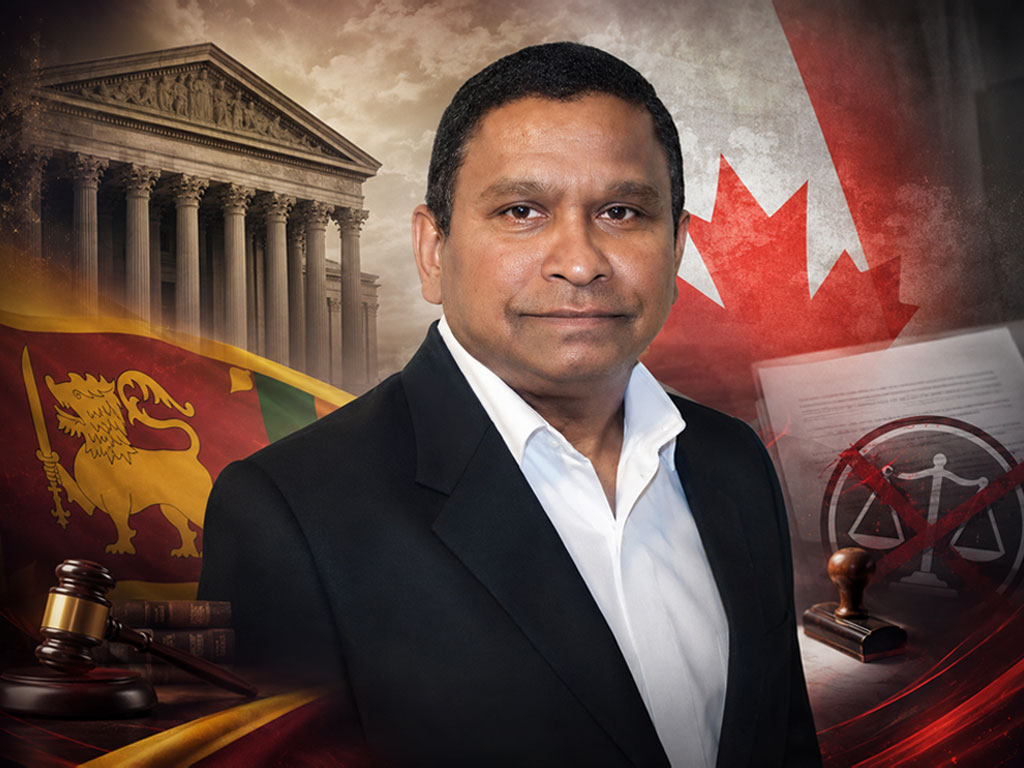
Tamil Genocide Education Week Act challenge led by Neville Hewage has ended after Canada’s Supreme Court declined leave to hear a further appeal.
The Tamil Genocide Education Week Act legal battle involving Sri Lankan academic Dr. Neville Hewage has ended after the Supreme Court of Canada declined to hear a further appeal.
The case has generated significant attention among Sri Lankan communities in Canada because it challenged Ontario legislation concerning remembrance and awareness of what the law describes as the “Tamil genocide.”
However, the legal outcome requires careful distinction.
The Canadian courts did not make a judicial finding that “no Tamil genocide occurred in Sri Lanka.” Equally, the litigation was not a criminal or international-law determination establishing whether genocide occurred. Instead, the courts considered whether Ontario had constitutional authority to enact the legislation and whether it violated Charter rights.
The Supreme Court of Canada ultimately dismissed Hewage’s application for leave to appeal on March 27, 2025. That left the Ontario Court of Appeal’s decision in place.

Tamil Genocide Education Week Act Began in Ontario
The legislation at the centre of the dispute was enacted by Ontario’s legislature in 2021, rather than Canada’s federal Parliament.
The Tamil Genocide Education Week Act proclaims the seven-day period ending May 18 each year as “Tamil Genocide Education Week.”
It encourages Ontarians during that period to educate themselves about, and maintain awareness of, what the legislation calls the Tamil genocide and other genocides in world history.
Critics, including Hewage and Sri Lankan Canadian organisations, argued that the legislation presented a contested account of Sri Lanka’s conflict as established fact.
They also expressed concern about its potential influence on public education and future generations of students.
Neville Hewage Took the Challenge to Court
Dr. Neville Hewage, who has been affiliated with Laurentian University in Canada, mounted a separate constitutional challenge against the Ontario Government.
The legal effort was pursued alongside challenges from Sri Lankan Canadian organisations.
According to the account surrounding the campaign, approximately US$350,000 was raised to support the litigation and legal work.
The challengers argued that Ontario had exceeded its constitutional authority and that the legislation infringed protections under Canada’s Charter of Rights and Freedoms.
The Ontario Superior Court rejected those challenges in June 2022.
It ruled that the Act fell within provincial authority and did not violate the challenged Charter protections.
Importantly, that case did not amount to a judicial trial deciding whether genocide had factually occurred in Sri Lanka.
Ontario Appeal Court Upholds the Law
Hewage and the other challengers then took the case to the Ontario Court of Appeal.
The appellate court dismissed their appeals in September 2024 and upheld the constitutionality of the Tamil Genocide Education Week Act.
However, its reasoning differed from that of the lower court.
The Court of Appeal said the legislation’s dominant purpose was not to legally “declare” or “recognize” genocide. Instead, it characterised the law as affirming and commemorating the Tamil-Ontarian community’s experience of the Sri Lankan Civil War while promoting human rights, diversity and multiculturalism within Ontario.
That distinction has become central to Hewage’s interpretation of the outcome.
He argues that because the courts did not determine whether genocide occurred, the legislation cannot itself be treated as a judicial finding that genocide was established.
However, the Court of Appeal did not invalidate the Act. It expressly dismissed the constitutional challenge and left the law in force.
Supreme Court Declines Further Appeal
Hewage subsequently sought permission to appeal to the Supreme Court of Canada.
On March 27, 2025, the Supreme Court dismissed his application for leave.
The Supreme Court did not conduct a new hearing on whether genocide occurred, nor did it issue a judgment on the merits declaring that no genocide took place.
Its decision simply meant that the Ontario Court of Appeal ruling remained the final judicial determination in the constitutional litigation.
That is an important difference from saying the Supreme Court “affirmed” a factual finding about events in Sri Lanka.
Hewage Says Courts Did Not Determine Genocide
Hewage has nevertheless described the outcome as significant because, in his interpretation, neither the Superior Court nor the Court of Appeal made a judicial determination that genocide occurred.
He has stated:
“Pro-LTTE elements are agitated because both the Superior Court and the Ontario Court of Appeal ruled that no Tamil genocide occurred in Sri Lanka. The Supreme Court of Canada will not investigate this matter further. The truth stands strong.”
The first part of that statement represents Hewage’s interpretation of the litigation rather than the wording of the Canadian judgments.
The legal record shows that the courts upheld the Ontario legislation while avoiding a judicial determination on whether genocide factually occurred.
The case therefore ended with two important realities existing simultaneously.
Ontario’s Tamil Genocide Education Week Act remains constitutionally valid, while the Canadian courts did not conduct a trial establishing genocide as a historical or criminal-law fact.
For Sri Lankans following the case, that distinction is essential to understanding what Dr. Neville Hewage’s lengthy legal challenge achieved, and what the Canadian courts actually decided.