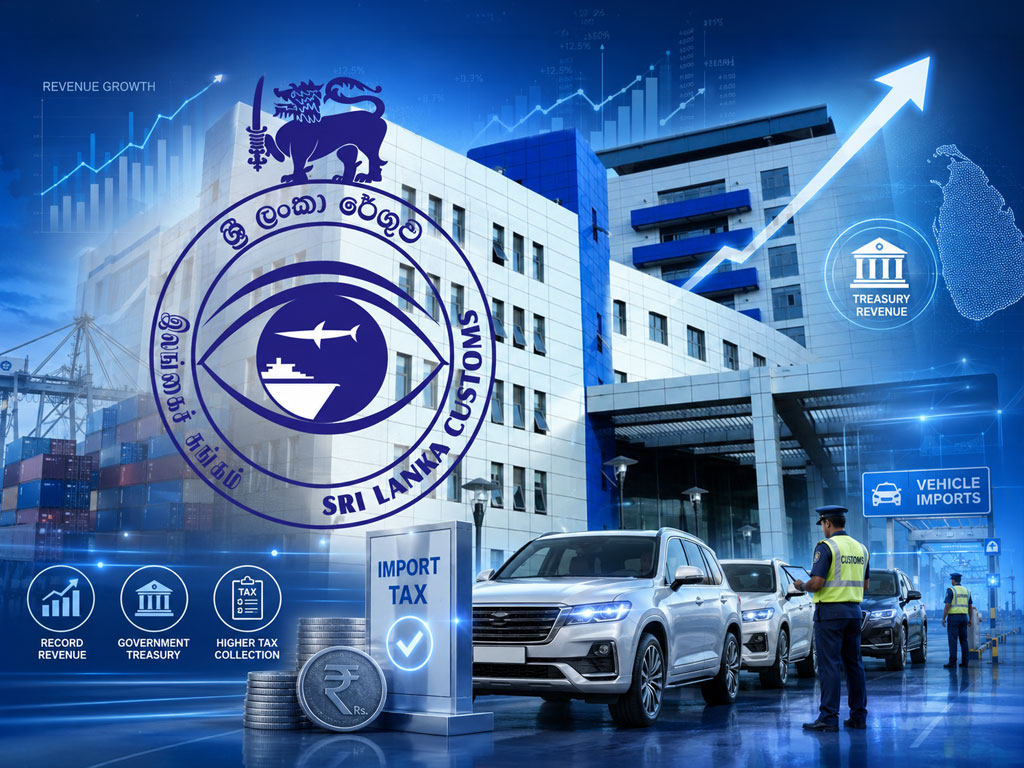
Sri Lanka Customs revenue reached Rs. 1.379 trillion by June 30, driven by vehicle imports that generated more than Rs. 512 billion in taxes.
Sri Lanka Customs revenue has surged well beyond expectations in 2026, with officials identifying vehicle imports as the biggest driver behind the record collection.
The Director General of Customs and other officials revealed the latest figures before Parliament’s Committee on Ways and Means.
According to the data presented, Customs had been expected to collect Rs. 1,060,559 million by June 30 this year.
Instead, total revenue collected by the end of that period reached Rs. 1,379,084 million.
That represents revenue performance of around 130% against the expected target.
Officials also noted that, compared with figures recorded in 2025, Sri Lanka Customs had exceeded its expected monthly revenue targets throughout this year.

Sri Lanka Customs Revenue Boosted by Vehicle Imports
The relaxation of vehicle import restrictions has played a major role in the increase.
By June 30, 2026, approximately 316,000 vehicles had been imported into Sri Lanka.
Taxes collected from those vehicle imports alone reached Rs. 512,547 million.
Motor cars accounted for Rs. 386,726 million of that tax revenue.
Among individual categories, petrol-powered motor cars with engine capacities below 1,000cc generated the highest revenue.
Customs collected Rs. 137.4 billion from this category.
According to the figures presented, these small-engine petrol cars alone contributed 9.96% of total Customs revenue.
The data therefore shows the significant contribution made by renewed vehicle imports to government revenue during the first half of 2026.

Sri Lanka Vehicle Prices Rise as 50% Surcharge Extended
Vehicle prices have jumped after the government extended the 50% import tax surcharge, with some models rising by up to Rs. 4.5 million.
The Morning Telegraph • September 3, 2026 • 2 min readCustoms Looks to Digital Modernisation
The parliamentary committee also examined measures aimed at improving Customs operations beyond revenue collection.
Officials discussed ways to streamline procedures used to inspect imported containers.
Attention was also given to introducing modern digital technology to improve efficiency within Sri Lanka Customs.
The meeting further examined difficulties affecting revenue administration and strategic plans intended to address future challenges.
With revenue already exceeding expectations by June, the figures presented to Parliament show that vehicle imports have become one of the strongest contributors to Sri Lanka Customs revenue in 2026.