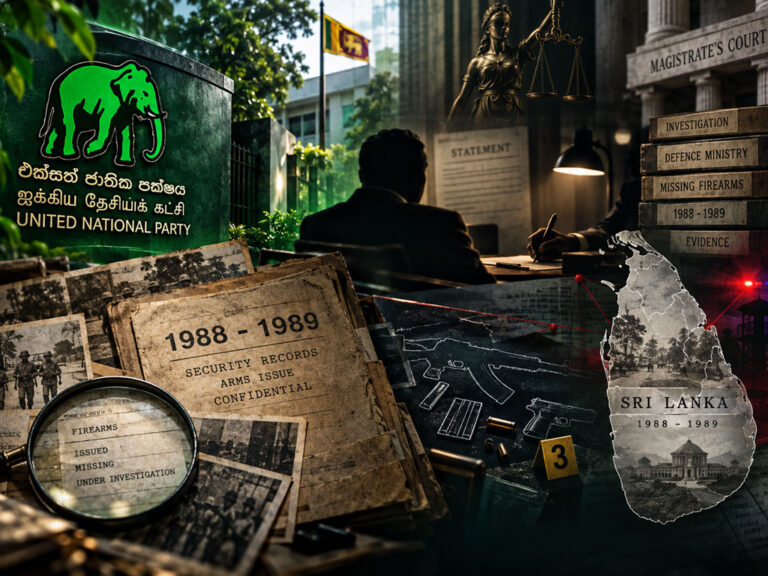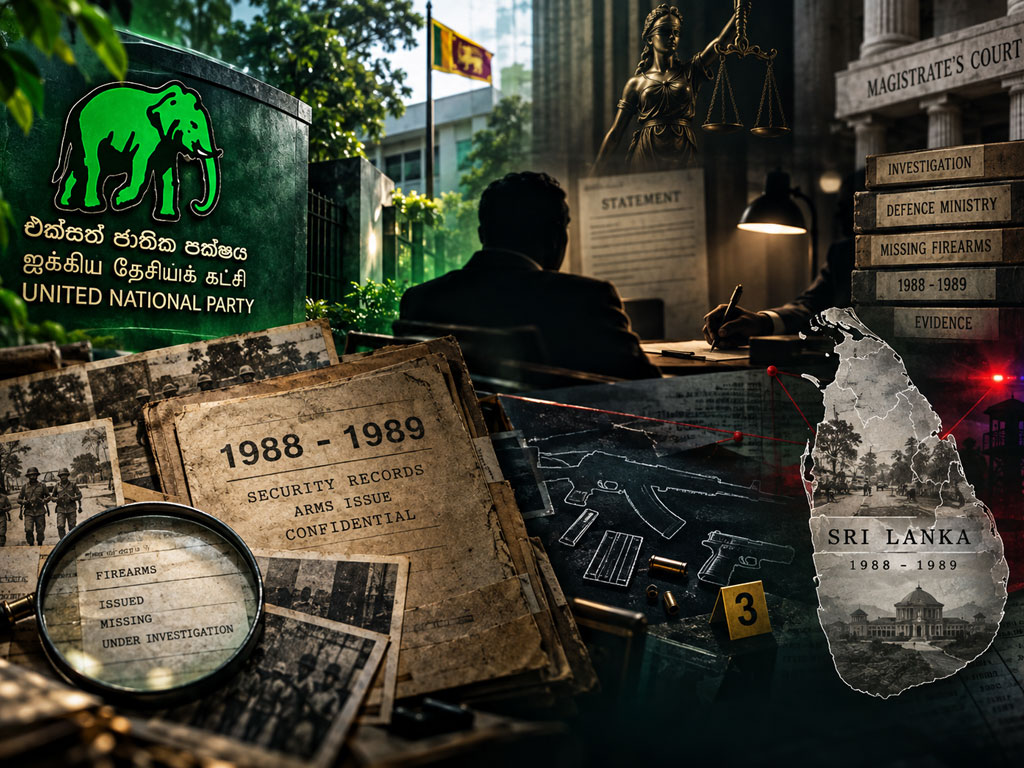
An investigation into firearms issued during Sri Lanka’s 1988-89 unrest is expected to include a statement from a senior Sirikotha official.
COLOMBO — Sri Lankan authorities have opened a special investigation into a consignment of military firearms reportedly issued for civil defence purposes during the violent unrest of 1988-89, with investigators preparing to question a senior official at the United National Party’s Sirikotha headquarters over historical records linked to the weapons.
The inquiry centres on firearms allegedly transferred from military custody during the period when the late Ranjan Wijeratne held responsibility as Minister of State for Defence. Parliament’s official records show that Wijeratne served as Minister of State for Defence from February 18, 1989, until his death in March 1991.
Investigators are examining claims that a lorry carrying military weapons was handed over at the time to an individual who served as a personal assistant to Wijeratne, but that the firearms were never formally returned to state custody. Current reporting on the inquiry says authorities have been unable to locate records showing that the consignment was subsequently surrendered.
The allegations remain under investigation, and no finding of criminal responsibility has been reported against any individual connected to the original transfer.

Court proceedings linked to missing weapons
Information relating to the missing firearms and associated documentation has already been placed before a Magistrate’s Court, where proceedings concerning the failure to return the weapons are under way, according to reports on the investigation.
Authorities are particularly interested in firearms that were issued during periods of civil unrest for personal protection, civil defence and related security purposes but were not surrendered once the immediate threat had passed.
Sri Lanka’s security authorities have faced similar concerns more recently over firearms issued to civilians and other licence holders. In October 2024, the Ministry of Defence ordered civilians holding firearms for personal protection to return them temporarily for review, warning that legal action could follow if weapons were not surrendered.
A subsequent Defence Ministry notice said around 85% of licence holders had complied and added that a substantial number of firearms and ammunition had historically been issued by the Army and Police. Those weapons were also ordered to be returned for inspection.
Sirikotha official expected to give statement
As part of the new inquiry, investigators are expected to record a statement from a senior official at Sirikotha, the headquarters of the United National Party.
The purpose, according to security sources cited in current reporting, is to verify surviving records and administrative information connected to the transfer of the weapons and any communications between government ministries and political offices at the time.
Sources have said the move should not be interpreted as an investigation directed against the UNP as a political party, but as an attempt to reconstruct the documentary trail surrounding a decades-old transfer of state-owned firearms.
That distinction is important because the investigation concerns events during an exceptionally violent period of Sri Lanka’s history and involves records that may now be more than three decades old.
Wijeratne was a prominent UNP politician and served as Minister of State for Defence during the latter part of the 1987-89 JVP insurrection. He simultaneously held senior ministerial responsibilities during the administration of President Ranasinghe Premadasa.
Authorities widen search for unaccounted firearms
The investigation comes against the backdrop of broader efforts by the Police, armed forces and Defence Ministry to account for firearms issued outside ordinary military inventories over previous decades.
Authorities have said such reviews are intended to reduce the number of weapons circulating outside state control and prevent legally issued or historically distributed firearms from eventually entering organised crime networks.
The Defence Ministry’s previous firearm recall explicitly cited the need to regulate weapons in civilian possession and reduce the risk of their misuse.
Investigators are now expected to examine surviving Defence Ministry, military and political-office records connected to the 1988-89 period to establish how the consignment was authorised, who received the weapons, whether individual serial numbers were recorded and what happened to the firearms afterwards.
Further legal action will depend on what investigators are able to establish from those records, witness statements and the evidence already placed before court.