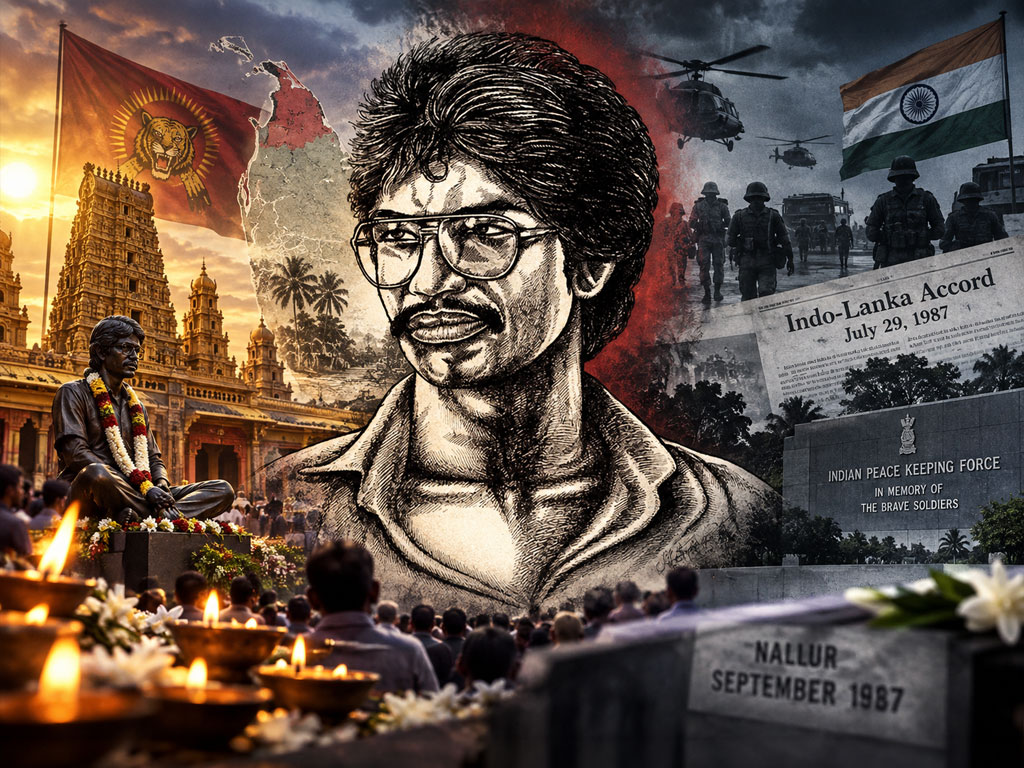
The Thileepan hunger strike remains contested 39 years later as new commemorations revive debate over the LTTE, India and the 1987 conflict.
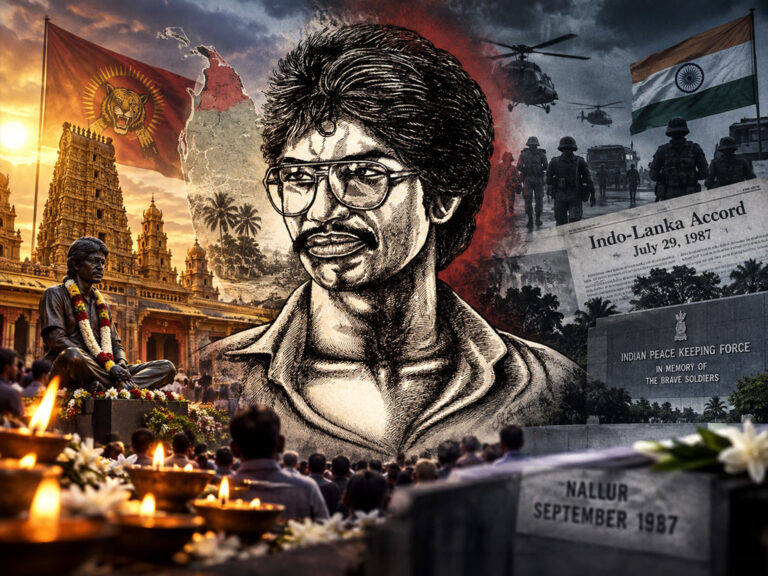
The newly installed bronze statue of Rasiah Parthipan, better known as Thileepan, at Nallur has revived one of the most contested episodes of Sri Lanka’s conflict: his September 1987 hunger strike and the political circumstances surrounding his death.
Commemorations began in Nallur on September 15, exactly 39 years after Thileepan started his fast without food or water near the Nallur Kandaswamy Temple. They are due to continue until September 26, the anniversary of his death.
For many Tamils, Thileepan remains a symbol of sacrifice and resistance. For his critics, particularly those who view the episode through the subsequent LTTE-IPKF conflict, his death raises a different question: was the 23-year-old LTTE political leader exercising his own political agency, or was his sacrifice also useful to Velupillai Prabhakaran’s wider strategy?
Almost four decades later, the historical record supports competing interpretations. That makes it important to distinguish what is documented from what remains interpretation.

The Five Demands Behind the Fast
Thileepan’s protest followed the Indo-Lanka Accord signed on July 29, 1987 and the arrival of the Indian Peace Keeping Force in Sri Lanka’s North and East.
On September 13, the LTTE presented five demands to India. They concerned the release of Tamils detained under the Prevention of Terrorism Act and emergency regulations; an end to Sinhala settlement in Tamil areas under the guise of rehabilitation; suspension of such rehabilitation until an interim administrative council was established; an end to the construction of new police stations and camps in the North and East; and the withdrawal of security forces from schools, together with the disarming of government-backed home guards under Indian supervision.
Thileepan began fasting on September 15.
He died on September 26 after refusing food and water.
The protest was directed at India because the LTTE argued that New Delhi, having brokered the Accord and deployed its forces, had the leverage to compel Colombo to meet those demands.
That remains the conventional explanation of the hunger strike and is central to the way Thileepan is remembered by many Tamils today.
But another account complicates that narrative.
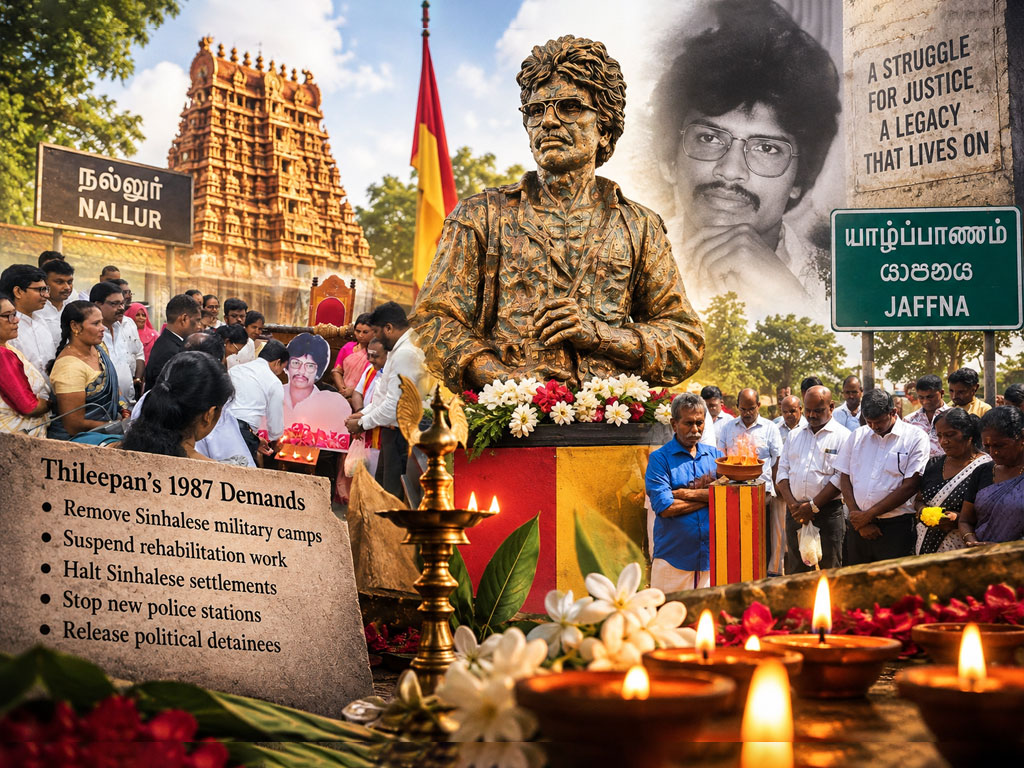
Jaffna Municipal Council Joins Thileepan Tribute
Thileepan commemoration events begin in the North with a new bronze statue in Nallur and tributes involving Jaffna Municipal Council members.
Read MoreWhat Tamil Tigress Says
Former LTTE combatant Niromi de Soyza, a pseudonym used by the author of the memoir Tamil Tigress, offers an insider’s account of the period.
According to her narrative, Thileepan chaired a meeting at the Freedom Birds’ headquarters before the fast and spoke of forcing the Indian military out of Sri Lanka.
De Soyza quotes him as saying:
“This is my chance. I’m optimistic it will achieve something, whether I live or die. We must force the Indians out of our land.”
If accurate, that recollection suggests Thileepan saw the fast as part of a broader confrontation with India’s military presence rather than solely as an attempt to secure the five publicly stated demands.
The distinction is important.
A hunger strike seeking concessions under the Indo-Lanka Accord and a political campaign intended to mobilise opposition to the IPKF are not necessarily mutually exclusive. Both objectives could have existed simultaneously.
De Soyza’s memoir also raises questions about why Thileepan, whom she describes as physically fragile, was selected for such an extreme protest.
Her account deserves consideration because she says she knew Thileepan and Prabhakaran personally and was present within the LTTE during this period. But it remains a memoir and should be treated as one source rather than as the final historical verdict on Prabhakaran’s intentions.
That distinction matters when considering the claim that Thileepan was deliberately selected to die.
The available evidence establishes that he knowingly undertook a fast unto death. Establishing that Prabhakaran specifically engineered his death as a predetermined outcome requires a stronger evidentiary basis.
From Accord to War
What happened immediately afterwards is beyond dispute.
The Indo-Lanka Accord envisaged the surrender of weapons by Tamil militant organisations. A highly publicised arms handover involving the LTTE took place at Suthumalai in August 1987.
The peace did not last.
Tensions between the LTTE and India deteriorated rapidly, and open warfare between the Tigers and the IPKF erupted in October.
De Soyza’s memoir again offers a striking account of the atmosphere within the LTTE. She quotes Prabhakaran as telling cadres after the Suthumalai surrender:
“All our good ammunition was stashed prior to the surrender. We’ll continue to hand over the rest.”
She also attributes another statement to him:
“War will resume in a month or two.”
If her recollection is accurate, it would suggest that at least some within the LTTE leadership did not regard the arms surrender as ending the organisation’s military capability.
The subsequent crisis at Palaly further accelerated the breakdown.
Seventeen LTTE members detained by Sri Lankan forces attempted suicide by swallowing cyanide on October 5, 1987; 12 died. Among them were senior commanders Kumarappa and Pulendran.
Violence escalated soon afterwards, followed by full-scale fighting between the LTTE and the IPKF.
The sequence inevitably raises questions about whether Thileepan’s fast formed part of the political escalation that preceded that conflict. But chronology alone cannot establish that his death was deliberately orchestrated to trigger war.
That remains an interpretation.
The IPKF Memorial and a Difficult History
Sri Lanka’s relationship with the IPKF adds another layer of complexity.
India’s military intervention remains deeply controversial in Sri Lankan political history. The Indian intervention came after New Delhi had supported and trained Tamil militant organisations during earlier stages of the conflict, while the June 1987 Indian airdrop over Jaffna demonstrated the extraordinary pressure India was prepared to exert on Colombo.
Yet Sri Lanka now maintains a memorial at Battaramulla honouring Indian personnel killed during the IPKF deployment.
The memorial contains the names of more than 1,000 Indian personnel who died during the mission.
Its existence captures one of the contradictions of the period. India had intervened forcefully in Sri Lankan affairs, yet Indian soldiers subsequently fought and died against the LTTE after the political settlement New Delhi helped broker collapsed.
The new Thileepan statue creates a similarly complicated juxtaposition.
One memorial commemorates Indian soldiers who died fighting the LTTE. Another commemorates an LTTE political leader whose final protest was directed at India during the period immediately preceding that war.
Neither can be understood properly without acknowledging the other.
Commemoration Returns to Nallur
This year’s events have again demonstrated how politically sensitive that history remains.
The bronze statue was unveiled at Nallur on September 15 as the 39th annual commemoration began. Participants have continued gathering at the memorial during the anniversary period.
Police intervened on September 18 and removed loudspeakers being used at remembrance events, saying permission had not been obtained. Commemorations nevertheless continued in Nallur, while remembrance events and a procession were also reported elsewhere in the North and East.
Those events have once again produced competing political interpretations.
Critics see the commemorations as glorification of an LTTE figure. Participants and Tamil nationalist organisations regard them as remembrance of a man who died while pursuing political demands through a hunger strike.
A responsible examination of the controversy has to acknowledge both positions without pretending that the underlying historical dispute has disappeared.
The NPP’s Political Dilemma
The government consequently faces a difficult political and legal balancing act.
The National People’s Power made substantial electoral gains in the Northern and Eastern Provinces in 2024, breaking patterns that had long dominated Tamil electoral politics.
That political context has encouraged opponents to interpret the government’s handling of commemorations through an electoral lens.
It would go too far, however, to state as fact that the NPP has permitted Thileepan commemorations because it fears losing Tamil votes. That is a political interpretation unless supported by evidence of the government’s actual reasoning.
The police intervention over the use of loudspeakers demonstrates that authorities have not simply remained absent from the events.
A broader question nevertheless remains: how should a post-war democracy deal with commemorations involving members of an organisation that waged an armed separatist campaign?
That question is not unique to Thileepan.
It touches the boundaries between remembrance, political expression, glorification of armed movements and the rights of communities to construct their own understanding of traumatic history.
Tamil Politics After the War
There is another contradiction worth examining.
Tamil-majority districts overwhelmingly supported former Army Commander Sarath Fonseka in the 2010 presidential election, despite his central role in the military campaign that defeated the LTTE less than a year earlier.
That electoral choice demonstrates the danger of assuming that Tamil political behaviour can be reduced to a single attitude towards the LTTE or the war.
Voters can commemorate Thileepan while opposing other elements of the LTTE’s legacy. They can reject one national political candidate while supporting another for reasons unrelated to wartime history.
Post-war Tamil politics, like politics elsewhere in Sri Lanka, has repeatedly demonstrated such complexities.
The same caution should apply when interpreting the behaviour of Tamil political parties and politicians who have formed alliances with Sinhala-majority parties or supported candidates who once stood on the opposite side of the conflict.
History rarely produces the ideological consistency that political rhetoric demands of it.
Who Really Needed Thileepan?
That brings the debate back to the young man who sat near Nallur Kandaswamy Temple in September 1987 and refused food and water until he died.
His five demands are documented. So is his membership and political role in the LTTE. His protest against India’s handling of the post-Accord situation is documented, as is the rapid collapse of relations between the LTTE and the IPKF afterwards.
What is harder to establish conclusively is precisely how Thileepan’s death fitted into Prabhakaran’s calculations.
Niromi de Soyza’s account provides one perspective from inside the organisation. Other accounts emphasise Thileepan’s own commitment to the protest and the failure of India to respond to his demands.
Those interpretations need not be artificially collapsed into one convenient narrative.
Thileepan could have been a committed LTTE activist willing to die for his political objective while his death simultaneously became strategically valuable to an organisation moving towards confrontation with India.
The two possibilities are not mutually exclusive.
Thirty-nine years later, perhaps the most useful question is therefore not whether Thileepan should simply be classified as hero or villain.
It is whether Sri Lanka is prepared to examine the complete history surrounding his death, including the LTTE’s strategy, India’s intervention, the failure of the Indo-Lanka Accord to produce lasting peace and the political grievances that allowed a 23-year-old man’s death by starvation to become such an enduring symbol.
That history is more complicated than any statue can convey.