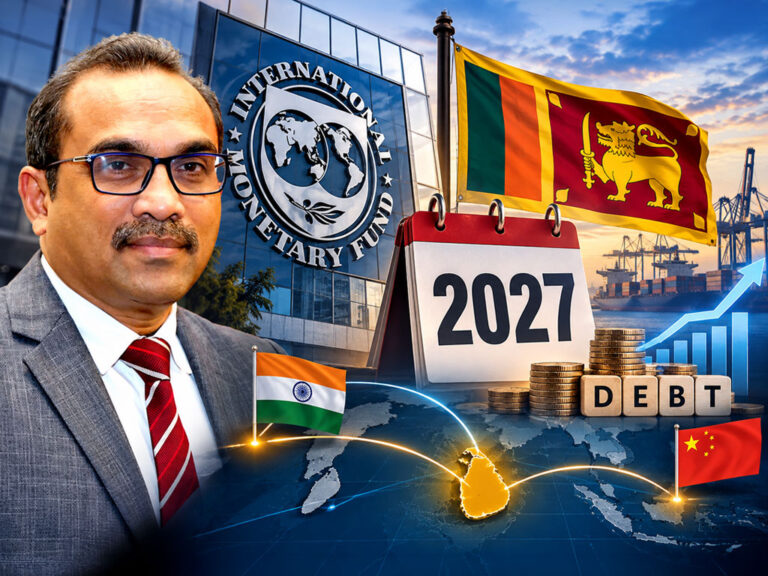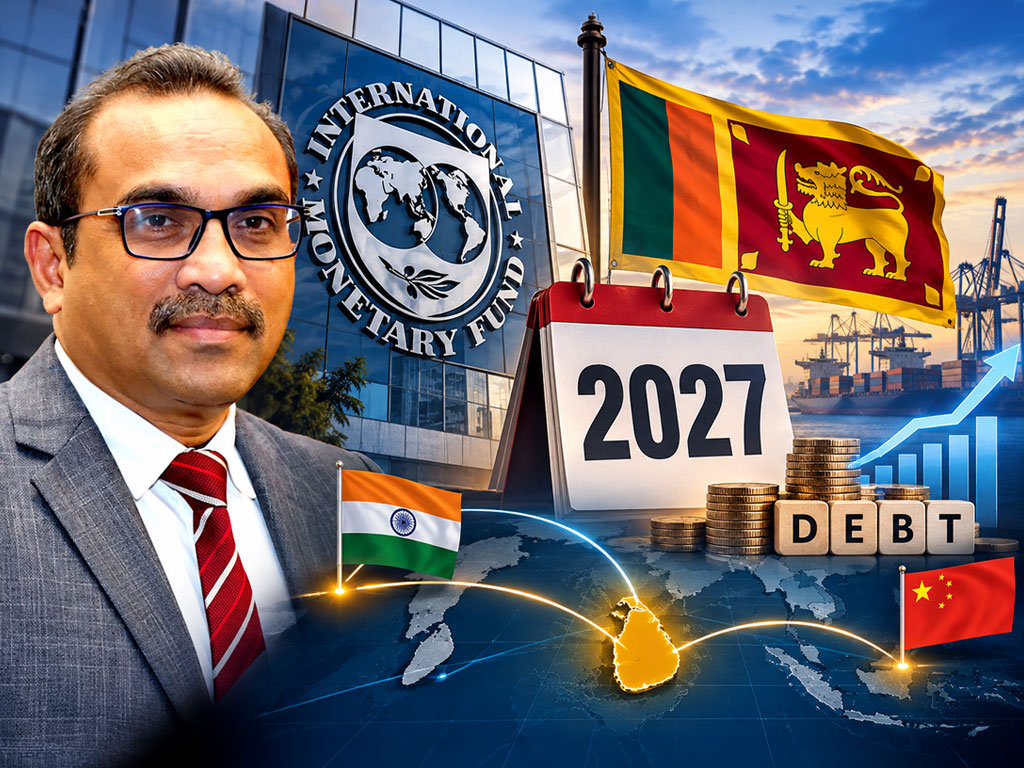
Sri Lanka IMF exit plans after 2027 raise questions over debt repayments, fiscal discipline, reserves and balancing relations with India and China.
Sri Lanka’s stated intention not to seek another International Monetary Fund programme after the current four-year Extended Fund Facility ends in 2027 has opened a wider debate over whether the country can preserve economic stability without another IMF-backed arrangement while navigating renewed debt repayments and competing geopolitical interests.
Transport, Highways, Ports and Civil Aviation Minister Bimal Rathnayake has said the government sees no need for another programme after completing the present arrangement, beyond normal financial and diplomatic dealings with international institutions. IMF Mission Chief for Sri Lanka Evan Papageorgiou has also indicated that whether Sri Lanka requests another programme is ultimately a decision for the government.
The current EFF was approved by the IMF Executive Board in March 2023. Its final scheduled review is in March 2027, subject to Sri Lanka meeting programme requirements.
Moving beyond the programme would therefore represent more than the end of an IMF financing arrangement. It would test whether reforms introduced since the 2022 economic crisis can survive without the discipline and external oversight associated with an IMF programme.
That makes the real question less about whether Sri Lanka can leave the IMF programme and more about what economic position the country will be in when it does.

Reforms Have Stabilised the Economy, but Risks Remain
Sri Lanka’s IMF-supported programme has centred on restoring debt sustainability, strengthening government revenue, maintaining price stability, rebuilding foreign reserves, protecting financial stability and pursuing structural and governance reforms.
Among the major measures introduced during the adjustment period were an increase in VAT to 18%, cost-recovery pricing for electricity and fuel, domestic debt optimisation and legislation including a new Central Bank Act, Public Financial Management Act and Anti-Corruption Act.
Debt restructuring has also progressed through negotiations involving official creditors, China and international sovereign bondholders.
Recent economic indicators point to a substantial recovery from the depths of the 2022 crisis. The IMF said this week that economic activity expanded by 4.2% in the second quarter of 2026, marking 11 consecutive quarters of growth. It also said Sri Lanka’s economy had demonstrated resilience despite successive external shocks.
Yet the Fund’s September mission made clear that the recovery remains exposed to significant risks. Medium-term revenue mobilisation, energy cost recovery, capital investment and continued structural reforms remain priorities, while the IMF has stressed the importance of maintaining prudent policies to protect macroeconomic stability.
Sri Lanka is also expected to return to a primary surplus target of 2.3% of GDP in 2027.
Leaving an IMF arrangement, therefore, does not mean the economic disciplines associated with recovery can simply be abandoned.
Sri Lanka IMF Exit Offers Greater Policy Freedom
A successful transition beyond the EFF could give the government greater freedom to formulate economic policies without having to negotiate programme conditions with the IMF.
That could provide more political space to reconsider taxation, support domestic industries and agriculture, determine public spending priorities and decide how the benefits of economic growth are distributed.
Such flexibility could prove important for a population that has endured higher taxes, increased utility costs and other consequences of the adjustment programme.
It could also allow Sri Lanka to explore alternative financing mechanisms and manage future borrowing according to domestic priorities rather than the requirements of another IMF arrangement.
But policy freedom and economic freedom are not necessarily the same thing.
Sri Lanka would still have to convince creditors, investors and financial markets that it can maintain fiscal discipline, meet debt obligations, protect foreign reserves and avoid the policies that contributed to the 2022 balance-of-payments crisis.
Those constraints would remain regardless of whether an IMF programme existed.
Debt Repayments Could Become the Hardest Test
Debt servicing is likely to be among the most difficult challenges of the post-programme period.
Sri Lanka’s restructuring has provided breathing space, but that does not eliminate its obligations. As restructured debt payments increase, the country will need sufficient foreign currency earnings to meet external obligations while continuing to finance imports and maintain adequate reserves.
Without another IMF programme, international markets would pay particularly close attention to fiscal performance, foreign reserves, debt-servicing capacity and the credibility of economic policy.
A breakdown in fiscal discipline could increase borrowing costs and weaken confidence in Sri Lanka’s ability to manage its obligations.
That risk is particularly important given the experience of 2022, when severe foreign exchange shortages left the country struggling to finance essential imports and ultimately led to a sovereign default.
The IMF itself continues to describe Sri Lanka’s debt sustainability risks as high, even as restructuring approaches completion.
Economic sovereignty after 2027 would therefore depend less on the absence of IMF conditions than on Sri Lanka’s ability to finance itself sustainably.
India and China Add a Geopolitical Dimension
The challenge is not purely economic.
Sri Lanka’s strategic position in the Indian Ocean means its financing decisions inevitably intersect with relations involving India, China and other major international partners.
India played an important role during Sri Lanka’s 2022 crisis, providing emergency financial assistance at a time when foreign exchange shortages had become acute. New Delhi also remains a major economic and strategic partner.
China, meanwhile, is one of Sri Lanka’s important bilateral creditors and has extensive economic interests connected with infrastructure and Belt and Road Initiative projects.
How Colombo manages those relationships after the IMF programme will matter.
The source article argues that recent defence engagement demonstrates India’s desire to protect its regional strategic interests, while China’s infrastructure investments provide Beijing with continuing economic influence. Those are geopolitical interpretations rather than established evidence that either country intends to force Sri Lanka into an exclusive alignment.
Sri Lanka’s policy challenge is consequently not simply to choose between India and China. It is to preserve sufficient economic and diplomatic room to work with both, alongside Japan, the United States, the European Union and other partners, without becoming excessively dependent on any single source of financing.
Leaving the IMF Does Not Mean Leaving the IMF Behind
Another distinction is essential.
Completing the current EFF without requesting a new programme would not mean Sri Lanka had severed its relationship with the IMF.
Sri Lanka would remain an IMF member and continue normal engagement with the institution, including surveillance and policy consultations. Existing financial obligations to the Fund would also remain.
The decision after 2027 is therefore more accurately understood as whether Sri Lanka seeks another IMF-supported financing programme, rather than whether it “leaves” the IMF.
For the present, even that decision remains in the future.
The IMF’s September 10-23 mission held discussions with the government on the Seventh Review of the EFF and the 2026 Article IV Consultation. Those discussions were described as productive, but no staff-level agreement on the Seventh Review was announced when the mission concluded. Talks are continuing.
The existing programme itself must therefore still be completed successfully before the merits of the post-2027 strategy can be properly assessed.
Economic Sovereignty Will Depend on Resilience
There is an understandable political attraction in declaring that Sri Lanka will no longer need another IMF programme.
For a country that endured sovereign default, shortages, queues and severe economic contraction, being able to finance itself without emergency international assistance would represent a significant recovery.
But independence from another IMF programme cannot itself guarantee economic sovereignty.
That will depend on whether Sri Lanka can generate sufficient export earnings, rebuild and protect foreign reserves, attract sustainable investment, maintain government revenue, service restructured debt and resist politically attractive policies that could again undermine fiscal and external stability.
The source article argues that reserves would need to rise beyond US$10 billion to US$12 billion. No evidence supplied with the article establishes that particular range as an official threshold required for successfully operating without another IMF programme. The broader need to rebuild adequate external buffers, however, is consistent with the IMF’s continuing emphasis on reserve accumulation.
Nor is geopolitical balance simply a choice between New Delhi and Beijing. Sri Lanka’s economic relationships extend considerably beyond those two capitals, and the country’s ability to diversify trade, investment and financing could itself reduce vulnerability to pressure from any single partner.
The government may ultimately decide that another IMF programme is unnecessary. It could also reconsider if economic conditions change before or after the current arrangement concludes.
For now, the immediate test comes earlier: completing the existing programme while preserving the stability achieved since the crisis.
Sri Lanka’s economic sovereignty after 2027 will ultimately be measured not by whether the IMF remains in the background, but by whether the country can meet its obligations, withstand external shocks and make its own policy choices without once again requiring emergency financial assistance.