By Dwayne Ferreira.
A planned Israel–UAE meeting on the flydubai terror investigation is cancelled as questions grow over cockpit security screening.
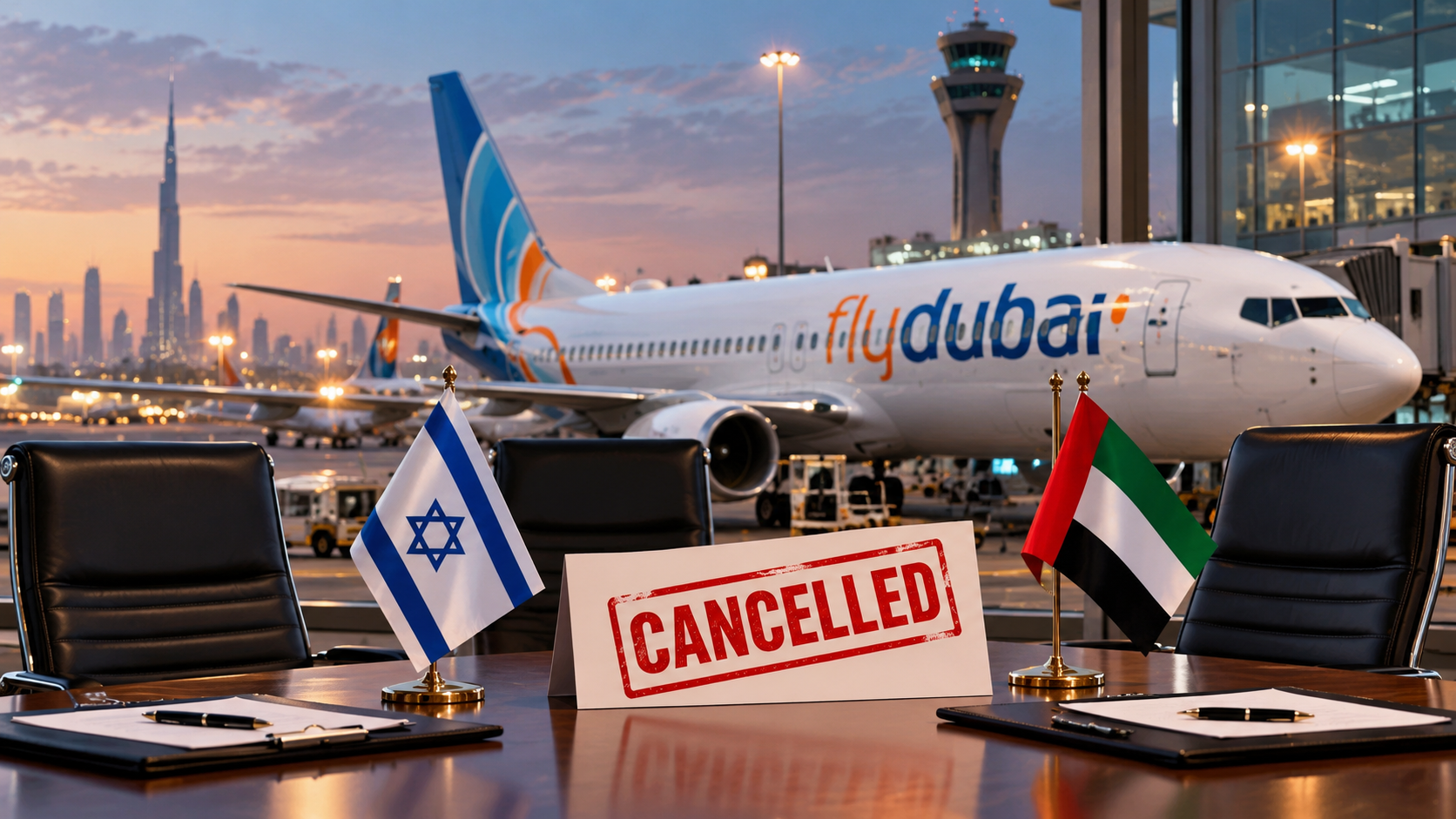
A planned meeting between Israel and the United Arab Emirates to discuss the investigation into the attempt on the Flydubai passenger aircraft has reportedly been cancelled at the last minute, raising questions over international cooperation in one of the most serious recent aviation-security incidents.
The meeting was expected to involve representatives of Israel’s Transportation Ministry and Emirati authorities examining the September 30 attack aboard flydubai Flight FZ1073.

According to Israel’s Channel 13 television, as reported by The Times of Israel, the cancellation means findings from the UAE investigation will not be presented to Israeli officials at the meeting as originally planned.
Conflicting accounts have emerged about which side cancelled the discussions.
One version suggested that Emirati officials objected to the participation of Israeli Transportation Minister Miri Regev because they did not want the meeting to assume a political character.
Another account suggested that Regev herself called off the meeting for reasons that remain unclear.
Neither explanation has been independently established.
Attempted Attack on Passenger Aircraft Shocks Aviation Industry
The cancelled discussions follow an incident aboard Flight FZ1073, which departed Dubai for Tel Aviv on September 30.
During the flight, the aircraft’s Omani first officer attacked the captain inside the cockpit using an emergency axe and attempted to seize control of the aircraft.
The captain, identified as Indian national Smit Machchhar, sustained serious injuries during the confrontation. The aircraft subsequently experienced a dangerous loss of altitude before control was restored.
Passengers and crew helped restrain the attacker, and the aircraft diverted to Tabuk in Saudi Arabia, where it landed safely.
What initially appeared to be an extraordinary cockpit assault subsequently developed into a terrorism investigation involving multiple countries.
UAE Prosecutors Reveal Alleged Suicide Attack Plot
On October 9, UAE Attorney-General Dr Hamad Saif Al Shamsi announced findings indicating that the suspected attacker had allegedly planned to use the aircraft as a weapon against Israel’s Ben Gurion International Airport.
According to the Emirates News Agency, prosecutors said the 29-year-old suspect had intended to crash the aircraft into the passenger terminal, potentially causing mass casualties.
Investigators also reported examining the suspect’s ideological development and aviation career.
Their findings indicated that signs of extremist radicalisation emerged as early as 2017, while he was studying in Australia.
UAE prosecutors further stated that the suspect’s career decisions and preparations formed part of a premeditated plan.
Those findings represent the authorities’ account of an ongoing criminal investigation and should not be confused with a final judicial determination of guilt.
Warning Signs Raise Serious Questions About Screening
The case has prompted scrutiny of the aviation recruitment and security processes that allowed the suspect to operate international passenger flights.
According to reporting by The Wall Street Journal and Associated Press, questions have emerged about his previous employment history, alleged extremist indicators and whether relevant information was available to authorities or former employers.
Investigators are examining how an individual suspected of harbouring violent intentions could progress through airline recruitment, training and security checks.
The case has also raised questions about the exchange of security information between aviation regulators, employers and intelligence agencies.
Airlines generally rely on several layers of protection, including employment verification, medical assessments, background screening, recurrent training and operational supervision.
However, the incident highlights a potential vulnerability: safety procedures designed to address technical failures and routine operational risks may not necessarily detect a crew member who deliberately conceals violent intentions.
Cancelled Meeting Complicates Information Sharing
The planned Israeli–Emirati meeting would have offered an opportunity for officials to review investigative findings and discuss potential security implications.
Its cancellation does not establish that cooperation between the two countries has ended.
Nevertheless, the reported postponement comes at a sensitive moment, with questions surrounding the background screening of flight crews, aircraft security and the responsibilities of national authorities.
Israel has examined whether its own security procedures adequately assessed the information available about the flight and its operating crew.
The UAE is continuing its investigation into the alleged attack.
India has also opened a separate investigation through its National Investigation Agency, seeking to determine whether the assault on Captain Machchhar involved a wider conspiracy.
What Other Airlines Can Learn
The wider aviation industry is likely to examine whether existing recruitment and reporting systems provide sufficient protection against internal security threats.
Potential areas for review include international verification of pilot employment records, communication between regulators, procedures for escalating credible security concerns and safeguards against unauthorised control of an aircraft.
Any proposed changes would need to respect employment law, privacy protections and the principle that security decisions must be based on reliable evidence rather than nationality, religion or unsubstantiated suspicion.
The flydubai incident is particularly significant because it involved an alleged threat originating inside the cockpit rather than from an external passenger.
That distinction makes the effectiveness of internal controls and crew-support procedures central to any future safety review.
Questions Remain Unanswered
It remains unclear when Israeli and Emirati officials will next meet to discuss the investigation, whether the findings will be exchanged through alternative channels, or what changes aviation authorities may recommend.
There is also no confirmed evidence that the cancelled meeting represents a broader diplomatic breakdown.
For an industry built upon international cooperation and public confidence, the most important outcome will be ensuring that investigative findings are shared appropriately and translated into practical safety improvements.
The survival of those aboard Flight FZ1073 prevented an alleged attack from becoming a mass-casualty disaster.
The investigation must now establish how the threat developed, what warning signs existed and whether more effective international safeguards could have prevented it.