Asiri’s response to allegations surrounding a female patient’s death has intensified scrutiny of its handling of the body, while questions remain over medical records, forensic examinations and the responsibility of senior management.
COLOMBO, October 17, 2026 — A statement reportedly issued by Asiri Hospital on October 16 denying that unsettled medical bills delayed the release of a deceased female patient’s body has renewed scrutiny of the circumstances surrounding her death, which is the subject of reported proceedings before the Maligakanda Magistrate’s Court.
The hospital’s response followed allegations that the woman’s body had been retained for two days, prompting her daughter to complain to the Maradana Police.
According to information concerning the judicial proceedings, the court directed a post-mortem examination, the preservation of medical evidence and the release of the body to the daughter following the examination.
Tissue and organ samples were reportedly referred for further scientific testing, while the precise cause of death remained undetermined in the material available.
The dispute now centres on two questions: whether the hospital followed proper procedures in handling the deceased woman’s body and whether the medical and forensic evidence can establish what caused her death.
Neither question has yet been conclusively answered.

Asiri Hospital Denies Delay Over Unpaid Bills
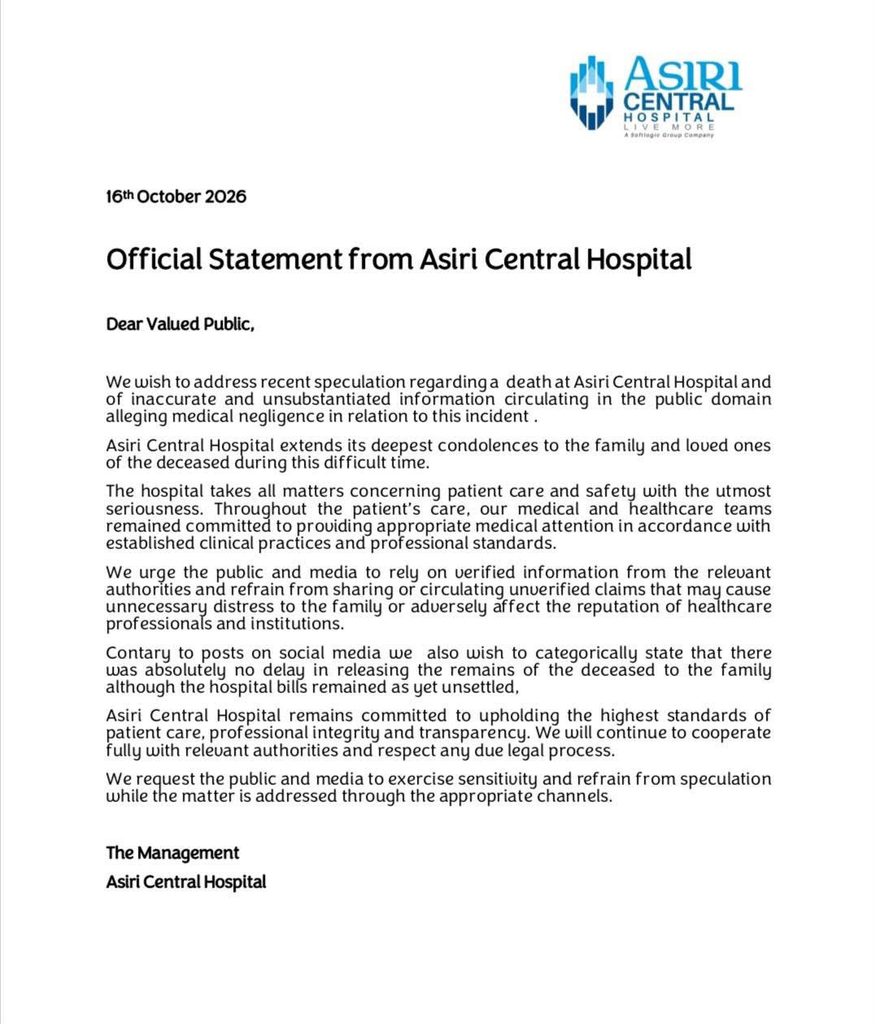
In a statement dated October 16, Asiri Hospital reportedly rejected suggestions circulating publicly about the circumstances of the woman’s death and the handling of her remains.
The statement, as reproduced in the supplied material, said:
“Although bills remained as yet unsettled, there was no delay in releasing the body.”
That assertion directly disputes the allegation that unpaid charges prevented the family from obtaining the woman’s remains.
The reference to unsettled bills confirms that an outstanding financial balance was acknowledged in the reported statement. It does not, however, establish that payment was demanded as a condition of releasing the body.
The source criticises the hospital for raising the issue of unpaid bills while expressing condolences to the family, arguing that the disclosure placed unnecessary attention on the deceased patient’s financial obligations.
Whether the reference was included to explain the circumstances of the release, respond to a specific allegation or serve another purpose cannot be determined without examining the statement in full.
The Morning Telegraph has not independently authenticated the complete October 16 statement directly with Asiri Hospital.
The hospital’s account must therefore be considered alongside the family’s complaint, relevant administrative records and the court proceedings.

An account of proceedings before the Maligakanda Magistrate’s Court describes orders for a post-mortem examination, the preservation of medical evidence and further forensic testing following the death of a female patient at an Asiri hospital in Colombo.
Read MoreWhy Did the Daughter Approach the Police?
The dispute becomes particularly important in light of the complaint reportedly lodged by the deceased woman’s daughter.
According to the account supplied to The Morning Telegraph, the daughter contacted the Maradana Police after the hospital allegedly failed to release her mother’s body for two days.
Information presented concerning the proceedings identifies Acting Maligakanda Magistrate Premalal Athukorala as having issued directions on October 13 under Section 373(1) of the Code of Criminal Procedure Act No. 15 of 1979.
The reported case number is 49085/01/26.
The source raises three questions requiring clarification:
- Why was the body reportedly not handed over to the family for two days?
- What circumstances led the deceased woman’s daughter to lodge a complaint with the Maradana Police?
- Why was judicial intervention required before the body was reportedly handed over following the post-mortem examination?
These questions are legitimate, but they do not independently prove that the hospital detained the body because bills had not been settled.
A delay could involve administrative, medical, investigative or other circumstances. Establishing the reason requires contemporaneous records showing when the family requested release, what response it received and when the body was legally available for handover.
The reported court order does not, by itself, establish that hospital officials committed an offence or deliberately obstructed the family.
Medical Records Reportedly Taken Into Police Custody
Another significant aspect of the investigation concerns the preservation of the deceased patient’s medical records.
The account describes four measures associated with the reported court proceedings.
1. Medical records: Maradana Police reportedly obtained the patient’s bed-head ticket (BHT), treatment notes and related medical documents, which were subsequently provided to the Colombo Chief Judicial Medical Officer.
2. Organ samples: Samples collected during the post-mortem examination were reportedly referred to the Government Analyst for toxicological and chemical testing intended to assist in establishing the cause of death.
3. Tissue samples: Investigators reportedly obtained tissue samples relating to open wounds observed on the woman’s body, requiring further examination to determine their origin and medical significance.
4. Identifiable burial: The reported court order directed burial at Borella Public Cemetery in a marked location, allowing the grave to be identified if further lawful examination became necessary.
The reported preservation of evidence is important because it enables independent specialists to examine the patient’s treatment history alongside the post-mortem findings.
Medical records may reveal information about her condition, medication, clinical procedures and the events preceding death.
Laboratory tests may also assist forensic specialists in determining whether substances, infections or other factors contributed to the fatal outcome.
Nevertheless, referring samples to the Government Analyst is a routine investigative measure in appropriate cases and does not itself establish poisoning, negligence or another criminal offence.
Questions Over Wounds Observed on the Patient’s Body
The original account places particular emphasis on open wounds reportedly observed during the post-mortem examination.
It questions why the hospital’s statement did not explain their presence.
The nature of those wounds, their location, when they developed and whether they were connected to medical treatment remain unverified in the material examined.
Open wounds can arise in different medical circumstances, including underlying illness, pressure injuries, procedures or other causes. Their significance cannot be determined from their reported presence alone.
The relevant forensic and clinical specialists must establish whether the wounds were present before admission, developed during treatment or resulted from another cause.
Only after examining the medical records and forensic evidence would it be appropriate to determine whether the injuries indicate a failure in patient care.
The hospital should also have an opportunity to explain the relevant treatment history, subject to patient confidentiality and the requirements of the investigation.
Court-Directed Burial Preserves the Possibility of Further Examination
The reported judicial order also contained directions concerning the burial of the body.
According to the supplied account, Clause 06(3) required burial at Borella Public Cemetery with an identifying marker.
The source interprets the restriction on cremation as an indication of serious suspicion surrounding the death.
A more precise interpretation is that identifiable burial may preserve the possibility of further examination or exhumation if the investigation subsequently requires it.
Such a direction does not, on its own, establish criminal wrongdoing or an adverse medical finding.
Its significance lies in preserving access to potential forensic evidence while the cause of death remains under examination.
The exact wording and legal reasoning behind the order should be confirmed against an authenticated court copy.
Ashok Pathirage and Earlier Asiri Hospital Court Proceedings
The case has also renewed scrutiny of the Asiri hospital network’s senior leadership, including Chairman Ashok Pathirage.
The source draws attention to separate legal proceedings concerning allegations that medicines were sold above government-regulated maximum retail prices.
In September 2025, the Maligakanda Magistrate’s Court issued warrants against several directors of Asiri Medical Hospital, including Pathirage, after they failed to appear in proceedings concerning medicine pricing.
On September 26, seven directors who appeared before court were released on personal bail of Rs. 500,000 each.
The case concerned the alleged sale of 11 pharmaceutical items above stipulated maximum retail prices.
Earlier proceedings included a guilty plea entered by a hospital representative, but the procedural validity and subsequent handling of those proceedings were contested.
In January 2026, the Maligakanda Magistrate’s Court rejected preliminary objections concerning the maintainability of the case and directed that the directors be summoned for the reading of charges.
These developments demonstrate that the hospital group has previously faced regulatory and judicial scrutiny.
They must, however, be distinguished from the present death investigation.
Being released on bail in the medicine-pricing proceedings does not establish personal guilt, nor does it provide evidence that Pathirage or any other director caused, concealed or improperly handled the patient’s death.
No evidence examined establishes a causal connection between the earlier pricing case and the reported circumstances of the woman’s death.
Responsibility of Asiri’s Senior Management
The supplied commentary also calls for an explanation from senior hospital administrators, including Dr. Samanthi de Silva, whom it identifies as Chief Operating Officer with responsibilities relating to clinical operations across the Asiri network.
Her precise current title, operational authority and personal involvement in the events have not been independently established.
Corporate leadership and hospital administration have responsibilities for maintaining appropriate clinical governance, patient safety procedures, complaint-handling systems and administrative controls.
Those responsibilities make it reasonable to seek an institutional explanation when a patient’s death results in police and judicial proceedings.
However, responsibility for institutional oversight should not be confused with proof of personal wrongdoing.
The appropriate questions concern what the hospital’s internal review established, whether the family’s complaint was investigated and whether the relevant medical and administrative records were preserved and provided to the authorities.
An official account would also help determine whether any weaknesses in the hospital’s procedures require corrective action.
Should Private Hospital Regulators Intervene?
The controversy has renewed calls for closer oversight of Sri Lanka’s private healthcare sector.
The Private Health Services Regulatory Council, operating within the framework of the Private Medical Institutions (Registration) Act No. 21 of 2006, has responsibilities concerning private medical institutions and applicable healthcare standards.
The Ministry of Health and other relevant authorities also have roles in the wider regulation of healthcare services.
The source argues that these institutions should examine whether existing safeguards adequately protect patients and their families, particularly when disputes involve medical treatment, billing and the release of deceased patients’ bodies.
Regulatory attention should focus on documented procedural failures, where established, rather than assumptions about an institution’s motives.
It is also important that any regulatory examination remains distinct from the forensic investigation and any criminal proceedings.
An independent assessment of hospital procedures could nevertheless help establish whether improvements are needed in communication with families, medical record management and the handling of deaths requiring judicial investigation.
Forensic Findings Will Be Central to Accountability
The outstanding issue is the medical evidence.
Asiri’s reported statement disputes the allegation that unpaid bills delayed the release of the body, while the family’s complaint and reported court intervention require a clear account of what occurred.
The forensic investigation must separately determine the cause of death and assess the significance of the reported wounds and laboratory samples.
The available material does not establish that the hospital deliberately concealed evidence, unlawfully detained the body or provided negligent treatment.
Nor does it establish that the hospital’s explanation has resolved the family’s concerns.
The next significant development will be the Government Analyst’s findings and the final judicial medical conclusions, together with any further directions issued by the Maligakanda Magistrate’s Court.
Those records, supported by the hospital’s full statement and the family’s documented complaint, will provide the basis for determining whether further investigative, regulatory or legal action is warranted.
For the deceased woman’s family, the essential requirement remains a clear and evidence-based explanation of the circumstances surrounding her death and the handling of her remains.