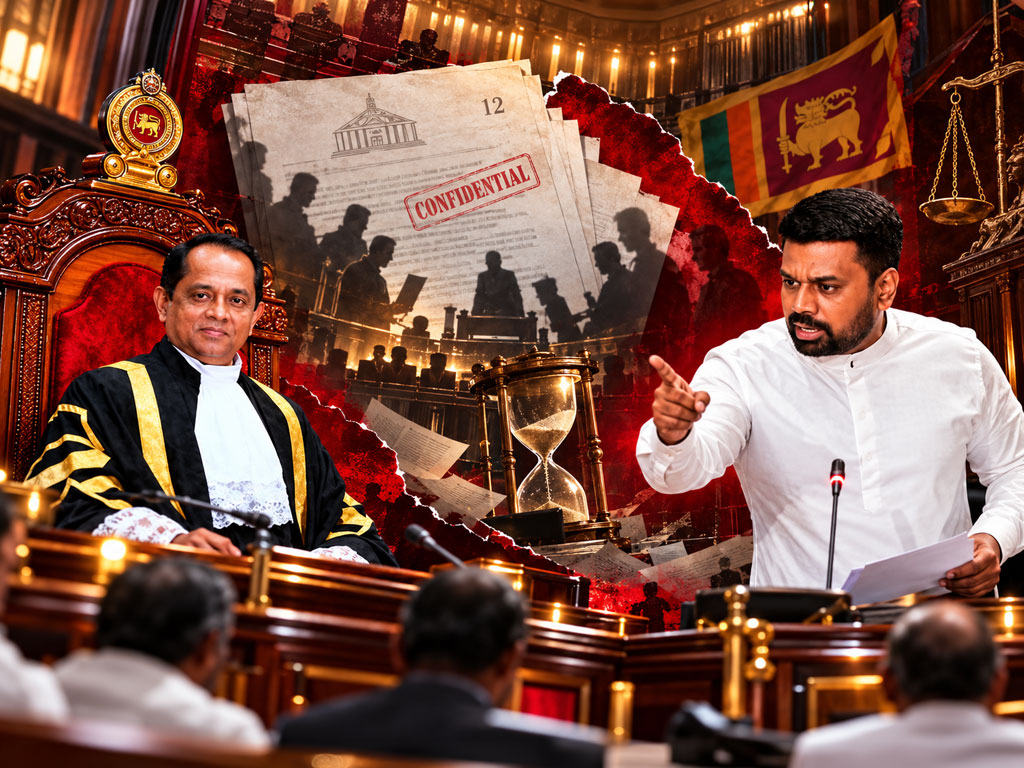
COLOMBO, October 19, 2026 — The postponement of a no-confidence debate against Speaker Dr. Jagath Wickramaratne has been followed by claims that Parliament’s Secretary General submitted a confidential 12-page complaint to President Anura Kumara Dissanayake. The alleged correspondence and reports of pressure on the Speaker to resign remain unverified.
The indefinite postponement of a no-confidence debate against Speaker Dr. Jagath Wickramaratne has been followed by allegations that Parliament’s Secretary General, Kushani Rohanadeera, submitted a confidential 12-page letter to President Anura Kumara Dissanayake concerning alleged interference in her official duties and inappropriate treatment by the Speaker.
The claims, published by the news platform HariDeshayaLk and attributed to an unnamed senior Government minister, have not been independently verified. The alleged letter has not been made publicly available in the material examined, and its contents have not been authenticated.
According to the report, the President was angered by the alleged correspondence and subsequently discussed the Speaker’s conduct with two senior ministers regarded as close associates of Wickramaratne.
The publication further claims that senior Government figures are pressing the Speaker to resign rather than face a parliamentary debate on the opposition’s no-confidence motion.
Neither an instruction from the President seeking the Speaker’s resignation nor a decision by Wickramaratne to step down has been officially confirmed.
What is established is that the debate has been postponed while parliamentary authorities await the Attorney General’s advice on procedural objections raised by Government representatives.

No-Confidence Motion Postponed After Government Objections
The Samagi Jana Balawegaya (SJB) submitted a no-confidence motion against Wickramaratne in October, supported by 44 opposition parliamentarians.
The motion contains approximately 50 allegations concerning the Speaker’s conduct, including claims relating to parliamentary administration, the exercise of official authority and the handling of parliamentary proceedings.
These remain allegations. Their inclusion in a parliamentary motion does not establish that the Speaker has committed any misconduct.
The Government had initially indicated its willingness to debate the motion at an early opportunity.
When the Committee on Parliamentary Business met on Friday, October 16, a debate was considered for October 20.
Opposition representatives objected to limiting the proceedings to one day, arguing that the number of allegations and the participation of several opposition parties required a longer debate.
Government representatives subsequently raised questions about the motion’s technical and procedural validity.
They also reportedly questioned the circumstances under which the Secretary General had accepted the motion and requested that the Attorney General’s advice be obtained.
Chief Opposition Whip Gayantha Karunatilaka said a date would be determined after that opinion was received.
The debate was consequently left off the parliamentary programme for October 20 to 23.
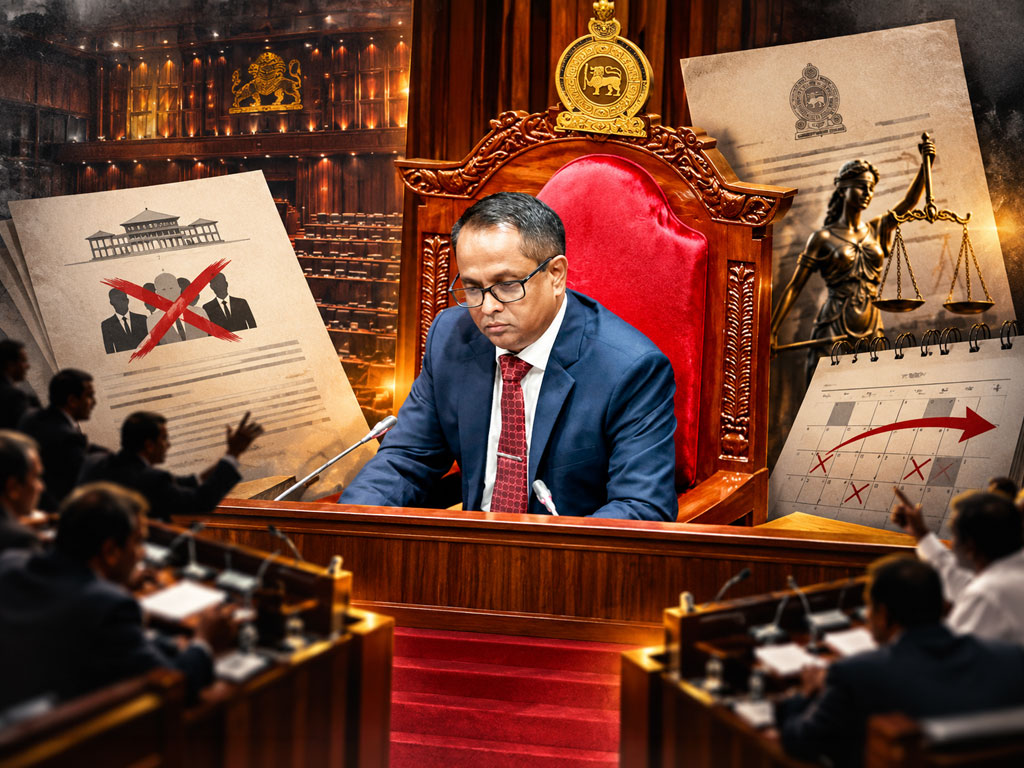
COLOMBO, October 18, 2026 — The Government has sought the Attorney General’s advice over procedural objections to the opposition’s motion against Speaker Dr. Jagath Wickramaratne, leaving the debate without a date amid speculation about his political future.
Read MoreAllegations of Interference With Secretary General’s Duties
The more serious claims in the HariDeshayaLk report concern the alleged treatment of Secretary General Kushani Rohanadeera.
Citing information said to have been disclosed privately by a senior Government minister to one of its representatives, the publication alleges that Wickramaratne repeatedly interfered with Rohanadeera’s independent administrative responsibilities.
It further claims that the Speaker addressed or treated her in an insulting and demeaning manner in the presence of his personal secretary.
No specific dates, documented incidents or independently authenticated communications accompanying these allegations were provided in the supplied report.
The distinction between the Speaker’s parliamentary authority and the Secretary General’s administrative responsibilities is important.
As Parliament’s senior administrative officer, the Secretary General performs functions established under the applicable constitutional, statutory and parliamentary framework.
Any allegation of improper interference in those duties warrants examination through the relevant institutional procedures.
At the same time, a disagreement over parliamentary administration cannot automatically be characterised as misconduct without examining the circumstances, applicable rules and evidence.
The reported allegations require an opportunity for the individuals concerned to provide their accounts.
Claims of Confidential 12-Page Letter to President
According to HariDeshayaLk, Rohanadeera communicated her concerns directly to President Dissanayake through a confidential letter running to 12 pages.
The publication alleges that the correspondence described administrative interference, pressure and treatment she considered unacceptable.
Its source reportedly told the publication that the President reacted angrily after reading the letter and brought its contents to the attention of two ministers who were close to the Speaker.
The same account attributes remarks to the President questioning whether an individual accused of treating a senior female official in such a manner should continue occupying the Speaker’s chair.
However, the exact language reportedly used by the President cannot be authenticated from the material supplied.
The Morning Telegraph has not examined the alleged letter or obtained independent confirmation that it was delivered to the President.
Neither the existence of the correspondence nor the President’s reported response should therefore be treated as established.
If such a complaint was submitted, its authenticity, precise contents and any resulting official action would be essential to understanding the dispute.
Those facts could also help establish whether the allegations concern administrative disagreements, breaches of parliamentary procedure or conduct requiring a formal inquiry.
Report Claims Women MPs Expressed Objections
The HariDeshayaLk account also alleges that several female parliamentarians belonging to the National People’s Power (NPP) expressed strong objections after learning of the reported treatment of Rohanadeera.
According to the publication, the parliamentarians were angered by claims that a woman holding one of the country’s most senior parliamentary administrative positions had been subjected to humiliating behaviour.
The report describes their response as a protest.
It does not, however, identify the MPs involved, establish when or where the alleged protest occurred, or provide independently verifiable details of any formal complaint or parliamentary action.
Consequently, the claim cannot be reported as a confirmed protest by NPP women parliamentarians.
Any substantiated complaint concerning workplace dignity, professional independence or inappropriate conduct would deserve proper consideration, irrespective of the political positions of those involved.
Is the Government Seeking the Speaker’s Resignation?
The source report interprets the postponement of the no-confidence debate as an attempt to provide Wickramaratne with an opportunity to resign before the allegations are examined in Parliament.
It alleges that senior Government figures believe a parliamentary debate could prove politically damaging and are seeking to avoid such an outcome.
The publication presents the Attorney General’s involvement as part of that alleged strategy.
No documentary or independently corroborated evidence has been supplied establishing that the Attorney General’s advice was requested for the purpose of delaying proceedings until the Speaker could resign.
The Government’s publicly reported explanation is that questions about the motion’s procedural validity require clarification.
The decision to seek legal advice does not, by itself, prove an attempt to obstruct parliamentary scrutiny.
Equally, the indefinite postponement means the opposition’s allegations have not yet been subjected to the debate it requested.
A clear explanation of the procedural objections and the expected timetable for obtaining legal advice would help Parliament address concerns about the delay.
Should the reported allegations involving the Secretary General be substantiated, they would raise separate questions about institutional accountability that should not depend solely on the outcome of the no-confidence motion.
Parliament’s October 20–23 Programme Excludes the Motion
The Committee on Parliamentary Business, meeting on October 16 under the chairmanship of Deputy Speaker Dr. Rizvie Salih, approved the programme for Parliament’s next sitting week.
Secretary General Kushani Rohanadeera announced the following arrangements.
- Daily proceedings: Parliament will convene at 9.30 a.m. Business under Standing Order 22(1) to (6) will be taken up until 10.00 a.m. Questions for Oral Answers will follow from 10.00 a.m. to 11.00 a.m., with questions under Standing Order 27(2) scheduled from 11.00 a.m. to 11.30 a.m.
- Tuesday, October 20: An opposition adjournment motion will be debated from 11.30 a.m. to 5.30 p.m.
- Wednesday, October 21: A resolution under the Public Debt Management Act and a supplementary estimate will be debated from 11.30 a.m. to 5.00 p.m. Annual reports of five statutory institutions will subsequently be considered without debate. Questions at the Adjournment Time are scheduled from 5.00 p.m. to 5.30 p.m.
- Thursday, October 22: Two Bills numbered 79 and 80, proposing amendments to the Poisons, Opium and Dangerous Drugs Ordinance, will be taken up for second reading from 11.30 a.m. to 5.00 p.m. Annual reports of statutory institutions will also be considered, followed by an opposition adjournment motion from 5.00 p.m. to 5.30 p.m.
- Friday, October 23: Parliament will debate the second reading of the Elimination of Rabies and Registration of Dogs Bill from 11.30 a.m. to 5.00 p.m., followed by a Government adjournment motion until 5.30 p.m.
The programme does not include the no-confidence motion against the Speaker.
Speaker’s Future Awaits Official Clarification
The postponement has created two distinct questions concerning Wickramaratne’s position.
The first is procedural: when will the Attorney General provide the requested advice, and when will Parliament decide whether to proceed with the opposition’s motion?
The second concerns the allegations reported by HariDeshayaLk about the Speaker’s relationship with the Secretary General and the claimed involvement of the President.
Those claims are serious, but they remain unverified.
No authenticated 12-page letter has been made available for examination, no official confirmation of the President’s alleged remarks has been established, and no resignation decision has been announced.
An official response from the Speaker, the Secretary General or the President’s Office could clarify the disputed account.
For Parliament, the immediate responsibility is to resolve the procedural issues surrounding the no-confidence motion and establish whether the debate will proceed.
If a separate administrative complaint exists, its handling should be guided by evidence and appropriate institutional procedures.
Until then, the Speaker remains the subject of a pending parliamentary challenge, while the claims surrounding the alleged confidential correspondence require independent substantiation.