By a Special Reporter
Nitesh Tiwari’s ambitious adaptation of the Hindu epic demonstrates the extraordinary technological capabilities of Indian cinema. Yet beneath its spectacular imagery lies a troubling absence of emotional depth, character development and imaginative storytelling.
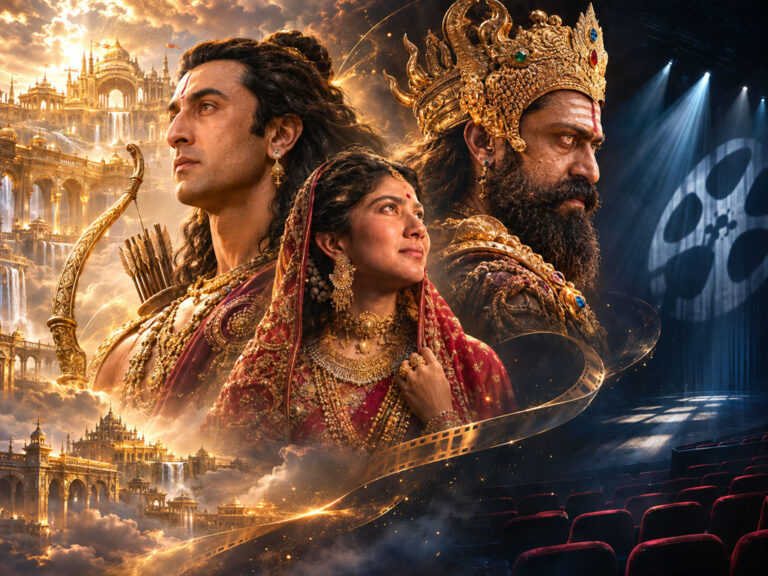
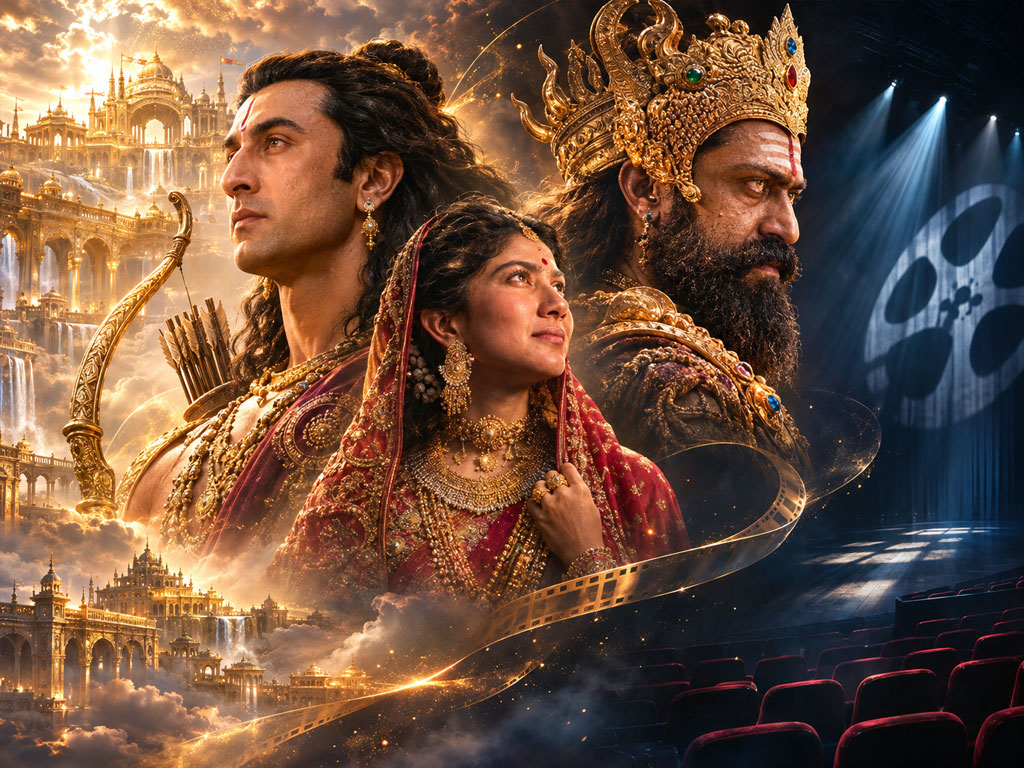
Nitesh Tiwari’s Ramayana arrives with all the ingredients of a cinematic phenomenon: an enormous budget, advanced visual effects, an internationally recognised production team and a star-studded cast led by Ranbir Kapoor, Yash and Sai Pallavi.
It is unquestionably an impressive technical achievement.
The elaborate mythical creatures, monumental palaces, digitally constructed landscapes and spectacular battle sequences demonstrate how far Indian cinema has progressed in recreating extraordinary fictional worlds.
Yet the film’s greatest achievement also exposes its most significant weakness.
For all its technological sophistication, Ramayana struggles to deliver a genuinely compelling cinematic experience.
Beneath the extraordinary visual presentation lies a screenplay that appears reluctant to explore its characters beyond their established mythological identities. Emotional relationships remain underdeveloped, conflicts seldom acquire sufficient dramatic weight, and much of the film’s considerable running time is devoted to spectacle rather than storytelling.
The result is a production that frequently resembles an exceptionally expensive mythological television serial, albeit one equipped with some of the most advanced visual technology available to contemporary cinema.
This raises a fundamental question about modern filmmaking: Has the pursuit of technological perfection begun to replace the pursuit of artistic creativity?

When Spectacle Becomes a Substitute for Storytelling
There is no denying the technical accomplishment represented by Ramayana.
Produced by Namit Malhotra and directed by Nitesh Tiwari, the film demonstrates exceptional ambition in its visual construction.
Its computer-generated environments, elaborate action choreography and mythological creatures possess a sophistication that places the production alongside major international fantasy films.
Such accomplishments deserve recognition.
However, the extraordinary resources invested in a film do not automatically translate into artistic excellence.
Cinema is fundamentally concerned with storytelling, conflict, emotion and the relationship between characters and their circumstances.
Technology can strengthen those elements, but it cannot replace them.
A mythical creature may be breathtakingly realistic. A battle may involve thousands of digitally generated warriors. A palace may appear more magnificent than anything previously attempted in Indian cinema.
Yet none of these achievements necessarily creates an emotionally engaging film.
Spectacle becomes meaningful when audiences understand what is at stake for the characters involved.
Without that connection, even the most extraordinary images eventually lose their impact.
Ramayana repeatedly encounters this problem.
Its visual achievements are undeniable, but the screenplay rarely demonstrates an equivalent level of imagination.
The Challenge of Retelling a Story Everyone Already Knows
The Ramayana presents filmmakers with an unusual opportunity.
Unlike an original screenplay, its central characters and principal events are already familiar to audiences across South Asia and beyond.
Rama, Sita, Ravana, Lakshman and Hanuman have occupied the cultural imagination for centuries.
Their stories have been reproduced through religious texts, literature, theatre, television, animation and countless regional adaptations.
Consequently, audiences do not necessarily approach a new adaptation to discover what happens.
They are interested in how the filmmaker interprets events they already recognise.
That distinction is essential.
An effective adaptation does not merely reproduce the established narrative. It discovers fresh dramatic possibilities within it.
Mani Ratnam’s Ponniyin Selvan offers a useful comparison.
Although its source material was already familiar to a substantial readership, Ratnam approached the story through his own cinematic interpretation.
The relationships between characters, political tensions, emotional conflicts and visual construction gave the adaptation a distinctive identity.
The audience was not simply watching familiar events reconstructed on screen. It was experiencing those events through a filmmaker’s creative perspective.
The same principle explains why Shakespeare’s Romeo and Juliet continues to inspire new adaptations.
Audiences already know the central tragedy.
What makes each interpretation interesting is the filmmaker’s treatment of the characters, their motivations, the world they inhabit and the emotional circumstances leading to their fate.
A familiar narrative should encourage creative interpretation.
In Ramayana, however, familiarity too often appears to have become a substitute for storytelling.
The film depends heavily on the audience’s existing understanding of its characters instead of establishing their dramatic identities within the screenplay.
Rama Is Worshipped, but Is He a Compelling Character?
The most significant weakness lies in the portrayal of Rama.
Ranbir Kapoor’s character is repeatedly presented as righteous, courageous, compassionate and extraordinarily skilled.
Other characters reinforce these qualities through dialogue, while elaborate sequences demonstrate his abilities.
Yet there is a fundamental difference between describing a character’s virtues and allowing the audience to experience them.
What does Rama genuinely desire?
What frightens him?
What does he doubt?
How does he respond when his personal wishes conflict with his obligations?
And how do his experiences transform him?
These are not demands for the character to abandon his established religious significance.
They are questions concerning the basic construction of compelling dramatic characters.
Rama possesses recognisable objectives.
He wishes to honour his father, fulfil his responsibilities, protect his loved ones and remain faithful to Sita.
Each of these offers considerable dramatic potential.
However, the film frequently treats his righteousness as a predetermined quality rather than something that must be explored through conflict.
His moral perfection is repeatedly announced.
What remains insufficiently developed is the emotional and psychological complexity that could make those qualities meaningful.
This is particularly disappointing because Hindu mythology contains an extraordinary range of characters who experience recognisably human emotions.
Even divine beings encounter desire, anger, jealousy, pride, doubt and moral uncertainty.
These qualities contribute significantly to the enduring appeal of mythological storytelling.
Greek mythology demonstrates a similar principle. Its gods are fascinating not merely because they possess extraordinary powers, but because their behaviour frequently reflects human weaknesses and contradictions.
There is no inherent reason why a divine incarnation cannot also become a compelling cinematic character.
Indeed, exploring the tension between divine responsibility and human emotion could make Rama’s journey considerably more powerful.
Instead, the film often relies upon majestic entrances, prolonged close-ups, reverential music and demonstrations of physical ability.
Rama is repeatedly shown to be extraordinary.
What is missing is a convincing opportunity to understand him.
Ravana Has Purpose, but Rama Lacks Dramatic Momentum
Yash’s portrayal of Ravana is among the film’s strongest elements.
His commanding screen presence gives the character a sense of authority and dramatic intensity.
More importantly, Ravana possesses identifiable ambitions.
His actions suggest a clear direction, while his decisions contribute to the progression of events.
This creates a noticeable imbalance between the two central characters.
Ravana appears driven by objectives.
Rama frequently appears to move through circumstances established around him.
Although Rama’s moral obligations provide the foundation for his journey, the screenplay does not consistently translate those obligations into compelling dramatic conflict.
The contrast becomes particularly apparent when the narrative moves between the two characters.
Ravana’s ambitions produce tension, while Rama’s established goodness often leaves relatively little room for uncertainty.
The problem is not that virtuous characters are inherently uninteresting.
Rather, virtue becomes dramatically compelling when it is tested.
A character who makes difficult choices, faces meaningful consequences and struggles to reconcile competing responsibilities offers audiences something emotionally substantial.
A character whose righteousness is repeatedly affirmed without sufficient exploration risks becoming a symbol rather than a person.
Supporting Characters Deserve More Than Spectacular Entrances
Among the supporting performances, Ravie Dubey’s Lakshman offers welcome moments of personality.
Lakshman is occasionally impulsive, humorous and imperfect.
These characteristics make him more accessible because his behaviour introduces the possibility of error and emotional unpredictability.
Sita also provides moments of emotional substance, although her relationship with Rama requires considerably greater development.
Other important characters receive insufficient attention.
Vibhishana, for example, possesses enormous dramatic potential because of his relationship with Ravana and the moral conflicts associated with loyalty, duty and conscience.
Kumbhakarna presents another missed opportunity.
In the broader Ramayana tradition, he is far more than a physically imposing supernatural warrior.
His loyalty to his brother, his intelligence, his understanding of duty and the consequences of his decisions make him a character of considerable complexity.
Yet the cinematic presentation places disproportionate emphasis on his enormous physical form.
The visual effects are impressive, but the emotional possibilities remain largely unexplored.
Kumbhakarna consequently risks becoming another remarkable digital creation rather than a fully realised dramatic character.
The same criticism applies to several members of Ravana’s family.
Their relationships could have provided political intrigue, familial tensions and meaningful conflict.
Instead, much of their presence is devoted to establishing the scale of the mythical world.
Rama and Sita: A Love Story That Needed Greater Emotional Depth
One of the film’s most disappointing shortcomings concerns the relationship between Rama and Sita.
Their love is central to the epic.
However, the audience’s existing familiarity with their relationship cannot substitute for its cinematic development.
Why are these two individuals drawn to each other?
What do they discover about one another?
How does their relationship evolve as their circumstances change?
What does Sita experience when Rama accepts exile?
How does the prospect of fourteen years away from royal life influence her emotional world?
These questions offer rich opportunities for storytelling.
The relationship could have been explored through conversations, disagreements, moments of vulnerability and the consequences of difficult decisions.
Instead, the film frequently assumes that audiences will accept their love because the characters are Rama and Sita.
Their relationship becomes an established fact rather than an emotional experience.
This is a significant weakness in a film lasting approximately three hours and fifteen minutes.
A running time of 195 minutes provides ample opportunity to develop personal relationships alongside the larger mythological narrative.
Yet much of that time is devoted to elaborate entrances, action sequences and visual spectacle.
The screenplay could have achieved considerably more by exploring the emotional circumstances underlying the central relationship.
Knowing that Rama loves Sita is not equivalent to experiencing that love through cinema.
Ayodhya and Lanka Look Magnificent but Lack a Living World
Another important limitation concerns the film’s world-building.
Epic cinema requires more than extraordinary architecture and extensive digital landscapes.
The fictional world must possess a sense of social, political and cultural existence beyond the central characters.
The Lord of the Rings provides an obvious example.
Middle-earth becomes convincing through its geography, history, languages, traditions, communities and everyday relationships.
Audiences understand that the world exists independently of the immediate adventures of its protagonists.
Game of Thrones achieves something similar through relatively ordinary incidents.
The movements of a young princess, a conversation among household members or the arrival of a royal procession can reveal the relationships between social classes and political institutions.
These details establish the world in which the larger drama unfolds.
In Ramayana, Ayodhya and Lanka possess impressive physical grandeur.
Their palaces, landscapes and mythical environments are often visually remarkable.
Yet the film provides comparatively little opportunity to understand the societies inhabiting them.
What defines everyday life in Ayodhya?
What political tensions exist within its royal household?
How do ordinary people relate to the decisions of their rulers?
What makes Lanka a powerful kingdom beyond Ravana’s extraordinary abilities?
How do its institutions, communities and competing loyalties function?
The answers could have enriched the entire narrative.
Instead, the kingdoms frequently operate as elaborate backgrounds for the principal characters.
Their visual magnificence is not matched by comparable social or dramatic depth.
A believable cinematic world requires more than its appearance.
It needs a sense of life.
Has Religious Reverence Restricted Artistic Freedom?
The film’s creative caution cannot be examined without considering the religious significance of its source material.
For millions of Hindus, the Ramayana is not simply a literary epic.
Its characters and events possess profound spiritual importance.
This creates particular challenges for filmmakers.
An unconventional interpretation of Rama, Sita or another revered figure could provoke criticism from audiences who regard the traditional narrative as sacred.
Such sensitivities become especially significant within India’s contemporary political environment.
Rama occupies an important position in the cultural and political discourse surrounding Hindu nationalism.
The inauguration of the Ram Mandir in Ayodhya on January 22, 2024, under Prime Minister Narendra Modi, demonstrated the considerable political significance associated with the figure of Rama.
That ceremony also carried a contested historical background involving the demolition of the Babri Masjid in 1992, decades of legal proceedings and the political mobilisation surrounding the temple movement.
These developments form part of the broader cultural environment in which contemporary adaptations of the Ramayana are produced and received.
It would be inaccurate, however, to conclude that the film’s creative decisions were directly dictated by political authorities without evidence establishing such influence.
The more persuasive criticism concerns the possibility of artistic self-restraint.
Filmmakers adapting sacred narratives may hesitate to introduce moral ambiguity, psychological complexity or unconventional interpretations because of the potential reaction.
The consequence can be an adaptation that prioritises reverence over dramatic exploration.
This is particularly unfortunate considering the extraordinary diversity of the Ramayana tradition.
Valmiki’s Sanskrit epic is only one part of a much broader cultural history.
Kamban’s Tamil Ramayana, Tulsidas’s Ramcharitmanas, Buddhist and Jain Rama narratives, and numerous Southeast Asian traditions demonstrate how the story has evolved through centuries of reinterpretation.
Scholar A. K. Ramanujan famously explored this multiplicity.
These traditions demonstrate that the story has never existed exclusively in one narrative form.
Its endurance is partly attributable to its capacity for reinterpretation.
Contemporary filmmakers should therefore possess considerable opportunities to explore the epic creatively while treating its religious significance with respect.
Instead, Ramayana often appears hesitant to move beyond the most familiar presentation of its principal characters.
Politics and Cinema Are Not Mutually Exclusive
Cinema has always maintained a relationship with politics.
Hollywood has produced films reflecting American military and political interests.
Chinese cinema has also been used to reinforce national narratives and political values.
Sri Lankan audiences are familiar with films that present military conflicts through explicitly patriotic interpretations.
Indian cinema is no exception.
The relationship between filmmaking and political ideology is neither new nor automatically incompatible with artistic achievement.
A film may communicate political ideas while remaining dramatically compelling.
The essential question is whether those ideas enrich the narrative or subordinate its characters to a predetermined message.
In Ramayana, the problem is not simply the presence of religious or political meaning.
It is the apparent reluctance to examine the characters beyond the established identities that make them culturally significant.
A reverential depiction can still be imaginative.
A politically meaningful film can still explore contradictions.
A religious epic can still portray human vulnerability.
What matters is the filmmaker’s willingness to treat the characters as participants in a living drama rather than figures whose virtues and destinies need only be announced.
The Commercial Machinery Behind the Epic
The film also raises important questions about the contemporary marketing of blockbuster cinema.
Major productions are increasingly promoted through their budgets, technological innovations, international distribution arrangements and the commercial influence of their principal actors.
The scale of investment becomes an attraction in itself.
Ramayana has been promoted as a technological and production achievement of exceptional magnitude.
Namit Malhotra’s contribution in assembling the resources and expertise required for such a project is considerable.
The technical accomplishment is evident on screen.
Nevertheless, cinema is not simply an exhibition of financial resources.
The prominence of the producer’s vision and technological capabilities also raises questions about the place of creative authorship.
Nitesh Tiwari has previously demonstrated considerable storytelling ability through films including Dangal and Chhichhore.
Screenwriter Shridhar Raghavan has worked on successful commercial productions such as War and Pathaan.
The creative talent associated with Ramayana is therefore substantial.
Its shortcomings cannot easily be explained by an absence of filmmaking experience.
Instead, the film appears to illustrate how extraordinary commercial expectations can coexist with a cautious approach to storytelling.
Large investments demand substantial returns.
Recognisable characters, established narratives and familiar emotional structures may therefore appear commercially safer than unconventional interpretations.
However, commercial considerations do not eliminate the need for artistic ambition.
A film’s cost cannot determine its creative value.
Slow Motion Is Not the Same as Slow Cinema
One of the most persistent stylistic weaknesses is the film’s reliance on slow motion.
Characters enter elaborate environments.
The camera lingers on their faces.
Music rises.
Movements are prolonged.
A succession of reverential images reinforces their importance.
These techniques can be effective when used selectively.
However, their repetition frequently interrupts the dramatic progression of the narrative.
There is an important distinction between slow cinema and cinema that relies excessively on slow motion.
Filmmakers such as Andrei Tarkovsky, Satyajit Ray and Adoor Gopalakrishnan have explored the expressive possibilities of duration, silence and observation.
Sri Lankan filmmaker Vimukthi Jayasundara has similarly examined the relationship between cinematic imagery and the experience of time.
In such films, extended moments often invite contemplation or reveal dimensions of character and environment that conventional storytelling might overlook.
The duration itself possesses artistic significance.
In Ramayana, many prolonged sequences appear primarily concerned with emphasising grandeur.
A character’s entrance is extended because the character is important.
An action is slowed because it is visually impressive.
Music is intensified because the moment is expected to inspire awe.
Yet these techniques cannot independently produce emotional depth.
A prolonged close-up does not necessarily reveal a character’s internal world.
An elaborate musical passage does not automatically establish conflict.
And repeatedly photographing a hero as magnificent cannot compensate for insufficient dramatic development.
The film frequently confuses the visual presentation of importance with the creation of dramatic significance.
What Makes an Epic Worth Watching?
The disappointment surrounding Ramayana is particularly significant because its source material contains almost limitless dramatic possibilities.
Love, jealousy, loyalty, duty, ambition, sacrifice, revenge, family conflict and moral uncertainty are central to the narrative.
These are the fundamental ingredients of compelling cinema.
The story offers opportunities to explore the relationship between personal desire and public responsibility.
It can examine the consequences of political decisions within royal households.
It can investigate conflicting loyalties and the moral difficulties faced by characters caught between duty and affection.
Even its supernatural elements can acquire emotional significance when connected to recognisable human motivations.
Yet the adaptation frequently places the emphasis elsewhere.
The audience is repeatedly invited to admire the scale of the production rather than engage deeply with the characters’ experiences.
A spectacular battle may provide immediate excitement, but lasting dramatic satisfaction depends upon understanding the consequences of that battle.
The presence of danger must become emotionally meaningful.
The possibility of loss must matter.
The decisions of individual characters must carry sufficient weight to influence the narrative.
Without these elements, even the most technically accomplished epic can begin to feel strangely empty.
Film Criticism Is Not an Attack on Religious Belief
Another concern surrounding culturally significant productions is the tendency to treat artistic criticism as opposition to the beliefs associated with the source material.
A viewer who questions the quality of a Ramayana adaptation is not necessarily rejecting Hinduism or the cultural importance of the epic.
Similarly, criticism of a film’s political interpretation does not automatically constitute hostility towards Indian cinema.
Artistic works should remain open to evaluation according to their storytelling, performances, direction, visual construction and emotional impact.
There are entirely legitimate reasons for audiences to appreciate Ramayana.
Religious devotion may make the experience meaningful.
Fans of Ranbir Kapoor, Yash and Sai Pallavi may find considerable enjoyment in their performances.
Others may admire the technological achievement and elaborate production design.
These responses deserve respect.
However, the existence of such attractions does not mean that the film must be regarded as artistically successful.
Technical brilliance and dramatic achievement are different qualities.
A film can possess one without fully achieving the other.
Criticism should be capable of acknowledging both.
Indian Cinema Is Capable of Much More
The central disappointment is not that Ramayana fails to match the achievements of Hollywood.
Indian cinema possesses its own extraordinary history of storytelling, performance, visual imagination and emotional expression.
Its greatest filmmakers have demonstrated that compelling cinema does not require unlimited financial resources.
Equally, large-scale Indian productions have shown that technical sophistication and effective storytelling can coexist.
The problem arises when technological achievement becomes the principal measure of cinematic quality.
A major production should aspire to more than demonstrating how much money has been spent or how sophisticated its digital imagery has become.
It should also demonstrate what its filmmakers have discovered about the people, relationships and conflicts represented on screen.
The mythology surrounding Rama and Ravana offers ample material for such an exploration.
A more imaginative screenplay could have deepened the emotional relationship between Rama and Sita, examined Ravana’s family with greater complexity and developed Ayodhya and Lanka as living societies.
It could have explored the contradictions between duty and personal desire without abandoning the fundamental narrative.
Above all, it could have trusted audiences to appreciate characters who possess emotional complexity rather than requiring them to remain permanently elevated above human experience.
That would have created a film whose artistic ambition matched its technological achievements.
Final Verdict: An Extraordinary Production Without Equivalent Dramatic Depth
Ramayana is likely to satisfy audiences seeking a visually extravagant presentation of a familiar religious epic.
Its digital environments, elaborate battles and major performances offer considerable spectacle.
Yash’s Ravana provides some of its strongest dramatic moments, while Lakshman and Sita occasionally introduce welcome emotional texture.
Nevertheless, the film’s central weakness remains its limited willingness to explore the human dimensions of its characters.
Rama is repeatedly described as extraordinary without becoming sufficiently complex.
The relationship between Rama and Sita depends too heavily on the audience’s prior knowledge.
The worlds of Ayodhya and Lanka possess visual grandeur without comparable social or dramatic development.
And the enormous running time is frequently consumed by elaborate presentation rather than meaningful storytelling.
None of these criticisms diminishes the technical accomplishments of the production.
They establish a distinction between spectacle and cinema.
An epic does not become great merely because its characters are legendary, its budget is enormous or its visual effects are unprecedented.
Its greatness must also emerge from the relationships it explores, the conflicts it develops and the emotions it creates.
Indian cinema possesses the talent and creative heritage to accomplish all three.
The concern raised by Ramayana is that the commercial pursuit of magnitude may increasingly discourage the imaginative risks required to produce genuinely memorable films.
Technology can create magnificent kingdoms, extraordinary creatures and spectacular battles.
But it cannot, by itself, give those kingdoms a soul, those creatures meaning or those battles emotional consequence.
That remains the responsibility of cinema.
And it is precisely where Ramayana, despite its extraordinary achievements, falls disappointingly short.