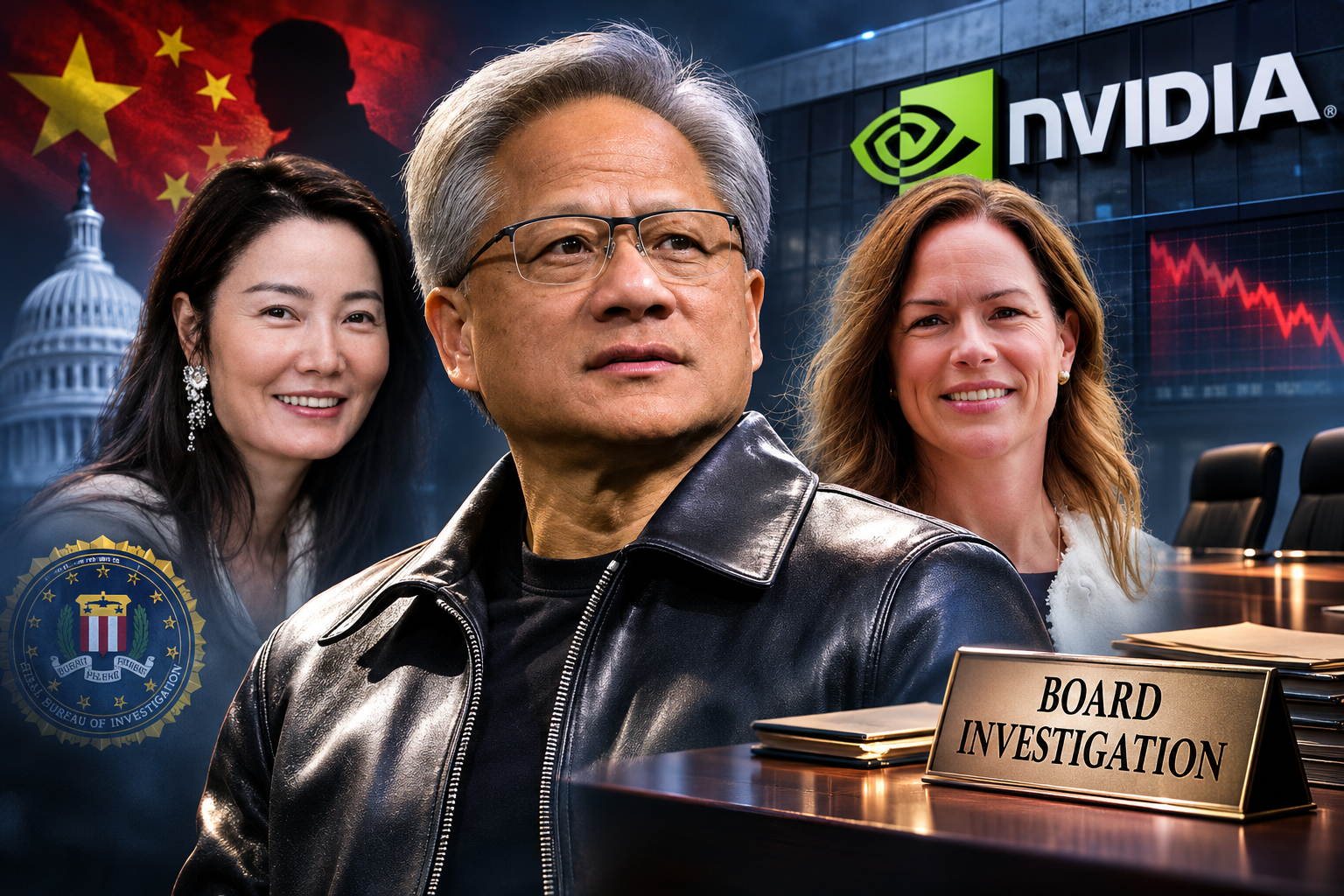
A suspected Chinese intelligence operation, a second reported workplace relationship and an escalating board investigation have placed the future of one of the world’s most influential technology executives in doubt.
SANTA CLARA, California – NVIDIA founder and Chief Executive Jensen Huang is facing the gravest leadership crisis of his three-decade career, as allegations involving a suspected Chinese intelligence operative and a separate reported relationship with a senior company executive threaten his position at the world’s leading artificial intelligence chipmaker.
What initially emerged as a personal scandal has rapidly escalated into a potential national-security controversy, drawing scrutiny from American intelligence agencies, congressional lawmakers and NVIDIA’s own board of directors.
The crisis intensified on November 11 when reports emerged that Huang had allegedly maintained a relationship with Kimberly Powell, NVIDIA’s vice-president of healthcare, who reportedly answered directly to him.
According to Reuters, citing a New York Times investigation based on accounts from five people who worked at NVIDIA, the alleged relationship raised fresh questions about workplace ethics and the governance of a company that has become central to the global artificial intelligence industry.
The latest disclosure came just days after Huang acknowledged marital infidelity amid reports that a separate relationship may have exposed him to a Chinese intelligence operation.
The woman at the centre of the espionage allegations
The first controversy centres on Alice Huang, a Chinese citizen associated with Singapore-based technology company Megaspeed, which purchases NVIDIA processors for data-centre operations.
According to reporting by the Associated Press and USA Today, American intelligence officials suspect that Alice Huang was recruited by China’s Ministry of State Security to gather information about Jensen Huang and potentially influence NVIDIA’s approach to exporting advanced computer chips to China.
Megaspeed is reportedly a substantial NVIDIA customer, having purchased more than $4.8 billion in chips over a two-year period.
The allegations are particularly sensitive because NVIDIA’s processors form part of the technological infrastructure supporting artificial intelligence systems, advanced scientific research and high-performance computing.
Washington has imposed restrictions on exporting certain advanced semiconductor technologies to China because of concerns that such equipment could strengthen Chinese military and intelligence capabilities.
Any attempt by a foreign intelligence service to influence NVIDIA’s chief executive would therefore carry implications extending far beyond the company’s commercial interests.
However, the allegations against Alice Huang have not been established in court, and the available reporting does not demonstrate that Jensen Huang knowingly cooperated with an intelligence operation or transferred classified or proprietary information.
Huang apologises as NVIDIA orders independent investigation
On November 8, Jensen Huang acknowledged his infidelity in a message to NVIDIA employees.
He apologised to his family and colleagues, accepted personal responsibility for his conduct and pledged to cooperate with the company’s investigation.
That same day, NVIDIA’s board announced that it would initiate an independent investigation following reports that its chief executive had been targeted by a foreign intelligence effort.
The board stressed that it had no reason to believe company secrets or American national security had been compromised.
In a further announcement dated November 10, NVIDIA confirmed that its independent directors had retained Joon H. Kim, a former acting United States Attorney for the Southern District of New York, and the law firm Wachtell, Lipton, Rosen & Katz to conduct the investigation.
The appointment of outside legal counsel underscores the seriousness with which NVIDIA’s directors are treating the matter.
It also raises questions about what the investigation will examine, including whether sensitive commercial information was exposed, whether executives were aware of potential risks and whether internal safeguards functioned as intended.
A second relationship threatens to deepen the crisis
The emergence of Kimberly Powell’s name on November 11 introduced a separate corporate governance dimension.
Unlike Alice Huang, who was associated with an outside NVIDIA customer, Powell holds a senior leadership position within NVIDIA itself.
The New York Times reported allegations of an intimate relationship between Huang and Powell, citing five people who had worked for the company.
NVIDIA had not immediately responded to Reuters’ request for comment on the allegations.
If established, a relationship between the chief executive and an employee reporting to him could raise questions about management oversight, potential conflicts of interest, internal disclosure requirements and the fairness of employment decisions.
It would not, on its own, establish that improper promotions, compensation arrangements or preferential treatment occurred.
However, the combination of an alleged relationship involving a company subordinate and an independently investigated foreign intelligence concern has intensified scrutiny of Huang’s judgment.
NVIDIA board considers Huang’s future
By November 11, the controversy had reportedly reached NVIDIA’s highest decision-making body.
The Financial Times and Washington Post reported that directors were considering the future of Huang’s leadership.
Possible responses reportedly under consideration included suspension during the investigation, accelerated succession planning or removal from the chief executive position.
Reuters subsequently reported that the board was meeting to decide whether to remove Huang, although no final dismissal had been officially confirmed.
The prospect of removing Huang is particularly consequential because he co-founded NVIDIA in 1993 and has been central to its transformation from a graphics-chip manufacturer into a global leader in artificial intelligence computing.
Unlike companies with established succession arrangements, NVIDIA faces the potential difficulty of replacing an executive whose personal leadership has shaped much of its strategy, research direction and industry relationships.
Its next chief executive would inherit responsibility for a business whose products are essential to data-centre investment and the development of increasingly powerful artificial intelligence systems.
Billions in market value at risk
Financial markets have already responded to the uncertainty.
NVIDIA shares reportedly dropped more than 8% in after-hours trading on November 11 following the latest disclosures and reports of an impending board decision.
Reuters reported that the decline could potentially erase approximately $600 billion in market capitalisation, based on the company’s valuation and the scale of its share-price movements. That figure represents an estimated change in market value, not a realised corporate loss.
The pressure comes at a sensitive time for NVIDIA, which is scheduled to announce its next quarterly financial results on November 17.
Investors must now consider not only the company’s financial performance and demand for AI processors, but also the possibility of major disruption to its leadership.
Washington’s growing concerns
The intelligence dimension has also reached the highest levels of the American government.
President Donald Trump acknowledged on November 9 that the FBI was examining matters relating to Huang, although the precise scope of any federal investigation has not been fully disclosed.
Trump also publicly expressed confidence in the NVIDIA executive, stating that Huang had denied knowing that the woman involved was suspected of being a Chinese intelligence operative.
Meanwhile, senior congressional leaders have reportedly received classified briefings on the intelligence concerns.
According to the Los Angeles Times, members of the bipartisan congressional leadership group commonly known as the Gang of Eight were briefed on the matter.
These developments elevate the controversy beyond ordinary corporate misconduct allegations.
They place it within a broader dispute over access to advanced computing technology, American export controls and China’s ambitions in artificial intelligence.
Nevertheless, an intelligence investigation is not equivalent to a criminal conviction, and no evidence cited here establishes that Huang deliberately compromised American national-security interests.
The questions NVIDIA can no longer avoid
For NVIDIA, several questions remain unresolved.
Did the company’s leadership know that Huang’s personal relationships could create conflicts of interest or security vulnerabilities?
Were any internal disclosures required and, if so, were those requirements met?
Did foreign intelligence personnel obtain access to confidential information or attempt to influence commercial decisions?
And, perhaps most importantly for shareholders, can Huang continue to lead NVIDIA while these matters are investigated?
These questions require documentary evidence, credible testimony and findings from independent investigators, not speculation.
NVIDIA’s board initially expressed confidence in Huang on November 8. Subsequent reports that directors were weighing his removal suggest the company’s position may be under considerable pressure, although the board has not publicly announced a reversal of its earlier statement.
A personal scandal with global consequences
For more than three decades, Jensen Huang has been the defining figure behind NVIDIA’s extraordinary rise.
He helped transform a company best known for graphics processors into one of the principal suppliers of the computing infrastructure powering the global artificial intelligence revolution.
Now, that same concentration of leadership has created an extraordinary challenge.
A company whose technology underpins billions of dollars in global investment must determine whether its founder’s continued leadership remains compatible with the standards of accountability, transparency and security expected of an enterprise of its strategic importance.
The outcome may determine not only Huang’s personal future, but also how one of the world’s most influential technology companies navigates an unprecedented governance crisis.
For NVIDIA, the issue is no longer simply what its chief executive may have done in private. It is whether the company can preserve public trust, protect its commercial interests and satisfy national-security obligations while its most important leader remains under investigation.